
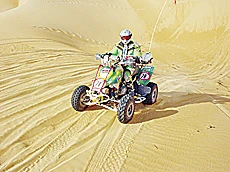
Two thousand four hundred kilometers of the Dubai Desert Challenge cross some of the harshest driving conditions anywhere on the planet. The route tests drivers and machines to breaking point. It is a real achievement to cross the finish line, let alone win.
Factory sponsored teams with huge support teams spread over the bivouac area — the start and finish point for each day's racing at the center of a cloverleaf of routes. Almost anyone with a machine can compete and nestled in the midst of the high profile bustle of the big teams are "privateers," single competitors who compete for all sorts of reasons. The race is cruel to even the best teams and drivers; for the privateer, it drives them to the limit and beyond, as the pilots of the rescue helicopters on constant standby will confirm.
With most automobile sports, the race almost invariably goes to the team with the best combination of cash and driver. But the desert is a great leveler and sometimes, from the ranks of privateers comes a challenge that threatens to upset the status quo. This year's race produced one.
The privateer amateur three man team of Shihab Alireza and Martin Kemp as drivers with Kevin Webster the race manager, mechanic and just about everything else, sponsored by Mountain Dew took on the best and beat them.
Webster is a raw-boned South African. Twenty years into motorcycle and quad bike racing, he has extensive racing background, is not easy to impress and is given to understatement.
"They did exceptionally well against professionals who spend a lot of their year here," he said with a paternal glow.
"These two guys with scratch facilities and no reputation came from nowhere and really scared the big teams at the top. The quality of the equipment is part of the equation.
The race is about physical and mental endurance and sheer determination.
Each of the quad bikes is equipped with a complex Global positioning system terminal (GPS). On the almost featureless desert, pinpoint navigation is vital — and errors are penalized by time penalties — each waypoint missed, attracts a five-minute time penalty. "One waypoint penalty can be the difference in 5 days racing," said Alireza.
If you imagine trying to read a digital print display, scroll the route map and control a bucking quad bike at speeds of 120 kph over dunes and rocks that could easily destroy your machine and end your racing career for 5 hours a day in temperatures of over 45 centigrade while wearing several kilos of body armor and airtight racing leathers, then you begin to get an idea of the challenge. All this, and you are expected to turn at every waypoint to within 200 meters and navigate by something as small as a small pole in the sand. And this is every day, for five days on less than 4 hours sleep at night.
"We only missed one waypoint in four days and that the organizers corrected as they had made a mistake themselves," said Alireza.
"When you are flat out, you develop tunnel vision," added Camp. "You are looking for every bump, each could cost you the bike, the race and everything else." The cars can be hazardous. "They are usually quite courteous — but when they blow by you, vision goes to zero in 10 meters. You have to back off."
The two Bombardier quads the team used were stock specification. Large and heavy, they lacked the searing top speed of the custom built quads by as much as 40 kph. Speed though is only part of the equation. On the technical sections — rough tracks or dunes — the fact that Alireza and Camp both live and work in Saudi Arabia helped enormously.
"We hardly trained at all for this — but we have been riding these things for most of our lives and were just getting better day after day."
Starting the race as 16 and 18 out of the field of 78 motorbikes — after the two kilometer "Prologue" to establish starting order — placed the team in a good position. "You don't want to lead off- that's a lot of head work," said Alireza, "We needed a few good tracks not huge ruts." At the last minute the organizers decided to through out the Prologue results and use entry numbers to establish starting order. Martin and Shihab were numbered 77th and 78th so they started nearly last. This was a blow to the team but they made the best of the situation and come out guns blazing.
Over the 400 kilometers of the first day, they clawed their way into third and fourth position in the quad category. It was noticed and heads turned as the distinctive green machines and racing leathers hove into the checkpoints, racing side by side. The question rippled round the professional teams; who are these guys?
The machines held up and because much of the route involved sand and difficult surfaces, the blistering speed of the professional machines was little advantage.
During day two, the conditions got tougher. With four check-points to pass and riding lower power quads, they kept up with the best of the professionals — losing out on the roads, but catching them with better technical skill on the sand.
"At the third, we were lying second and third. Potentially, if we had carried on at that pace, we would have been got to first and second," said Camp. Then disaster struck.
Alireza's quad stopped; there was just no spark. The pair spent two and a half hours in the hottest part of the day attempting to fix the bike, but to no avail. It was a cruel blow; they were only 16 kilometers from the checkpoint where Webster was waiting with spares.
Low on personal water they took the decision to abandon the quad and head for the checkpoint.
Two rescue vehicles made the attempt and failed, one burning out its clutch in the exceptionally deep sand in the attempt. Retrieval would be delayed.
"It is very much risk-reward situation," said Camp philosophically. "The fewer tools and the less you carry, the faster you will be. Risk the low weight and gain speed to win against simple breakdown and lose."
The team was shattered by the news that the abandoned quad would not be back in time for day three of the race. The strategy meeting that night was tense, but the team had only one option. Camp had to go on alone. Having worked so intensely together as a team, it was a difficult but ultimately correct decision said Camp.
"Day three was very technical day and I didn't realize that I had won the stage," he said. Money, power and speed counted for little. "It was a very hard day, a day of incredible dunes, the desert at its worst."
"You can't see over a dune, so you have to ride with enough speed to carry you over — you can't crest it and drive. As you go over, the far side could be a bowl that you will never get out of. It was a very physical day — the whole time quick decisions — all while navigating."
That day saw a lot of competitors drop out. Dehydration affected many; one entrant ended up temporarily paralyzed, comatose and evacuated by helicopter.
After the disaster of day three, the threat that Camp's skillful riding presented to the top professionals had been noticed.
Part of racing is the war of minds between the drivers. On day four, Camp started two minutes ahead of the eventual winner of the race. By the first checkpoint, which has a mandatory 15-minute stopover, he was over 13 minutes ahead, on a very much slower machine.
"When the pursuer arrived and saw Camp about to leave, he drove down to the start line and sat next to Martin, trying to psyche him," said Alireza. "He simply couldn't believe it." Later, he crashed and dropped even further behind.
Team Mountain Dew picked up two stage wins — and top four in several others.
"It is such a profound experience, I have only done it once," said Alireza. "There is a calmness after the storm — feel really at peace with yourself — little thing don't bother you any more."
"Its all team work, preparation, mechanical support; all part of a great mental game," said Camp. "Even though we didn't pick up an overall win, it's made them so nervous that next year going to be worried. It gives us the edge."
Kevin Webster was reflective and proud of "his lads." "It will be a shame if they don't race again next year. To break down was tragic. They have opened a few eyes to say the least. The look of the bikes and the way they performed made a very big impact. "Who are you guys?" was the question doing the rounds."
Both Shihab Alireza and Martin Camp have full time jobs. "They go back to work tomorrow," said Webster. "That shows their drive."