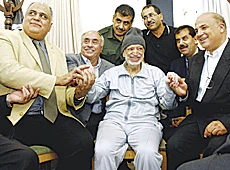
RAMALLAH, 29 October 2004 — Palestinian leader Yasser Arafat is set to be flown to Paris for treatment. A senior lawmaker from Arafat’s Fatah movement, Abbas Zaki, said yesterday Arafat would be flown out early this morning from his Ramallah headquarters to Jordan, and thence to Paris.
Saudi Arabia offered to send an air ambulance. Crown Prince Abdullah telephoned Palestinian Prime Minister Ahmed Qorei to inquire about Arafat’s health and tell him Saudi Arabia was ready to send an air ambulance to fly Arafat “to any hospital in the Kingdom or wherever he wants to receive treatment,” Saudi Press Agency reported.
The Palestinian leader was fighting for his life last night. One of a team of doctors treating him said Arafat was suffering from a potentially fatal blood disorder which would require more tests outside the West Bank to determine the cause.
“His blood cells which should normally destroy microbes are currently destroying blood platelets,” the doctor said on condition of anonymity.
The disorder could have been triggered “by an inflammation caused by a virus, a cancer or blood poisoning,” he said.
The supplementary tests could not be conducted at Arafat’s West Bank headquarters where he is currently being treated, he added.
Tunisia, Egypt, France, Jordan and Britain were reported to have offered to receive Arafat for treatment. Sources in London said the British government had a special aircraft on standby in Cyprus to fly Arafat to London if and when needed.
Doctors from Jordan, Tunisia, and Egypt were attending to Arafat along with his personal Palestinian and French physicians.
“There is a lot of politics going on around Arafat’s sickbed,” a senior Palestinian source told Arab News. “ Different factions want him to be taken to different countries.”
The same source said Arafat’s wife Suha, who has a house in the French capital, supported those who wanted the ailing leader to be flown to Paris for treatment at the American Hospital. Suha hurried to his bedside for the first time since they were separated by Palestinian-Israeli fighting that erupted after talks foundered in 2000.
Khalid Al-Islam, a spokesman for Arafat said that the 75-year old ex-guerrilla was “very sick but conscious”. He said Arafat had met his private political secretary and dictated a message to him to the Palestinian people. The content of the message was not known but the official denied that it was a testament.
Arafat’s spokesman said the Palestinian leader will not name an acting president to replace him while he is abroad. The prospect raised speculation on who might take the reins of power in the West Bank and Gaza Strip. An official in Arafat’s office said the Palestinian leader had created a special committee composed of Qorei, former Prime Minister Mahmoud Abbas, and Salim Zaanoun, head of the Palestinian National Council, to run the Palestinian Leadership Organization and the Palestinian Authority while he is ill. But when asked if Arafat had set up such a committee, his spokesman, Nabil Abu Rudeinah, said: “Nothing like that.”
Raanan Gissin, a spokesman for Israeli Prime Minister Ariel Sharon, said Israel would allow Arafat to travel anywhere for medical treatment as a humanitarian gesture. Asked whether it would then permit Arafat to return to the West Bank, Gissin said: “If the doctors will say that he needs to come back after he receives treatment, Israel will not impose any restrictions on that.”