
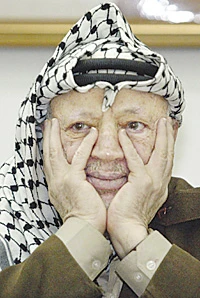
Speaking in front of television cameras the other day, the Palestinian envoy to Paris, Leila Shahid, was almost in tears.
“I cannot imagine life without Arafat,” she said referring to the Palestinian leader who is reported to be fighting for his life in a French military hospital.
Miss Shahid was expressing the sentiments of many Palestinians. Miss Shahid and her fellow Palestinians, however, are now obliged to use their imagination, and fast.
The Palestinians would have been better off had they imagined life without Yasser Arafat over a decade ago. At the Madrid Peace Conference of 1992, the world discovered a new Palestinian leadership. There was Haider Abdul-Shafi, a respectable patrician from Gaza, along with Faisal Al-Husseini, a statesman in the making. There were other voices of wisdom and moderation.
Covering the Madrid Conference, I was witness to the unease that the Israeli delegation, notably Prime Minister Yitzahk Shamir and his protégé Benjamin Netanyahu felt in the face of a Palestinian leadership that could not be branded “terrorist” or “extremist.”
The Palestinians who had come to Madrid were genuine. They lived in Palestine and, because of their work as teachers, lawyers and doctors were in daily contact with their people. They were not professional “liberators” living in golden exile, mixing business and politics.
They did not want the Palestinian people to kill and die so that Arab despots could silence their own people in the name of the Palestinian “cause.” They had no time for the so-called intellectuals and return-ticket revolutionaries who, for more than half a century, have been telling the Palestinians to go and get killed so that their “martyrdom” could be remembered in poems recited at tea houses and sermons made at mosques thousands of miles away.
By the time I went to Madrid I had known Arafat and most of his associates for more than 20 years. In Madrid I suddenly realized how Arafat and his associates had persuaded me, along with millions of others, to see Palestine only as a “cause”, which means an abstraction with which one could play endless intellectual games. One could talk of “the Palestinian cause” at dinner parties when other subjects were exhausted. One could write editorials about “the Palestinian cause”, and feel good. One could wear the Palestinian keffieh as a cache-col or a head-cover, making a statement in Cairo, Tehran, Paris, London or New York.
In Madrid I began to imagine Palestine without Arafat.
That gave me a new perspective on an issue that had interested me since student days. Talking to the Palestinian delegates I started to see Palestine as less of an abstract cause and more of a concrete political problem that affected the lives of real people — men and women who wanted peace, dignity and prosperity; people who did not want to kill and be killed so that others would beat their chests for them from a safe distant.
Before the Madrid exercise had ended, it had become clear that the Israelis were uncomfortable dealing with moderate, genuine Palestinians from inside Palestine. To address that unease Israel opened a back channel to Yasser Arafat, thus undermining the burgeoning new leadership from inside Palestine.
At the time Arafat was isolated in Tunis. Having sided with Saddam Hussein in invading Kuwait, the PLO chief was a pariah. No one invited him for official trips, and few big shots in Europe and the Arab world returned his calls.
More importantly, given his obsession with money, Arafat was beginning to feel the pinch in financing his entourage and frequent-flier trips, without dipping into his pocket. He needed attention and money. The Israelis offered him both. In exchange, he agreed to join the Oslo game. The aim was to shut the Americans out of the negotiations, and derail the Madrid process.
And the rest is history.
Palestinians should read the Oslo accords to see how Arafat was prepared to sign anything to get back on the international carousel.
As Madrid was derailed and Oslo became the order of the day, Arafat was back in fold as “the sole leader of the Palestinian people.” The new leadership that had appeared in Madrid melted away. Palestine once more became a “cause”. And a cause, of course, could be betrayed just as it could be served.
Over the years, Arafat became a fixture of the annual World Economic Forum in Davos, where he appeared in tandem with Shimon Peres. The two were inseparable, calling each other “dear friend” or “ brother”. Siblings in cynicism, Arafat and Peres managed to persuade the gullible Swedes to give them the Nobel Peace Prize.
Starting now, Palestinians must reorganize their lives without Arafat, not as a fantasy but as a necessity.
Here is how they can imagine it.
There are a dozen Palestinian politicians who have the stature to replace Arafat. With Arafat no longer there to interfere in their work, any of them can step in as head of a transitional government.
The transitional government would then ask the international community to help it organize elections. Since the Palestinians are the best educated and politically most mature of all Arabs, they are, if given a chance, certain to produce a parliament of reasonable people. That parliament would then appoint a government with a mission to negotiate peace with Israel based on the two-states formula.
Those addicted to Palestine as a “cause” would write poems and make speeches against such a government, accusing it of betraying “the blood of martyrs” and the “essence of Arabism”, whatever that means.
The Palestinians, however, should seize control of their destiny. Palestine is not about “Arab dignity” or “Islamic honor”, or any other abstraction. It is about real people who suffer every day. It is about people who want the birthright of every nation: self-determination. What they want cannot be achieved through war, propaganda, martyrdom, suicide attacks, and similar shenanigans. It can be achieved through political struggle, negotiations, and diplomacy.
The Palestinians must state clearly the minimum that they would accept in exchange for peace with Israel, something that Arafat never did because the “no-war-no-peace” limbo was his natural habitat. A new Palestinian leadership, freely chosen by the people and supported by the whole world, would have the moral authority to do that.
Arafat dubbed himself “a man for all seasons”. But his season came and went in the 1960s and 1970s. With his passing a new season opens, and the Palestinians need to choose a man, or woman, to represent them NOW.