
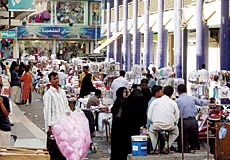
JEDDAH, 8 November 2004 — “Too expensive” and “high prices” are on the tongues of a majority of shoppers as Ramadan moves toward its culmination symbolized by Eid festivities. Since schools and government offices have started their holiday, souqs, malls and shops are witnessing a rush of shoppers, all racing against the clock to buy clothes, accessories, gifts, toys and sweets.
As the end of Ramadan draws closer the shopping bug buzzes louder causing traffic jams and prices to soar as tradesmen milk the season for all that they can reap. Consumer establishments, be it for women or men, stores and tailor-shops are all nearly in full swing of activity.
With consumer demands increasing and product options decreasing, people accuse tradesmen and store-owners of taking advantage of the situation and jacking up prices. Many businessmen see Ramadan, especially Eid, as occasions to make their annual killing.
“In Ramadan, expenses increase,” said Umm Hadi. “Then there is Eid shopping. There are clothes and gifts to buy for my children and my husband as well as for myself. Shopowners know that this is an important season and instead of being considerate, they rip us off.”
Muhammad Al-Ghamdi said: “The prices are all in the red zone because tradesmen want to profit easily and quickly at our expense. A dress priced at SR340 before Ramadan now has a tag of SR640 even though it’s the same dress. Why such an increase? What’s the reason behind this?”
“I dread Ramadan and Eid even more because of the shopping headache,” said Abu Hamed. “It’s a time of a lot of arguments and tension because there’s so much to buy and not much to buy it with. We shop mostly from Watani because in comparison to other places, its prices are somewhat reasonable but in other places they are higher by at least SR10-20.”
“The problem is that most of the families are big and shopping calls for a large budget which isn’t always available to everyone,” said Wafaa Abdullah. “Everyone in the family needs new clothes for Eid and with my father’s salary not more than SR2,000, and the prices of clothes soaring high, the situation becomes tight and desperate. Why do shopowners and tradesmen treat Ramadan as if it’s the only time they get to sell anything?”
Daifallah Abdullah, a government employee, said: “Just this week I’ve seen a husband knock his wife on the head as they were arguing about buying and not buying, exorbitant prices and so on. Just last night I saw a father scolding his child and another mother scolding her teenage daughter. All this tension and hostility because of things that people want but can’t afford. It’s trivial but serious.”
Salman Ali said: “Even men’s clothing has become expensive. The price of shumaghs has gone up from SR240 to SR300. And on a wholescale, prices at the beginning and middle Ramadan are one thing and the prices now and nearing the end of this month are something else.”
Suha Owaidah said: “I’ve gone to Tahlia Mall, and Jeddah Mall where the prices are high. Sales don’t start until after Eid is over. Sure I can understand prices going up and it all being about marketing but it’s getting out of control. Who controls the pricing anyway?”
Owners of shopping centers or shopping compounds raise the rent, consequently tradesmen raise the prices of their products. The owners protested that there is no use of designing establishments that are sophisticated if there is no chance of them regaining their capital over a period of 15 years as a maximum basis. The irony is that prices are toyed with in local souqs more than the designer shops.
“If we’re lucky we can argue our way into a good bargain and that’s why I shop at what is known as the Syrian Souq. I can’t do the same thing at international shops or designer shops,” said Umm Hani. She adds: “Actually you can get low-priced designer things at Al-Saha Shops in Al-Nakheel Center. There every thing is on discount. But then again discount is another trick. It makes you buy more. Every year when I’m put in this situation I wish I’d done my Eid shopping before the season. But prices this year are much higher than last year.”
Arab News met with Abu Abdullah, a tradesman who said: “Things are different from the past. Everyone only cares about himself. No one thinks about the tradesman who has a rent to consider and employees’ salaries not to mention the product-value. Sure the prices increase during this season. It’s called business.”
Nasser Al-Otaibi, also a tradesman, said: “Shoppers complain about us raising prices but what about the rent we’ve got to pay to store-owners? They raise the price and no one tells them anything. People demand that we keep prices low or lower the prices even more, well then how are we going to get the money to pay the rent of our shops? A just and consistent system must be found — one that everyone follows.”