
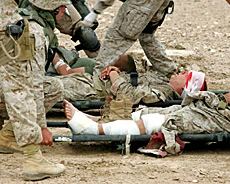
JEDDAH/ BAGHDAD, 10 November 2004 — While a majority of Iraqi political parties and personalities have approved the attack on Fallujah, “Operation Phantom Fury” has also drawn some opposition within the country.
The first to speak out against the assault was Moqtada Sadr, a junior Shiite cleric who fought his own brief guerrilla war against the US-led coalition and the forces of the interim Iraqi government earlier this year.
“We have called on Iraqi soldiers not to join the Americans in the battle for Fallujah,” a spokesman for Sadr said yesterday. “We still think that the problem could have been solved through negotiations, and that the US-led coalition insisted on using force to intimidate opponents of the interim government on the even of the elections.”
Criticism of the attack also come from the Iraqi National Congress (INC) whose leader Ahmad Chalabi is negotiating an electoral pact with Sadr. This is an interesting about-turn by Chalabi who was asking for the use of force in the rebel city as early as July 2003.
Sadr and Chalabi are the only two prominent Shiite figures to oppose the operation. Opposition on the Sunni Arab side has been more limited than expected.
Yesterday, The Iraq Islamic Party (IIP), a Sunni political group quit the interim Iraqi government and revoked its single minister from the Cabinet in protest over the assault on Fallujah.
The Iraqi Islamic Party wields significant influence over the country’s Sunni community and its withdrawal from the government will likely be a blow to Interim Prime Minister Iyad Allawi.
“We are protesting the attack on Fallujah and the injustice that is inflicted on the innocent people of the city,” said Mohsen Abdel-Hamid, head of the Iraqi Islamic Party.
Abdel-Hamid said the party leaders convened Monday and decided that their one minister in the Cabinet — Minister of Industry Hajim Al-Hassani — should quit. “We cannot be part of this attack,” he said.
It was not clear when the minister would actually step down.
On Monday, Allawi confirmed he had given the green light to multinational and Iraqi forces to retake the insurgent-held city of Fallujah, which has become a symbol of resistance to the US led-forces in Iraq.
Fallujah has become the major sanctuary for extremists bent on destabilizing the US-backed interim authorities in Iraq.
The Iraqi Islamic Party is the Iraqi branch of the Muslim Brotherhood, a Sunni Islamic party, founded by Hassan Al-Banna in Egypt in 1924 and well established in the Middle East.
A prolific author on the Qur’an, the party’s leader Abdel-Hamid was detained under Saddam Hussein. The party was suppressed under the former dictator and many of its members were forced to flee abroad.
The Iraqi Islamic Party returned to public life after US-led coalition forces toppled Saddam and established the country’s interim authorities. L. Paul Bremer, then head of the Coalition Provisional Authority, allowed the party to open branches in many cities and to publish a newspaper.
Many in Baghdad see the IIP’s move as a political maneuver with an eye on the forthcoming elections. The party is engaged in negotiations with several Shiite and Kurdish parties, which are also present in the interim government, to present a common list of candidates in next January’s elections. By coming out against the Fallujah operation, however, the IIP may be left out of the proposed joint list. Because Iraq is taken as a single constituency in the January election, being left out of he joint list could mean losing all chance of securing seats in the forthcoming assembly.
Operation Phantom Fury has also drawn criticism from other members of the interim government that is a coalition of 15 parties. By declaring a state of emergency on Saturday, Prime Minister Allawi made sure that the decision to go into Fallujah would not be discussed within the Cabinet where it could have provoked opposition from several ministers.
Under the emergency rule the prime minister can act without the Cabinet’s consent for 60 days, at the end of which he must report and, if necessary, face censure from his ministerial colleagues.
Opposition to the assault on Fallujah has been more muted in Iraq than in several other Arab countries.
Last week a group of 26 Saudi clerics issued a statement supporting the insurgency in Fallujah and calling on Sunni Muslims to rise against what they see as an American occupation. Other Saudi clerics, however, have rejected that view and described the Fallujah insurgents as rebels causing “sedition” a grave sin in Islam.
Crucially, no Iraqi Sunni cleric of note has described the Fallujah insurgency as resistance or “jihad”.
Inside Iraq, the strongest opposition has come from a little known group operating under the title of Fallujah Mujahedeen Council that has appealed for a nationwide insurrection in Iraq as a means of diverting the US and Iraqi forces from Operation Phantom Fury.
Several Arab Sunni religious leaders have threatened to call for a boycott of the elections if force is used in Fallujah. So far, however, leaders of the largest Arab Sunni tribes appear to be adopting a wait-and-see attitude. If Fallujah is retaken from the insurgents and pacified, most of the tribal chiefs are expected to quickly return to the fold and try to get seats in the future assembly. If, on the other hand, the battle could take weeks, some of the Sunni tribal leaders may decide to hedge their bets and show some solidarity with the insurgents in the city.