
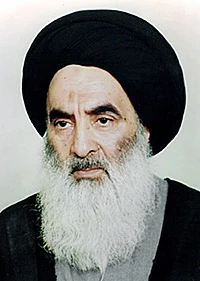
JEDDAH/ BAGHDAD, 10 November 2004 — Only hours before Iraq and US forces had launched their assault on Fallujah, Grand Ayatollah Ali Muhammad Sistani issued a statement inviting Iraqis to massively take part in the elections planned for January 2005.
“I will be the first to vote in the elections,” Sistani said, stopping just short of declaring participation in the election to be a religious duty.
Having been the first Iraqi personality to call for elections as early as June 2003, Sistani reaffirmed his support for the process earlier this month after receiving a delegation from the Iraqi interim government.
So, why did the Grand Ayatollah decide to renew his call on Iraqis to go to the polls?
The answer is one word: Fallujah.
For weeks all those opposed to the holding of elections in Iraq at the appointed time have used Fallujah as an excuse.
Paris has made noises about problems that might arise if Fallujah does not participate in the elections. United Nation’s Kofi Annan has echoed that. The issue has also been used as an argument in favor of inviting some of the insurgent groups to the forthcoming conference on Iraq, to be held in Sharm El-Sheikh on Nov. 22-23.
By reaffirming his support for elections on schedule, Sistani is sending a signal that he would not allow Fallujah or other cities in the Sunni Triangle to be used as excuses for postponing the elections.
“The Grand Ayatollah believes that the best way to end occupation is to produce a legitimate government based on popular elections,” says Mahdi Karbalai, a spokesman for Sistani. “Those who try to postpone the elections want to prolong the occupation. Their hope is that the occupation forces will get tired and walk away, leaving the armed groups to seize power in Baghdad. They are hoping for some restoration of the Saddamite dictatorship.”
But this is not the only reason for Sistani’s insistence that elections should be held as fast as possible.
Right now he is in a position to persuade the Shiites to vote for a unified list and thus dominate the future parliament and government. But as the time passes frictions and fractures begin to appear among the Shiites.
A warning signal came earlier this week when supporters of rival would-be Shiite candidates clashed in Najaf. One man was knifed to death and 16 others were injured.
Establishing the central government’s authority on Fallujah will improve chances of elections on time. And that, Sistani believes is the most important issue for the future of Iraq.