
Across Saudi Arabia, women are stepping forward to help the sick and the less fortunate through caring donations of time, effort and money given in the name of charity.
During Ramadan many of the charitable organizations hold their annual fund-raising events collecting people’s zakat and selling various products to distribute the proceeds in the form of money or clothing to the poor and the sick. At the forefront of all this activity are women who have dedicated their time and energy to the betterment of the needy and the continuation of the charity’s work.
“I think it’s women’s nature to be more compassionate and helpful of their fellow human beings especially if those in need are women and children,” said Rahma Mehdar, an active member of several charities. “And let’s be honest, most of the poor and the helpless are women and children.”
The charity organizations shift into high gear as soon as the holy month approaches. Many of the most active and successful are the women’s charities. One of the largest in the Western province is the Higher Women’s Committee for Social and Humanitarian Services chaired by Princess Sarah Al-Anqari, wife of Makkah governor Prince Abdul Majeed. Earlier in the month it was announced that more than 300 housing units obtained by the committee were given to the poor in villages outside Jeddah and Makkah on the first day of Ramadan. “We have spent SR127 million in less than four years on social, medical, housing and other projects,” said Princess Sarah.
She described the housing project as a cultural and developmental achievement. The project includes a mosque, two schools for boys and girls, a health center, a vocational training center and a school for Qur’an recitation and memorization. It has been provided with water, electricity and roads.
A presentation of the charitable housing projects was made at the fifth annual Exhibition for Family Requirements, which was organized by the committee. It opened Oct. 20. at the Jeddah International Exhibition Center. A charity souk run by the Women’s Charitable Society was offered at the exhibition and continues until the end of Ramadan. Detailing the committee’s achievements, Princess Sarah said it had established the 85-bed King Abdul Aziz Kidney Center in Taif at a cost of SR20 million. The center started operating last year.
“We also have provided financial assistance worth SR13 million to public hospitals in the region to help them acquire modern medical equipment,” she said. The committee purchased two buildings at a cost of SR2.5 million to provide housing for several poor families in Makkah. It has given a total of SR17 million to five charitable women’s societies, including the Disabled Children’s Association, and extended financial assistance worth SR2.5 million to many deserving families. Princess Sarah estimated the value of new charitable projects planned by the committee at SR60 million. They include a 100-bed recovery hospital in Jeddah to take care of patients suffering from chronic diseases and the elderly. The Health Ministry will provide it with the necessary equipment, she said. Another very active organization particularly in the area of health care is the National Home Health Care Foundation established by Princess Hessa Al-Shalaan, wife of Crown Prince Abdullah. The 5th Annual Magic Carpet Festival was held the week before Ramadan and attracted many visitors and donations. The NHHCF is a non-profit organization providing free medical and social services for Saudis at home who are in need. “We began with a small office in the King Abdul Aziz Medical City; it was originally an operation to bring care, support and medical assistance to those in need,” said Princess Adelah bint Abdullah, president of the NHHCF.
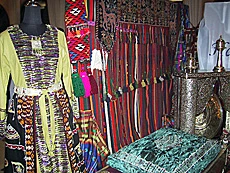
“At the beginning we looked after 300 patients, but now, with the growth and development of our medical and social support teams, we are helping more than 1,500 patients.” One of the charity’s principal money-raising projects is the annual Magic Carpet Festival. “Every year, we see a number of participating companies eagerly awaiting the Magic Carpet Festival preparation period to send in their sponsorship checks and other support materials,” said Princess Adelah. The festival featured the work of many at-home businesses of women, usually art and needle work, but also clothing — especially the abaya and jalabya. These bazaars help home-based businesswomen showcase their work and attract new customers. Perhaps the number of bazaars held during Ramadan diminishes interest in the events. “There are so many bazaars in Ramadan that most people have become bored with them and are not attending as much as before,” said Nisreen Al-Idreesi, director of The Women’s Welfare Society, the first private welfare organization to be registered in Saudi Arabia. It aims to help needy women and children and raise their standard of living by providing healthcare, education, social services as well as vocational training and general guidance. On Oct. 24-25, WWS held its Art Exhibition for Needlework and Antiques. “Ours was different because it was mostly handmade artifacts, and people really appreciated the items especially that they were made by the poor women we train and support,” Al-Idreesi told Arab News.
“We have our regular clients who come to our exhibitions and ask for our products, which we are very proud of,” said Layla Alireza, vice president of WWS.
The exhibitions are an opportunity to showcase all the beautiful work done by the women and families supported by the society.
“In general, some women come for fun, but many attend and ask to volunteer and become more involved with the society, especially young women. We don’t rely on the bazaars for raising funds as much as to raise awareness of our work and attract attention to the needs of the poor,” Alireza told Arab News. The society is supporting 5,000 indigent families, such as widows and the disabled or ailing men who cannot support their families, in addition to the house for the elderly and the orphanage is supports. “All charities benefiting internal projects have been greatly harmed by 9/11 and the media’s casting a shadow on all charity organizations,” Alireza said. “Even though we should be receiving more donations, people have become fearful of donating to charities. I think the media should do a better job in raising people’s awareness of charitiy work and the many poor families who need their help.”