RAMALLAH, 13 November 2004 — Take equal doses of pathos and politics; add pomp and populism, and you get Yasser Arafat’s final journey yesterday from a military hospital near Paris to an improvised tomb in Ramallah.
Wow, what a funeral! It was the first ever to be spread over three continents, pass through two capitals and a desert outpost, ending in a nondescript town that had been Arafat’s prison for more than three years.
Every step of this Odyssey had had a place in Arafat’s life, as checkered as his keffiyah, over many decades.
• First stop: Paris, Arafat’s favorite city, where he owned a pied a terre and where he had spent part of his honeymoon with his wife Suha. Their daughter Zahwah was born in Paris — at the American Hospital. Paris was also where President Jacques Chirac was in charge, a man Arafat regarded as his closest friend. “Whenever things go badly, I rush to Dr. Chirac,” Arafat once said with a twinkle in his eye. Paris had been the first and, for a long time, the only Western capital to recognize the Palestine Liberation Organization and allow it to open an “embassy”. Chirac was determined to advertise his attachment to Arafat right to the end. The deceased Palestinian leader was given a solemn send-off, complete with military honors reserved for French heroes.
• Second stop: Cairo, Arafat’s city of birth, and where he had studied engineering before joining the Egyptian Army. Cairo is also the only major Arab capital that never closed its doors to Arafat. Even in the worst days of relations with the late President Anwar Sadat, the Egyptian capital never became a no-go area for Abu Ammar.
• Third stop: El-Arish on the edge of the Sinai desert. This was the scene of one of the few battles in which the Egyptian Army, along with a small number of Palestinian volunteers, put up something of a show against the Israelis in 1967. At times Arafat, a corporal in the Egyptian Army, claimed that he had fought there, although many doubted that.
• Last stop: Ramallah, the accidental capital of the Palestinian Authority. Initially, Arafat had had no intention of using the modest town as his headquarters. But its proximity to Jerusalem was a major plus.
Each of the stops highlighted one aspect of Arafat’s complex reality. Paris symbolized his ability to win diplomatic kudos even in Western democracies. Cairo reminded the world of Arafat’s stature among Arab leaders. Ramallah was where his people claimed him. In Paris and Cairo the funeral had belonged to governments and security services. In Ramallah it was transformed into an explosion of popular emotion, sweeping the officialdom and its mukhaberat aside, at least for a brief moment.
The funeral underlined the duality of Arab life as the leaders, in their cocoon, stayed well away from the masses, especially those wielding Kalashnikovs and firing in the air.
Arafat’s timing was impeccable. The funeral came on the last Friday of Ramadan, and on the eve of e Eid Al-Fitr, the time for the annual gathering of angels and the cherubim to thank The Almighty for the blessings of the year. In his funeral Arafat hit the jackpot in other ways.
Leaders, including some Arabs, who had not returned his call for three years felt obliged to come and pay tribute to his mortal remains. Ariel Sharon who had tried to isolate Arafat for the past three years was himself isolated, staying away from the funeral and obliged to see the world pay tribute to his nemesis on television.
Arafat must have been delighted with the military honors bestowed on him in both Paris and Cairo.
He loved boasting about his own partly imaginary military background and, when angry, would remind interlocutors that he was “ Gen. Yasser Arafat”. Wearing a military uniform had become part of his persona, along with a Czech revolver he always carried.
For a while his obsession with the military aspect of his image was underlined by the marshal’s baton he always carried. The only identity he always carried on him was a card showing him to be a corporal in the Egyptian Army.
In Paris, he got a gun chariot, an elite army unit doing the slow, and a funeral march by the composer Couperin. He got what any French military hero would get. In Cairo, he got a full military sendoff with the various decorations he had collected from some 40 countries over four decades put on show for good measure.
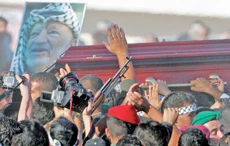
In Ramallah he was greeted with the sound of gunfire, laced with ululations, that he had often described as his favorite music.
The day underlined one fact: Arafat was one of those rare Arab leaders who could unite the two ends of society: The higher official echelons, and the lower one at the street level.
The proverbial Arab street, which had been quiet for years, struck back in Ramallah when frenzied mourners tried to seize the coffin and carry it on foot to Jerusalem.
The tomb at the Muqataa reflected Arafat’s concern not to become one of a pack. This is a lone tomb, under a lone tree, in an empty square.
A semiologist would have observed other implicit messages in the funeral. The final episode of the Arafat saga enables France to make a comeback on the Middle East political scene. Having scripted itself out by opposing the liberation of Iraq last year, France will now try to gain a new profile as the champion of the Palestinian cause.
The funeral was also good for Egypt, enabling it to reassert its position as the key player in Arab politics.
Some of Arafat’s bitterest enemies came to make peace, among them the mullas of Tehran who sent Foreign Minister Kamal Kharrazi to the funeral in the teeth of opposition from sections of their regime.
The Gulf Cooperation Council members, too, seemed to have forgiven Arafat’s treachery over Kuwait in 1990. GCC representation was not all at the same level, however, indicating differences in assessing relations with the Palestinians.
There were some little noticed surprises. Turkey, the first Muslim country to establish full relations with Israel, had sent its Prime Minister Recep Tayyip Erdogan in its biggest show of support for the Palestinian cause ever.
And did you notice the line-up of the new Palestinian leadership as it greeted the mourners in Cairo? Well, there was Mahmoud Abbas, the newly elected boss of the Palestine Liberation Organization, at the head of the group, followed by Farouq Kaddoumi who has just won control of Fatah.
In third place, perhaps for good measure, was Rauhi Fattouh, the interim president of the Palestinian Authority. Ahmed Qorei, the prime minister was kept in the background along with his Cabinet colleague.
The arrangement meant that with Arafat gone, governmental institutions had lost their meaning, and that power was back in the hands of the PLO and Fatah.
This was the old guard trying to fill the stage in the absence of its iconic chief, for the first time. Looking at them one could not help wonder whether they would not be swept if and when the Palestinians hold free elections.
Then there were the flags in Ramallah: French, Canadian, Algerian, Iraqi, Saudi and Egyptian, sending a mixed message.
All in all it was one whop of a funeral, a moving feast crossing continents. Arafat would have loved of be there to watch it.