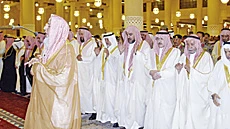
JEDDAH, 14 November 2004 — Millions of Saudis and expatriates attended Eid Al-Fitr prayers throughout the Kingdom as prayer leaders called upon Muslims to stand united under the banner of Islam. Custodian of the Two Holy Mosques and Crown Prince Abdullah joined 1.5 million faithful in prayers held at the Grand Mosque in Makkah.
Sheikh Saleh Bin-Humaid, one of the imams from the Grand Mosque who led the prayer, emphasized that reforms must come within Muslim countries. “Reforms imposed from outside will remove a nation’s identity and lead to the dissolution of personality,” he said while delivering the Eid sermon after the prayer.
Bin-Humaid, who is chairman of the Shoura Council, also said that reforms ignoring the nature and position of a nation would not succeed. “Reforms must be introduced in harmony with the nation’s principles and values and must be based on clear ideas,” he added.
Spelling out the salient features of reforms, the imam said it must establish justice, protect rights, restore supremacy of the law, prevent injustice and ensure fairness of judiciary and freedom of thinking. “No scholar or group should think that knowledge is their monopoly.” He lambasted a section of the media for making fun for Islamic signs such as hijab and beard, and for branding practicing Muslims as terrorists and extremists.
In Madinah, Sheikh Saleh Al-Bedair, imam of the Prophet’s Mosque, led the prayers and called upon Muslims to unify their ranks. He also advised Islamic scholars to shun bias based on madahib or the particular schools of thought, saying it would deepen division among the community.
Eid prayers were offered at more than 350 locations in Riyadh. Prince Sattam, deputy governor of Riyadh region, many dignitaries, members of the royal family and diplomats offered prayers at Prince Turki ibn Abdullah Mosque. Sheikh Abdul Aziz Al-Sheikh, the Kingdom’s grand mufti, led the prayers.
In his sermon, Al-Sheikh invoked Allah for his blessings on those who observed the fast during Ramadan and hoped that they would carry forward the spirit of the holy month.
Prince Sattam later received the Grand Mufti, Dr. Saleh Al-Sheikh, minister of Islamic affairs, Dr. Abdullah ibn Mohammed Al-Sheikh, minister of justice, and Sheikh Saleh Al-Liheidan, the chairman of the Supreme Judiciary Council.
Eastern Province Governor Prince Muhammad ibn Fahd joined prayers held at an open ground in Dammam. Sheikh Muhammad Al-Suleiman, who led the prayer, warned Muslims against extremism and asked them to follow the moderate teachings of Islam.
Prayers were held in several parts of Jeddah. Sheikh Muhammad Al-Masoud, a High Court judge, who led the prayers held at the Old Airport in Sharafiya, urged Muslims to help the poor, to compete with one another in doing righteous deeds and improve relations with their kith and kin.
In Baha, Sheikh Hashim Al-Naami led the prayer, which was attended by Asir Governor Prince Khaled Al-Faisal. Al-Naami called upon Muslims to imbibe the spirit of Eid and make use of the annual event to strengthen their unity and solidarity. He also cautioned the public against terrorists and extremists who wanted to destabilize the country.