
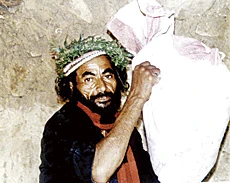
Sometimes you hear a story that sounds unbelievable. When Sayidaty, a sister publication of Arab News, heard about a family of 23 living in a cave on a mountaintop, it sounded more like fiction than fact. So Ahmad Musa of the magazine traveled to Jizan to check it out. What he found was fact stranger than fiction.
JIZAN, 21 November 2004 — The journey began at 8 a.m., and it was tiresome and complicated from the start. We didn’t have any accurate information to direct us to the land of the caveman, so we scoured the mountains asking those we encountered if they knew where he lived.
Most had only heard of him. After hours of searching, we came upon a person who confirmed that the man we were looking for lives at the top of a mountain named Hemiyah in central Al-Qasbah in Al-Ardhah region on the Saudi-Yemeni border.
Muhammad Al-Laghbi, the school principal, told us he knew the caveman well. He said the man’s name was Abu Hisham. When we asked him to take us to see the man, he told us to come again next morning before the heat struck. The mountain should be climbed before dark. He said the 15-km climb takes two hours on foot because cars can’t go to such places.
When we finally reached the mountain peak we saw the children first. They started running and calling out to their father. At that point Al-Laghbi turned to us and said: “This is the man you’re looking for. It is the mountain man, Abu Hisham.”
After introductions were made, the caveman agreed to an interview and we were invited into the cave. Among the boulders were 20 children, two wives and a lamb. The wives and older daughters took cover once they saw us enter.
I was surprised when I saw the place crawling with children while two of the little girls were eating a breakfast of corn bread and few cooked vegetables. The small lamb, that was also sharing their breakfast, was identified to us as the “Eid lamb.”
We then learned the caveman’s full name, Yahya Abdu Asaad Al-Ghaldbi, and the more we learned, the stranger the story got.
“I’ve never known any other place than here as far back as I can remember,” he said. “As a child I started selling skins with my father in the Yemeni market that was prosperous then. My father also taught me a number of other skills including being a shepherd, breaking stones, digging wells and construction.”
Perhaps war drove his family to the present circumstances.
“When the revolution happened in Yemen and the Egyptian Army came in 1962, I remember how the Egyptian planes soared overhead,” he said. “We would run in fear and hide so we wouldn’t get hurt. I was 12 years old then.”
After his parents died, he stayed on in the mountains and later sought companionship.
“When I was younger I married Mujaba Muhammad Laghbi, my first wife, at a very modest dowry and had children from her,” he said. “She was the best of wives and suffered a lot of hardships with me in the worst of circumstances. Afterward, I wanted to get married again, so I married Fatema Asad Al-Kaabi and also had children from her.”
Asked if it was his plan to have so many children, he shook his head.
“But what can we do?” he asked. “This is our fate, and I didn’t realize anything until it already happened. I’m grateful to Allah in all cases. My work has increased with their number as well as my responsibilities so that I can earn their daily bread.”
His family is his life.
“Whenever I’m able to satisfy their needs, it is the happiest day in my life,” he said. “I give my whole life for the sake of my children. I strive and sweat from dawn to dusk to provide their needs despite not having a stable, permanent job. I wake up early in the morning and pray Fajr in the village mosque. Then I ask those praying if they know of anyone there or in the neighboring villages who has any job I could do whether it’s construction or carrying stones or digging a well or any farming. I bargain with whoever comes forward and begin work, taking my oldest sons with me.”
It’s a hardscrabble existence at the very best.
“When the work is done I go home with whatever I’ve earned,” he said. “It doesn’t exceed SR20 most of the time. With the small sum of money I buy vegetables for cooking and then divide them into portions that will last as long as possible without any of us going hungry. At its worst, it’s hard to imagine. The day I don’t find any work is the night we sleep with empty stomachs,” he said. “We leave any food for the little ones because they can’t tolerate hunger like we can. As for my children’s clothes, it’s rare that I’m able to provide them with all that they want.”
The diet always is less than ideal for the family of 24.
“We are content with what’s cut out for us, our share,” he said. “And we eat whatever we can. But cornbread, yogurt and water are our constant main meals. Sometimes we get canned food. When circumstances become very dire we eat the leaves of trees. There’s this tree called Al-Ghalaf and it’s widespread. However, we’ve eaten so much of it that we’ve nearly consumed it all,” he laughs. “It’s rare that we ever get to taste meat, and it would likely be bird meat. Sometimes it’s meat provided by charity.”
The cave has taken form in the mountain because of natural causes. The humidity inside was extremely suffocating. We felt quite sad and sorry for the children thinking of how they sleep in such a place. We quickly left the cave running to the fresh air. The caveman sat on one of the boulders looking far away.
“I sleep and sit here and contemplate my situation,” he said. “And yet I find and feel peace in this place that has no parallel — watching the ants, the birds... and how they all work from the early hours to late at night in order to feed their young without stopping or tiring.”
We then walked to a well and drank from it. As we drew upon the pitcher we saw that the well was full of rainwater and found it to be revolting. The water was dirty and yellowish, dark and sort of greenish. Despite that, he drank from it.
“It is the harshness of life,” he said. “For this is a well that I dug with my own hands when all the roads were dead ends, and I found no means to provide my children with water.”
Things many of us take for granted in polite society are luxuries beyond dreams for them, and sometimes the price is paid in blood and flesh.
“So in digging the well my sons and I lost some of our fingers,” he said. “Half of our middle fingers were amputated as well as my 15-year-old son’s as a result of cutting into stone to get water out.”
There are never any blankets on cold nights.
“We don’t have any furniture at all,” he said. “These are bags and stiff leaves we sleep on, and our covers are the clothes that cover our skin. During cold nights, we sleep inside the cave, but in the summer we cover the dirt and sleep out in the open with no cover over our heads but the sky.”
It may seem like a strange, hard life, but it’s a life to which his family has become accustomed.
“They’re used to their cave, and they consider this mountain to be their big house,” he said of his children. “If they lived in a house it would limit their freedom. My children are more like birds who don’t like cages. But I do wish to see my children happy and for them to live a life better than mine.”
He says he learned to read and write and wants his children to do the same, but the days have their own, natural routine.
“My family and I wake up at dawn, and we all pray,” he said. “Afterward, I drink coffee with my family and then my oldest children and myself go to the village in search of a job that will provide us with that day’s bread. Then later after having lunch I sleep until the afternoon.”
And there’s time to ponder the meaning of life in these mountains.
“Sometimes I sit and think about my situation,” he said. “In the afternoon, my wife brews coffee on the fire using the same morning’s coffee which means we use the coffee beans twice.”
Although he’d like a better life for his family, this is the life he knows.
“I’m the son of this area,” he said. “I’ve found myself here for as long as I can remember. The land I farm isn’t mine. I’ve rented it and pay for it with half of the land’s harvest. As for the mountain, it’s Allah’s land — and no one will ever get me off it.”