
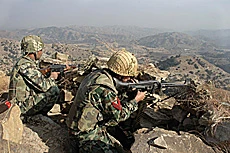
The unmatched mobility of top Al-Qaeda men has made operation in Wana very difficult. Both President Gen. Pervez Musharraf and Prime Minister Shaukat Aziz agreed that it was a matter of time before top Al-Qaeda men and other militants will be captured. Both renewed Pakistan’s commitment to fight against terrorism.
Reiterating Pakistan’s firm commitment to root out terrorism, Musharraf said the country is combating the menace in accordance with demands of the environment and not at all backtracking from its counterterrorism drive. “We are not backtracking; nothing of the sort is happening. We are strongly determined to fight off the menace; we are determined to eliminate Al-Qaeda militants and terrorists from Pakistan,” he said.
“The views about our backtracking are misplaced. Our fight has three dimensions: We are operating at military level to achieve short-term results; then we are dealing with the problem politically, and thirdly also bringing about development in the tribal areas to root out the menace in the long term. “There should be no doubt about Pakistan’s fight against terrorism; we will continue the fight against terrorism with strength in all dimensions,” he explained.
Musharraf claimed there was only one subtribe that was abetting Al-Qaeda-linked terrorists in one agency of the tribal areas, South Waziristan, while tribesmen of all other agencies of the tribally administered areas support the government’s drive. “We have to act at the roots of terrorism, we don’t want this menace to spread to other parts of the country,” he said. Pakistan, the president said, joined the international coalition in the fight against terrorism in its own national interest and has made vital contributions to the international efforts against the menace, capturing about 600 terrorists.
However, tribal leader Haji Muhammad Omar claimed that hundreds of US troops were engaged in operations against tribesmen under the guise of operations against Al-Qaeda and Taleban suspects. Haji Muhammad Omar, the successor of tribal leader Naik Muhammad who was killed in a missile attack by the Pakistan Army, has made it clear that recent attacks on the army were in retaliation for the ongoing operations in the area. The tribal militants have clearly warned that efforts would continue until US troops were expelled from the area. Omar had said that their supporters were avoiding clashes with the Pakistan Army and militia directly but only attacking those military camps of the Pakistan Army where US troops were present as well. The trial leader had earlier said that they were ready to abide by the Shakai Agreement reached between the army and Naik Muhammad in April. However, they believed that the government did not implement the agreement under pressure from the United States. The situation in the area worsened due to the nonimplementation of the agreement.
However, during operations in Shakai and the adjacent Santoi, Mantoi and Khamrang valleys in the South Waziristan Agency, Pakistan security forces have not only flushed out the terrorists and gained control of the area but also have seized huge caches of arms and ammunition.
The arms captured include cannons, mortars, rocket launchers, recoilless rifles, grenades, and fuses, anti-tank and anti-personnel mines as well as huge quantity of ammunition, explosives, communication gadgets, medicines and food items. According to investigations carried out by intelligence agencies, the same kind of weapons and ammunitions were used in various terrorist acts elsewhere in the country. The terrorists have been using these weapons indiscriminately on the civilian population in South Waziristan Agency. One such free-flight rocket hit the house of Mir Afzal Khoniakhel on July 12 and killed his two sons. There also have been numerous instances where terrorist mines caused death among civilians and security and destroyed vehicles.
It is worth mentioning that security forces have achieved substantial successes in the South Waziristan Agency. These operations have eliminated the main strongholds of miscreants in South Waziristan and have also facilitated political work resulting in the surrender of several wanted men. So far the security forces have cleared the terrorists from Shakai and adjacent valleys, including Khamrang Santoi and Mantoi, with active cooperation from local tribesmen.
It is satisfying to note that people of these valleys are breathing a sigh of relief after the eviction of terrorists from their area. This also helps pave the way for initiation of much-needed developmental activities in the area. Former Interior Minister Faisal Saleh Hayat and the present Interior Minister Aftab Sherpao claimed that operations against foreign extremists in Wana were fully justified as the majority of terrorism incidents in different parts of Pakistan have their linkage to foreigners who took refuge there. As a result of operations in Wana some suspects were captured, others were killed and still others fled — but Pakistan will not allow anyone to carry out terrorist activities The law enforcement agencies are continuing operations against terrorists.
The latest success of Pakistani agencies in nabbing the terrorists vindicates the policy of operations against foreign extremists in Waziristan area of the federally administered tribal region. Pakistan’s Interior Ministry claims that no other country in the world has done as much in the fight against terror.
There will be absolutely no compromise on the fight against terror, and Pakistan will eliminate all foreign terrorists, it warned. It may be mentioned that Pakistan’s recent success against terror suspects has been widely appreciated by the coalition partners in the fight against terrorism. Many coalition partners had assured Pakistan of financial and technical assistance to curb terrorism. Sherpao has confirmed that a large chunk of the U.S. aid to Pakistan is in the pipeline, which will help the country to strengthen its internal security and combat terrorism. The Pakistani military has been engaged in fierce fighting in the Waziristan area that has left hundreds of suspected militants and equal number of the security forces dead. Maj.-Gen. Shaukat Sultan, the chief army spokesman, had claimed that operations were winding down and that the army and paramilitary troops “successfully dismantled and destroyed” militant hideouts in the offensive. Contrary to that, reports confirm that hundreds of Al-Qaeda and Taleban fighters, said to be a mix of Arabs, Central Asians and Afghans, are believed to still be hiding in the area. Pakistan is a key American ally in the war on terror and, reports say, has handed over more than 500 Al-Qaeda suspects to the Americans since the Sept. 11, 2001, attacks on the United States. The decision to side with the United States has angered among many of Pakistan’s own Islamic militant leaders. But President Musharraf maintains that Pakistan will “go on with the same conviction and intensity until (the terrorist suspects) are completely eliminated.” Musharraf has stepped up Pakistan’s efforts against terrorism. In the spring of 2004, Pakistani forces launched military operations against suspected Al-Qaeda fighters sheltering along the border with Afghanistan in South Waziristan. At that time, Pakistan captured more than 60 suspected terrorists — including key members of Al-Qaeda.