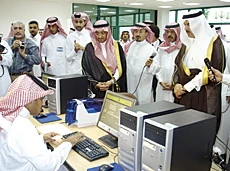
RIYADH, 24 November 2004 — Saudis yesterday took the first step toward voting in the Kingdom’s historic municipal elections, which are scheduled to start on Feb. 10, as voter registration opened at 140 polling stations in the Riyadh region.
Some of those signing up said they hoped the process would lead to more reforms. “I am happy because this is the beginning of (implementing) democracy,” said Mansour Shalhub, a Foreign Ministry employee who was among the first to register.
He hoped the civic polls, which are to be conducted throughout the Kingdom in three phases to name half the members of 178 municipal councils, would lead to electing other governmental bodies like the Shoura Council.
“In the next five years there should be elections to the Shoura Council,” said Shalhub. “But this is the first move toward choosing all decision-makers and leaders,” he pointed out. Shalhub’s enthusiasm was shared by Abdullah Ammar, who is a company manager, and was keen to be among the first to register. “Now it is at the level of municipalities, but in the future it will hopefully lead to electing the Shoura Council members with stronger powers,” he said.
“Islam calls for shoura or consultation... People electing officials is a type of shoura,” said Ammar, advocating a broad, though not necessarily Western, concept of democracy in the Kingdom.
But Saudi women, who fought fiercely to seek participation in the first-ever elections, are to be left out of the democratic process, with promise to be allowed in the next elections.
“I wish women were allowed to participate, as much as I wish they were allowed to drive in this country,” said Abdullah Al-Rajaan, a businessman who was the first to register in Al-Olaya. “I would have been the first in bringing my wife to the ballot center, and the first to buy her a car,” he added. “This is the first, small step. God willing, one day we will become like other countries, but it will take time”.
Muthaib Al-Otaibi, who was the first to register at a Malaz polling station, said he would contest the election. “I will try my best to create more job opportunities for young Saudis,” he told Arab News. “People in the neighborhood asked me to contest the election. So far more than 3,000 people have agreed to vote for me,” he said.
“I will set up a large camp to receive the voters and explain to them my programs,” Otaibi said.
Actor Abdul Aziz Al-Hammad, who has 40 years’ experience in the media, said he would also contest the election. “I don’t have any plan to conduct any campaigns as I believe that people know whom to vote for,” he said.
Hamoud Matar Al-Shammary, another prospective candidate, said he would work for a better future. He urged all Saudis to register their names to qualify to vote.
“I will support government and private programs as well as small-scale projects that are beneficial to society,” he said. “I will also work to solve the unemployment problem,” he added.
Hamoud Matar Al-Shammary, who intends to contest the elections in east Riyadh, hoped that he would get a large number of votes. He has appointed a media team to campaign for his election. Abdul Aziz Al-Majed, owner of an advertising office, said his organization was ready to carry out campaigns for prospective candidates.
Riyadh municipality has set up 140 polling stations in schools, universities and sports clubs for registration, which continues for a month. But the turn out was poor as a result of lack of awareness.
Newspapers and state television have carried advertisements for the elections. Posters throughout the capital also urge voters to “participate in decision-making”.
However, only seven people registered in the first 40 minutes of the process at the Arqam primary school in Riyadh’s Olaya district.
The information desk at another ballot center in Prince Salman Social Center said around 20 men had registered in the first hour.
Critics say the polls are irrelevant and the councils will have no real authority. “We have already forgotten them, no one cares,” said lawyer Mohsen Awajy.
Tight security was in place at polling stations. First-aid and civil defense vehicles were also present to face any unforeseen situation. Many Saudis resorted to the assistance of district chiefs to prove their IDs. Candidates for Riyadh can register between Dec. 26 and 30.
Regulations issued on Aug. 9 by the Municipal and Rural Affairs Ministry said that all citizens over the age of 21, except military personnel, would be able to vote in the polls. Although the new regulations made no specific reference to women, authorities said it was not possible for women to participate in this election.
Voting in the second round, which covers the eastern and southwestern regions, will take place on March 3. Saudis in the western regions of Makkah and Madinah, as well as northern regions, will not be casting their vote before April 21.
Saudi leaders promised in October 2003 to organize elections within a year, but a campaign of violence by suspected Al-Qaeda terrorists forced authorities to delay the polls to February 2005.
— Additional input from P.K. Abdul Ghafour and agencies