
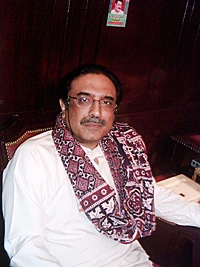
KARACHI, 1 December 2004 — The husband of a former prime minister of Pakistan, Benazir Bhutto, is suddenly media’s most sought-after person in this country since his release last week after eight years in jail on charges of crime and high corruption.
Pakistan’s ‘longest-serving’ political prisoner now spends time trapped the entire day in his small yet plush mahogany-walled ‘office’ at Bilawal House, his palatial residence.
Asif Ali Zardari aka “Mr. Ten Percent” aka “Pakistan’s Nelson Mandela” appears visibly exhausted from seeing visitors choking the narrow corridors of the House.
“Eleven years in jail has weakened me physically,” he asserts during the course of our talk, “with stress diabetes…and degenerating bones…”
“So, are you free now? In the literal sense of freedom?”
He paused and answered with a spark in his dark-circled eyes. “I have always been under the bondage of the people of Pakistan, because I feel that I have a mission in my heart which needs to be completed. So, one can never be free, depending on how you define freedom. I was free in prison, mentally…”
“I made some assumptions and calculations, and thought of how much we are harming ourselves. When you are sensitive, you feel everybody’s pain. When you feel pain, only then you can find a solution,” he says.
So, what thoughts did he have in prison, what solutions has he thought of, and what hopes and plans he has for the future?
“I see a beautiful future for myself and Pakistan,” he said optimistically.
He called the ‘threats’ coming from the chief minister of Sindh, suggesting he was safer and better off in the prison, “a conspiracy to assassinate me. If something worse happens, God forbid… the People’s Party will hold the government of the day responsible.”
Was his decision to relocate to Lahore, Punjab’s capital city, an after-thought as a result of the ‘threat’?
Appearing a little uncomfortable with the question, he says this decision is not a recent one and goes on to express his newfound love for Punjab. He says he promised the people of Punjab when last in the jail that he would ‘repay their love and affection’ he received from them.
Why Punjab?
“Because Punjab is what you have to be and where you have to be if you want to stay in Pakistan…. I think some people are trying to use the power of Punjab negatively, so I intend to use that power positively,” says Zardari, who in his salad days was one of Pakistan’s most powerful and feared men in political and financial terms.
So does he intend to extend his base to Punjab?
“I have bases all over Pakistan. I intend to go to Balochistan... I can operate from Punjab, through Punjab, and I intend to stand for Parliamentary elections from Punjab,” he announces.
There is a rumor that Zardari is planning to contest the top slot in Punjab. “No, no,” he expostulates, saying that it would be assuming too much on his part if he started to think that way. “I don’t know Punjab that well. I have to live there for ten years to get to know Punjab better. My role is not to be the chief minister of Punjab. My role is to help the nation, help the country and help Punjab.”
So, Bibi (Benazir) wants to come to Pakistan?… I ask, only to be abruptly cut in by Zardari, “Bibi is Pakistan,” in a manner that is intended to lighten the atmosphere after his overwhelmingly emotional view of Punjab.
“Punjab is a tremendous province. The people are educated, the literacy rate is high. I have lived in Punjab jails, and they have given me love which I cannot repay. The culture that I have seen there I have not seen in Sindh. I liked it.”
“I think Pakistan is in danger and has to be saved,” he says. Did he think the danger came from Punjab?
“No. The danger comes from the mindset of some vested interests there. There are some who are unknown participants and some who are willing participants. Punjab is a game for a lot of them. I have to clear that air, and win the trust of other provinces. I think I can win the trust of Balochis, Sindhis and Pathans and talk to them from Punjab, so that the Seraikis, MQM, Sindhis, Pushtoons, minorities of Punjab don’t feel alienated. There is a lot of power in the minorities of Punjab. That power, unfortunately, is being used to dismember Pakistan.”
How does he see the political structure with Benazir taking charge of PPP in Pakistan personally again?
Her party, he explains, was always in control of its leader, though she is not physically present in Pakistan. “We would have done much better if Bibi was with us. If she had led from the front the PPP would have won with a two-thirds majority. Pakistan is at a very important threshold of history.”
The situation in Wana appears to be a late development, but it was seething for years. How do Zadari and his party plan to contain it?
“Due to militancy, political forces and parties which had bases there were not allowed to do their proper work in the region. In that vacuum the military and extremism surfaced. They needed to politicize that issue. Democracy is the answer to even that issue. We may have needed a heavy hand, but it had far reaching effects. We had to talk to some people, we had to guide some people out of their mistakes. It has never been an overnight job with revolutions. It has been happening for the last 30 or 40 years.”
He said that most people thought that arrests and violence was the cure. “That is not the cure that is part of the problem. The martial mindset is part of the problem, not part of the solution. Democracy is part of the solution.”
PPP was twice given the chance to uphold democracy so why does martial law keep coming back? “Since the inception of Pakistan, ours has been a border state with one part in a kind of a war with another. Today it has become a border state for terrorism. Yesterday it was a border state for Soviet Union, the Cold War phenomena. America and Europe were all part of it. Unfortunately our elders did not think and were not assisted by the international statesmen of yesterday.
“In Finland, Sweden, Denmark and all these regions which border Russia, the state looks after you from cradle to grave. They were given a Marshall Plan to evolve, develop. We were never given a Marshall Plan although we think we have a right to it. We were partners in war with America. The plan was given to them to stop the expansion of Soviet Union.
“In our case, we were given aid and we were spoiled by this aid culture. If we were given the tools, we would have been a stronger country. That is not our fault… that is a fault of, again which I call, easy answer. Pakistan needs a budget support. So give it the money to develop the industrial base so it can flourish.
“In that lies part of the answer to martial law. They looked for quick cures. Instead of developing democracy the international powers developed the martial thought. We were active participants in it. Our people had limited vision.
“(Mahatma) Gandhi came to a conclusion that force would be non-productive for India. Someone has to think long term. I think it is now time for our politicians to mature, improve themselves and get down to improving our whole community and get ready to do the job. To this day the job is not getting done.”
Zardari thinks that civil society has come to that position where if motivated, it could see this problem. “Once you identify the problem properly then you identify the cure properly and collectively.”
How does he plan to work collectively, and build bridges between PPP and other parties?
“By meeting them, by talking to them, appeasing their inner-self. I believe that all men are human and basically good.”
Zardari hopes that he will build his strength, as at the moment he says, “I am weak, I am not well.”
At the moment he appeared very confident, strong and determined. Did he feel more in command than before?
“I find my party members giving me more respect than before. My mental self has grown, but my physical self has become weak. With all the love people are showering on me, and with their help, I can cure myself physically. But it will take a little time.”
With his passport given back to him, where would he like to go first?
“In my wife’s arms, where else I would be going!”