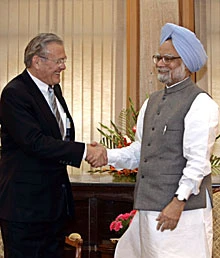
NEW DELHI, 10 December 2004 — The United States will build stronger defense ties with India, Defense Secretary Donald Rumsfeld vowed yesterday, but New Delhi said proposed US arms sales to Pakistan could affect relations with Washington.
Rumsfeld, who is in India on the final leg of a regional tour, held talks on a range of issues with Prime Minister Manmohan Singh, his Indian counterpart Pranab Mukherjee and Foreign Minister Natwar Singh. They were the first discussions at this level since President George Bush’s re-election last month.
“The defense relationship is a strong one and something we intend to see is further knitted together as we go forward in the months and years ahead,” Rumsfeld told reporters, adding that he had invited Mukherjee for more talks in Washington.
Relations between India and the United States have warmed in recent years, but Washington’s decision to embrace Pakistan as a vital ally in the war against terror has been an irritant.
New Delhi expressed serious concern about three proposed US arms sales to Pakistan worth $1.2 billion, including eight P-3C Orion surveillance planes. Islamabad is also seeking F-16 fighter aircraft.
“This is a general concern that has been expressed about repercussions of US arms supplies, both on the India-Pakistan dialogue ... as well as on the perception of the US in India as a strategic partner,” Foreign Ministry spokesman Navtej Sarna told a news conference.
Asked whether New Delhi’s concerns about proposed US sales of F-16s to Pakistan were raised, Rumsfeld told reporters earlier in the day: “We talked about a full range of things and I don’t think I would consider that to be a central part of the discussion at all.”
The two sides also discussed the situation in Iraq, Afghanistan and Iran.
Sarna said the US defense secretary told Indian leaders that holding elections in Iraq would lead to an improvement in the situation in the strife-torn Gulf nation.
In his talks with Rumsfeld, Manmohan Singh said India hoped that elections would indeed take place in Iraq, according to a statement issued by the government.
India has been steadfast in its refusal to commit troops to Iraq, and the Indian Parliament has adopted a resolution demanding the withdrawal of all US-led coalition troops from that country.
But New Delhi reiterated that it was ready to train Iraqi election staff in India in response to a UN request.
The United States, for its part, has been concerned about India’s relations with Iran, which it believes to be developing nuclear weapons. Both sides reiterated their commitment to work together to combat proliferation of weapons of mass destruction.
Rumsfeld’s visit is his first to India since the Congress-led government took power earlier this year.
Last month the Pentagon notified the US Congress of the arms sales to Pakistan.
India has also launched a huge program of arms modernization, buying weapons from Israel, South Africa, and even the United States in addition to traditional supplier Russia.
Last year, New Delhi ordered strategic airborne radar systems from Israel that would help it peer deep into Pakistan, sounding alarm bells in Islamabad. Pakistan has been concerned about India’s growing ties with both Israel and the United States.
Both nuclear-armed nations are in the midst of peace talks that have failed to produce a breakthrough on their main dispute over Kashmir since the cautious process began early this year.
The United States dropped sanctions against Pakistan after the country backed the US invasion of Afghanistan and the overthrow of the Taleban regime there in the aftermath of the Sept. 11, 2001 attacks.
— With input from Reuters