
THE public art that has woven itself into the fabric of the city of Jeddah is often largely unnoticed by short term visitors. Monuments and sculptures are frequently surrounded by buildings and highways that have grown since the sculpture was erected. Whilst the larger and more spectacular pieces are well-known, some of the smaller and equally interesting ones are relatively unknown.
Nearly every district in Jeddah has some striking piece of public art — so much so that they are used as landmarks for navigation around the city. Eccentric directions such as “Pass the fish on your right and turn left at the camel roundabout” are common currency. However, many seem destined to remain obscure as there are no tour guides for tourists who might well be intrigued by the artworks. Many of the works were placed on display to reflect the best of Islamic culture or to draw the visitors’ thoughts to philosophical themes.
Though Jeddah is best known for its relationship with the Red Sea, it was also blessed with Saudi and foreign thinkers and artists who made it even more enjoyable for citizens and tourists by displaying their art here. These monuments turned out to be not just a national project; it became a cause that drove contributors from around the world to participate in it; the result was the unique collection of monuments.
The story of the monuments began in 1963 when Mohamed Said Farsi was appointed Town Planning Officer to Jeddah and later became the Mayor and City Planner of Jeddah from 1972 through 1986.
During his tenure, Farsi developed what he felt was an obligation to beautify the city and bring works of art to the public. Driven by this thought, Farsi traveled around the world specifically seeking artists who could bring a combination of beauty and meaning to the beholders of public art. He sought them in Brussels, Paris, Rome, Cairo, Jakarta, Helsinki and Madrid. The artist used a wide variety of materials from simple clay and plaster to bronze and stainless steel to express themselves. Many incorporated the idea of recycling to create sculptures from scrap iron and other artifacts such as aircraft, ships and abandoned machinery.
Perhaps the most imposing sculpture in Jeddah is Ottoman Holloman’s “Cosmos” or Al-Falak monument. The manufacturing and logistical challenges this soaring 36 meter steel and aluminum sculpture presented took seven years to overcome. Quite apart from the problems of transporting it from Germany where it was made, mobile cranes with a 100 meter lift were needed to erect the piece. Passers by hardly notice that it had a hand made mosaic base which consists of around two million pieces of mosaic laid out in Italy and then shipped to Jeddah taking two months to be reassembled.
Just as Mayor Farsi was determined to reflect an artistic theme, he was determined too to reflect the Islamic culture through Arabic calligraphy and drew on verses from the Holy Qur’an. Caesar Baldaccini presented the idea Mayor Farsi wanted. He created “The Thumb” from 70 tonnes of Marble. The piece refers to God’s ability to create unique finger prints for each and every human being. Baldaccini also sculpted the bronze fist “Al-Qabda” and the eye monuments.
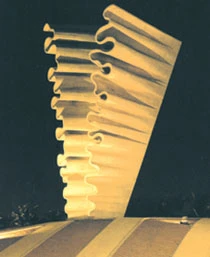
“Al-Qibla,” (the direction of prayer monument) a folded marble pointer to Makkah is another example that took five years to accomplish and used 260 pieces of carved marble shipped to the Kingdom from Italy. The base of this monument and many others is surrounded with mud bricks made from the red clay of Wadi Fatimah.
The best known site for viewing the city’s public art is the seaside sculpture park, known as the Open Air Museum, in Al-Hamra. This seashore venue has become popular with families picnicking — especially during the evenings of Ramadan. The very accessibility of the sculpture with children clambering through Henry Moore’s “Oval with Points” — where in other countries would be protected from the public — realizes the intimate public relationship with art that Farsi was hoping for.
There stands the sculpture Migrant Birds, a steel sculpture made by Sylvester Giovanni, an Italian artist. These birds are some of the flocks of birds which migrate from Africa northwards via the Arabian Peninsula. “Large Ball Bearing Symbols,” again by Ottmar Hollman, which combines oriental philosophy with astrology and western science, squats overlooking the Al-Salaam Palace island.
The public, largely unaware of the artists’ names for their works, devised a series of nicknames; Ottmar’s ball, because it is supported on tapering legs became the Octopus. Others called it the Spaceship each according to his/her own interpretations.
It seems a little sad that the enormous efforts and the vision of Mohamed Farsi are frequently seen yet so little understood. For some they are simply “there.” Others seem to like them and develop favorites — be it the huge concrete block with automobiles apparently crashed into it — or the flying carpet with an early ‘mini’ car balanced on it.
The simple placing of an explanatory plaque and a clearly defined spot to take photographs from would lead to a greater understanding of why they monuments are there. They would also provide some insight into the vision of a man whose monument is all around you.