
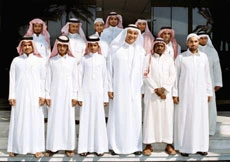
RIYADH, 8 December 2005 — As part of its initiative to launch young Saudis in micro enterprises in the field of Islamic decorative arts, the ALJ Fund for Vocational Training and Development has sponsored a group of 11 Saudis to qualify them as Islamic calligraphers.
It is the second initiative of its kind by the ALJ Fund for Micro Projects, which had earlier set up a training program for Saudis in cookery to help them own micro business establishments.
A salient aspect of this private-sector initiative is that the young Saudis will study the Islamic decorative arts in Balqa’ University in Amman (Jordan) which specializes in this field and offers the training program in collaboration with the Prince’s School for Traditional Arts in London.
The London School’s patron is Prince Charles, the Prince of Wales. The Visual Islamic and Traditional Arts program (VITA), currently directed by Dr. Khaled Azzam at the Prince’s School for Traditional Arts (PSTA) in London, offers specialized courses in the arts and architecture of Islam as well as the traditional arts of other civilizations.
The Prince’s School for Traditional Arts is located in Shoreditch in London and is part of a number of initiatives that are part of Prince Charles’ charitable work in the United Kingdom.
Muhammad Abdul Latif Jameel, President of ALJ Programs for Community Service, met with the trainees before their departure for the Jordanian capital. He stressed on the students the importance of making good use of their time during the training period and wished them all success.
Giving this information to Arab News, Omar Al-Thebaiti, training manager, ALJ Fund for Vocational Training and Development, said the six-month course is designed to help revive the dying heritage of Saudi traditional professions.
“The training course aims to qualify young Saudi technicians, especially as there is a noticeable increase in demand for qualified people in these skilled areas. After completion of the training course, the trainees will be appointed in companies dealing in this business,” he observed.
According to Omar, one of the objectives of the fund is to actively promote handicrafts. He said this new course will concentrate on gypsum, metal and wooden decorative work. Students will be trained in brass work, design and implementation of gypsum work, as well as the art of wood carving and moulding work.
The training course seeks to qualify young Saudis as Islamic calligraphers. After completion of the training program, they will be absorbed in companies engaged in this business.
The course will enable its graduates to have their own small businesses with the help of ALJ Fund for Micro-projects. It will also equip these enterprises and provide administrative and financial support to them.
Al Balqa’ University’s Department of Traditional Islamic Arts is considered to be the most prominent among the departments of the University. It aims at deepening the knowledge of Islamic arts and their principles to the younger generations of technicians and trainees to help them graduate as craftsmen skilled in producing original Islamic arts, wood work, glass work, ornaments, Arabic calligraphy and sculptures.
Speaking about the training course, Hilal Hasan Al-Beeshi, a Saudi trainee, said he enrolled for the course in view of the importance of the traditional crafts at present and in the future, as well as the role these crafts will play in reviving Arabic heritage within the Kingdom. Ahmed Yahya Al-Abdali, another trainee, added that, together with his other colleagues, he hopes to form the nucleus of a cadre of Saudi technical staff who would revive the Saudi and Arab artistic heritage in the Kingdom.
Omar said that after the renewed interest shown recently by the market in these handicrafts and the changes in taste of the Saudis in the fields of design, decoration and traditional works of art there was definitely a market for creating an Islamic ambience in the internal and external designs of houses and residential palaces.