
“You race what?”
The lugubrious mustachioed Russian raised the lid of one eye perhaps a millimeter and rolled his chosen reply around a little before he answered. “A truck,” he said, pointing to a blue slab-sided monster with the racing lines of a house-brick on five-foot wheels. “It go fast, tovarich.”
It was one of the several vehicles in the Dubai Desert Challenge which, to the untrained eye, simply should not have been there; however, in this race, expect the unexpected. Amongst all the glitter of the race, with expensively accoutered factory financed teams competing for world championship points, there are impossibly small teams with limited finances and relatively ancient vehicles. Their stories are generally buried in the rush to publicize the high profile competitors. The extreme conditions of the desert however are great levelers; ignore the talented and determined amateur at your peril.
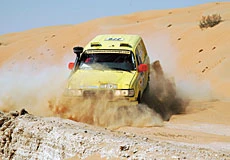
One such outfit, Team Saluki, entered that automotive oxymoron a 20 year-old “racing Land Rover.” A helpless case of misplaced hope? Not a bit of it. That would leave out the essential elements in this privateer team; enthusiasm and dedication and an encyclopedic knowledge of the workings of their immaculately turned out but rather mature vehicle.
This year, Team Saluki competed for the 6th time in the Desert Challenge, which says a lot for their determination and sheer single mindedness. But why do it? Back in 1997, Mark Powell, Team Saluki’s driver, was asked the same question. The answer then was the same as now. “It’s conquering the dunes; being in control of the car. It’s just an enjoyable feeling. We simply love driving.”
None of it could be achieved though without sponsorship. From major factory teams through to the talented privateer teams, the cash and equipment pumped into teams is the lifeblood of racing. The smart liveries of the sponsored vehicles are part of the racing scene and they advertise the products. However, without them and their financial weight, the spirit of challenge and competitiveness that fuels the race and shows visions of the possible to young people would be lost. Racing is about winning — but in modern, relatively safe and controlled society, it is also an avenue for adventure that is often missing from daily routine. That is an attractive proposition both for sponsors and racers and so the symbiosis between sponsor and racer develops.
Farhan Hasan, Marketing Manager PepsiCo International which was the main sponsor for the team this year summed up the sponsor’s view. “Mountain Dew is a youth icon full of exhilaration and portrays a very daring brand attitude. Team Saluki brings a lot of those credentials. Together Mountain Dew and Team Saluki can bring a great deal of extreme exhilaration and adventure to our young audience.”
On the ground, the glamour of the event translates for the privateer teams into extreme tension, short nights, long days under massive pressure and living for perhaps days in the same set of clothes and tearing down complex racing vehicles in the desert. The contrast between the glossy romance of the pre-race build up and the reality of the ‘bivouac’ — the camp 300km into the desert at Liwa where the competitors and teams live for the duration of the event — could not be greater.
The bivouac squats under an enormous dune looking as if it is about to engulf the site. Here the inequity of the competition becomes evident. Air-conditioned trailers with private chefs, fully equipped mobile workshops supported by ranks of engineers and air transport for the drivers rub shoulders with tiny one-man tents with a canvas lean-to for a workshop and canned food for a week. To compete and win is the dream; simply to finish is more of a challenge than most people will face in a lifetime.
The differences really do not matter to the racers; their focus is all on their own machines and as Powell pointed out, a team’s position in the race can turn on something as small as a single small component giving way at a critical moment. The Saluki camp falls about halfway between the two extremes; the sponsors and the native ingenuity of the team supporters have come up with three basic tents, a refrigerator, barbecue and generator. It’s workable.
On the race course, life is gritty, tense and hard work.
“Streaky,” the team’s chief mechanic, is a print engineer by trade. He lives and breathes Land Rovers, ingests formidable quantities of the sponsor’s product and instant noodles, denies that his name has anything to do either with food or personality and survives for three days on nine hours sleep working with the support team keeping the race car going. All for fun.
The support team is simply incredible. They keep the same hours as Streaky and maintain their tempers under the most stressful conditions. “The drivers are seen as the stars,” said Mark Powell the race driver, “but they would be nothing without the support from the team. I simply drive the car; keeping it in the condition that will stand up to the abuse I have to give it to race is a formidable job.”
Streaky lives on the job — literally — in a box on top of his extensively converted Land Rover. The vehicle, with almost as much power as the racecar is loaded with a couple of tons of tools and spare parts. During the race, the vehicle charges across the desert tracks, intercepting the racecar at the service stops.
Sometimes of course it does not. Powell modestly observed at the end of the first day’s racing, “We could have pushed it a bit harder, but we’re pleased so far.” At the end of a hard-fought race day, a front wheel bearing needed replacing and what he described as a “slight brake problem” — in reality was extreme brake fade — had caused some tense moments. Co-driver and navigator Tim Ansell simply said “It made for a few hairy moments; at those speeds it’s nice to know you can stop.”
As Powell rehydrated and talked over the performance of the car with the support team, Ansell tackled the task of checking the next day’s route. Hundreds of GPS waypoints, tulip diagrams and checkpoints had to be examined. One slip in the navigation and a wrong track taken and the race could be lost.
Incredibly out of the 35 car entrants, including factory teams with $500,000 kevlar and titanium racecars, the 20 year-old Land Rover was lying fifth! If ever proof was needed that the combination of local experience and dedication worked, there it was. Spirits were high as the team got down to the night shift.
The driver’s briefing revealed an aspect of the race community that the media generally misses; the camaraderie between the fiercest of competitors. One of the motorcycle racers ran out of fuel; in the wastes of the Rub Al-Khali after eight hours in the saddle and exhausted, this presents a real danger to the rider. A competing rider stopped, siphoned off some fuel for his rival and the two raced on.
The car was rapidly coming apart; wheel bearings and brake parts littered the team’s workshop area. Polite enquiries as to progress were answered but eventually declined; “Go away. This” observed one team member, “is screw-uppable,” drifting a new bearing race into the wheel hub. “Please,” he added after some time; this was time for serious business.
By 4 a.m. or so, the car was back on all fours and rumbling out of the pit for a test run, waking those who managed to drift into exhausted sleep. Not a murmur from the competitors; tomorrow it could be them.
Streaky and the team cleaned up, dozed for an hour and loaded the support vehicle for the 6 a.m. start.
Day Two the car performed well — so well that the team sneaked up a place in the standings to fourth. There was quiet admiration and a very tense atmosphere in the camp; fourth against the best in the world. “It makes a big difference to your attitude when you’re up at the pointy end of the table,” said Powel. “It’s a quantum change — this is the important end.”
Ansell was as happy as a co-driver could ever be, having overshot a checkpoint by a few meters. The dust cloud kicked up by the car just ahead completely obscured it, but the perfectionist in Ansell — a valuable characteristic in a navigator — made him particularly attentive to his preparations that night. All he would say was, “If Mark drives like that tomorrow, we’re going to seriously worry the leaders.” The hundreds of checks on the car complete, the team snatched a few hours rest, confident in their drivers.
Day Three dawned full of hope. The car was running sweetly, the Mountain Dew livery had been washed and polished, clean team shirts put on and there was an air of great expectancy that something special was going to happen. There were only 30 minutes between Team Saluki and third place, their first podium position in the Desert Challenge.
Then the gearbox failed. Ten kilometers into the stage, a tooth had sheared in the drive train. To continue might result in stranding in the deep desert for many hours. A disappointed convoy led by the racecar drove slowly back to the bivouac.
It was a tense team that reassembled at the bivouac. Within seconds of listening to the description of the problem, the mechanics were under the car, removing the gearbox. The decision to abort was justified. A cog on a gear had broken and pieces of metal were lashing around the gear train.
Both Powell and Ansell took the enforced day out very calmly. Their drop from the chase yielded TV interviews and media attention — the team had made a huge impression on the race and their sudden absence had been noticed. There was a funereal respect for the team among some of the media enquirers during the day. This team was not a factory team and the visitors sensed that the investment made by the supporters and engineers alike was special. None were being paid; this was personal.
The mechanics slaved; the damaged gearbox was removed and the replacement — from Streaky’s cavernous support vehicle — installed. These guys are remarkably well organized. Late into the night, the support team fussed round the car. The gearbox was in and tested, the other systems checked and rechecked; the car was as good as it could be. Midnight saw the team heading for the sleeping bags.
Day Four and the race was on again. Powell did “drive like that” again, clawing back places and, despite overcooking the charge in some soft sand, clawed back several places. Other competitors dropped out through a moment’s inattention or mechanical failure. It strikes the most opulent team. But then as Ansell observed, “The Desert Challenge would not be a challenge if it were easy.”
Once again, in the midst of fierce competition in the toughest of environments, the special spirit of the challenge took hold. A motorcycle rider, in the words of the pilot of the rescue helicopter that picked him up, “decelerated from 123 kph to zero in less than a second.” The result was a multiple compound fracture of the arm and other injuries. Alarms were raised on the satellite communications system carried by all competitors and within eight minutes of alert, the rescue helicopter was on site.
Seven other motorcyclists had stopped to assist the fallen rider — all of whom were trying to overtake him. When finally he was airlifted to hospital and an amazing — well, to me anyway — thing happened. In the middle of one of the toughest and most competitively contested races on the planet, the riders decided to ride in spread out formation on to the finish, line astern in the order they had arrived on the scene of their crashed rival; and thus they crossed the finish line. And we thought it was all about sponsorship and winning.
Team Saluki survived the course, finished 14th out of over 130 starters and 36 cars. They finished; many multimillion dollar teams did not. So what next? “Our ambition is to compete in and score in the Paris-Dakar Rally,” said Powell. “That is the ultimate race. We are confident that, given the equipment, we could give a very good account of themselves.”
Of that there is little doubt; what those guys — looked at cynically — can do as a bunch of amateurs and a twenty-year-old Land Rover is scary. But that leaves out essential elements; the human spirit and incredible levels of determination and commitment. Those are formidable assets and surely deserve sponsoring.