
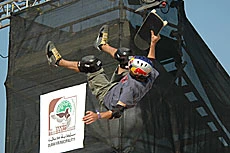
Wearing what looked like a pair of wheeled surgical boots, a petite 26-year-old woman from Brazil rotated gracefully in the air seven meters above the ground. The huge crowd of families, children and stern-looking fathers determined not to enjoy themselves roared their approval. To Fabiola da Silva, the best female free-style in-line skater in the world, this was both another day at work and an expression of sheer joy. Plummeting down the vertical wall of a four-meter high ‘vert ramp’ — a huge u-shaped structure with vertical walls — and demonstrating her extreme acrobatic athleticism is, to her, fun.
Fabiola was one of the elite group of athletes appearing at the first ever X-Games held in Dubai last week. According to Farhan Hasan of Pepsico and Mountain Dew, one of the main sponsors, they were unsure of the reaction they would receive. “We shouldn’t have worried. The size and enthusiasm of the crowds says it all,” he said indicating the packed arena and park.
The X Games — X standing for extreme — with its carnival atmosphere, fun and entirely distressing sartorial style had arrived in Dubai; the Emiratis loved it. The games were mounted on the edge of Dubai Creek and the setting provided an idyllic backdrop for a demonstration by some of the world’s top extreme sports athletes to introduce their very special talents to the Gulf region.
Much as they turned a child’s game into an industry — and I refer here to lobbing a ball through a hoop a few feet above ground level — the Americans turned the simple pastime of riding bicycles and skating into an international event and a whole youth culture. As with many youth cultures, it attracts its own musical style, mode of dress, vocabulary and marketing style — and sometimes this obscures the real sport and skills that lie beneath the glitzy spectacle.
The first games were held in Rhode Island in 1994 initiated by ESPN, a sports broadcasting channel that reaches over 89 million US homes. Over its eleven year history, the X Games have attracted - along with a winter version of the games - more than 2 million spectators, and created a generation of devoted aficionados.
Ken Newell, GM for GCC Business Development Unit Pepsico, said that the Dubai games were a result of a four year gestation period, originally conceived in Jeddah. “I am exceptionally happy to see the new child that has come into this part of the world.” He said his goal was to spread the games across the Middle East. “We want some Arab athletes to compete in these games as well.”
“Everything we do starts and ends with our athletes. We want to give them the chance to grow their sport, their discipline and their athleticism anywhere in the world,” said Jack Weinert, executive Director ESPN X Games.
The athletes themselves are equally clear about the effect they have on the people they bring the games to. Simon Tabron, a BMX rider, feels that an important part of what the athletes do is spread the word and educate people about action sports. “We are involved in sports that are still very young — not many have had the opportunity to see them. We want to introduce kids around the world to the opportunities that the sports have given us,” he told a packed amphitheatre on opening day. “If we can spread those opportunities, that’s the greatest thing we can hope to do.”
Skating, skate boarding and BMX cycle riding are the three most accessible of the sports represented at the games. The fourth, Moto-X — where apparently quite sensible young men accelerate up a 45 degree ramp and travel 35 meters through the air, often inverted and at altitudes of up to 20 meters — is less accessible to the majority of the young, mainly because of the expense. It is, however, very spectacular and to one who has ridden motorcycles for nearly half a century, entirely unnerving.
It would be easy to scorn the circus and spectacle of the X Games and dismiss the culture with a brusque, “Agh! Teenagers.” The aggressive music and inelegance of dress — why oh why do they have to wear their trousers more off than on? — encourages dismissal of the whole culture as faddish. To do so would be to miss some very valuable elements.
The skaters, boarders and bikers — referred to collectively as ‘riders’ — are athletes. All young, they have spent years dedicated to their chosen sport, are superbly fit and are simply the best around. It is only close up the spectator can see the physical effort, focus and determination in the athletes’ faces and get some feeling for the physical and mental challenges they have overcome to get this good.
Along with their successes comes a unsurprising portion of broken bones, wrenched ligaments and innumerable bruises. Indeed, on the second day, Fabiola landed very heavily (slammed, in skater parlance) after a particularly challenging aerial manoeuvre and damaged her knee; this kept her from competing on the third day. Yet even serious injury does not keep these determined young people long away from their sport.
One of the Moto-X riders Nixey Danielson explained in stark terms how he approached a new trick. “You just do it.” And if it goes wrong? “Do it again. You have to be confident in what you can do and understand how good you are, but then you have to push that bit more. You can’t practice a backward somersault on a motor bike before you have done it for the first time.”
All this determination and self-confidence from someone young enough to be still in school? How can any sport that produces this kind of confident young person be all bad?
Jamie Bestwick is a BMX rider. The BMX bike looks like a child’s cycle ridden by an adult; in the hands of a master such as Bestwick, it is an accessory to spectacular aerial gymnastics. He left the sport early and got a ‘proper job’ in the aerospace industry. “I had to come back,” he said, “It’s in the blood.” He moved from the UK to the US and took up a career in BMX riding and is now the man to beat in competition. A rugged 85 kilo six-footer with a wicked sense of humour, Bestwick typifies the athletes- if not physically then certainly in his self confidence and total self assurance of his abilities. “This sport gives me everything I want just now,” he said. “It also depends entirely on me how long I continue and how far I go.”
Therein lies one of the secrets to the appeal of the X Games and the disciplines the athletes follow. Like any sport, competition for recognition and glory among the athletes is fierce. In the years of training and fitness development, the toughest competitor rides the board, bike or skates with you. All the athletes made the point that when they win, the recognition is wonderful; when they don’t, their internal critic is relentless and drives them forward.
The other secret of X sports success lies in its accessibility. The vast majority of us will never drive a formula one car or win a powerboat race; the required money and training is simply not available to us. Standing on a cheap plank with wheels or putting on a pair of skates is where the professionals started. Like them, first timers fall off, scuff knees and collect bruises. However, with determination and practice, the possibilities are endless. Progress along the road to competence and recognition is, assuming basic physical competence, only limited by the will, focus and single-mindedness of the rider. Riders cannot compete for ever; the toll of injuries and the challenges from young competitors eventually mean retirement. What then?
“Back to school for me perhaps,” said Fabiola. After doing this for ten years, she said, she could handle any discipline. Fabiola started skating with the boys on the streets of São Paulo when she was eight. Against her mother’s wishes, her father gave her a pair of roller skates and Fabiola became a regular at a neighbourhood skate park. Her mother finally accepted the fact of her daughter’s obvious talent and gave her a pair of in-line skates. The rest is X games history. With her knee heavily strapped after her knee injury, yet raring to get back on the vert-ramp, her determination and grit showed.
Developing such characteristics which young people then take out into general society and apply to their careers surely cannot be wrong. Perhaps it is a road less travelled than the conventional route. Judging by the clear-eyed responses from the athletes at the X-Games, it is certainly a viable alternative.