
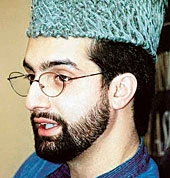
JEDDAH, 20 December 2005 — He has been described as Kashmir’s last and greatest hope. Suave and soft-spoken, sophisticated and articulate, 31-year-old Mirwaiz Umar Farooq was thrust into Kashmiri politics in tragic circumstances at an early age. On May 30, 1990, when his father, Mirwaiz Muhammad Farooq, was assassinated at the height of the anti-India insurgency, he was only 16. As the high priest of Kashmir and chairman of the All Parties Hurriyat Conference, Umar Farooq commands considerable respect, not only among Kashmiris but also internationally. It is because of this respect and following that he has been able to unite disparate separatist and militant groups in the Hurriyat Conference, which he has led into negotiations with India, Pakistan and diplomats worldwide. Despite the brutal killing of his father, he advocates moderation. He favors a political solution to the Kashmiri issue.
Umar Farooq was in Saudi Arabia earlier this month to take part in the extraordinary session of the Organization of the Islamic Conference. He met numerous diplomats during the summit and accompanied Pakistan President Pervez Musharraf to the president’s press conference in Makkah. In an exclusive interview with Arab News, Mirwaiz Umar Farooq took every opportunity to present his point of view and spoke at length on a number of issues including the ongoing dialogue with India, his differences with the hard-line faction in Hurriyat led by Syed Ali Geelani, demilitarization, self-rule and his latest proposal to form the “United States of Kashmir.” Following are the excerpts from the interview:
Q: What are your impressions of the OIC summit?
A: In 1994, when I attended the Casablanca summit as the chairman of the Hurriyat Conference, I was 20 years old. That was my first contact with the OIC. There was a contact group on Kashmir which included Saudi Arabia, Pakistan and Niger. Many summits have taken place since and we have always attended them. What we noted and realized was that despite being such a large organization — I believe it is the biggest organization after the United Nations — it is not taken seriously. This extraordinary session was a bid to infuse new life into the organization, and revitalize it. I believe this is a step in the right direction.
Q: People in the Muslim world, especially Kashmiris, have always been skeptical about the OIC and its resolutions, haven’t they?
A: There have always been question marks about the OIC. On Kashmir, they passed a number of resolutions. Every year we go to New York where the OIC foreign ministers discuss Kashmir. People in Kashmir think that besides passing resolutions, the organization was not doing anything practical. Nobody took the OIC seriously. But due to the kind of initiatives that have been taken at this extraordinary summit, we foresee a big change.
Q: What role can the OIC play concerning Kashmir?
A: The OIC can play an important role concerning both Palestine and Kashmir only if its decisions are made binding on its members. What we have seen is that, within the OIC, everybody supports us Kashmiris but when we talk about Kashmir outside this forum, every country thinks and talks about its own interest.
Q: You met Musharraf on the sidelines. He talked about demilitarization and self-rule. What is on the table?
A: Every time the Kashmir issue has been discussed, the human aspect of this tragedy has consistently been ignored. The recent earthquake has put the focus back once again on the human aspect of the tragedy. Families are divided; people are divided. Even in this hour of tragedy, we have not been able to come together. Everybody from all over the world is busy doing relief work in Muzaffarabad, Bagh and Rawlakot and we Kashmiris are so unlucky, we cannot even meet our brothers across the border. This is a bigger tragedy. We want this area to be demilitarized.
Q: You mean demilitarization by everybody?
A: Yes. When we talk about demilitarization in Kashmir, we mean the withdrawal of the Indian Army and also the Pakistan Army from Azad Kashmir. The situation is very bad. In Jammu and Kashmir, for every five Kashmiris there is a soldier. The world’s largest concentration of soldiers is in Jammu and Kashmir. There is a need to demilitarize this zone. What is happening now is that sand bunkers are being converted into concrete bunkers. People are upset and doubtful of the intentions of the Indian Army. People want to know how long this will go on. India and Pakistan are holding talks. The Indian leadership is talking to the Kashmiri leadership. But this should be translated into practical steps on the ground. Why is it that despite talks and the change in atmosphere we see increased troop concentrations? Demilitarization is the first step.
Q: First step toward...?
A: Toward a political solution. If Indian forces and Pakistani forces vacate Kashmir, we will ask the mujahedeen to halt their campaign. There should be a cessation of hostilities. Then there should be a timeframe of two, four or six years during which there should be a mechanism on how to find a political solution to the Kashmir issue.
Q: What about the so-called “United States of Kashmir” proposal?
A: We want the five regions of Kashmir, which include Valley, Jammu, Northern Areas, Azad Kashmir and Ladakh to be demilitarized. Of these five areas, three areas are under Indian control: Valley, Jammu and Ladakh. We are suggesting a federal structure of governance. We will call it the United States of Kashmir. We will later define the relationship of this body with the Indian and Pakistani governments. One thing is clear: The solution to Kashmir cannot be based on previously stated positions. India’s position is that Kashmir is an integral part of India; Pakistan’s position is that Kashmir is its jugular vein. Our stated position is that there should be a plebiscite in Jammu and Kashmir. We are ready for everything except for two things. One, we will not accept the status quo. It is not acceptable to us. Two, we will not allow the conversion of the Line of Control (LOC) into a permanent border.
Q: What are Pakistan’s and India’s views of the proposal?
A: Musharraf’s suggestion for self-governance is more or less the same thing. We are talking about federal structure and he is talking about self-governance. We are getting a lot of support from Pakistan. Musharraf Saheb said, “Whatever is acceptable to the people of Jammu and Kashmir is acceptable to Pakistan.” India’s position is still intransigent. It is not moving from its stated position. So far India has taken only one Kashmir-centric confidence-building measure: Starting the Srinagar-Muzaffarabad bus service. Everybody supported it whether they were pro-India parties or members of separatist groups.
Q: What about the five points opened along the LOC?
A: Yes five points on the LOC were opened after the Oct. 8 earthquake. There were high expectations that through these five points people would be able to cross the border, that paperwork would be reduced or done away with. That has not happened. For example, if you live in Uri, you just have to walk 3 km and you are in Azad Kashmir. At present you have to go 150 km and come to Srinagar first. Then you have to apply at the passport office, then there’s police clearance, then CID clearance, and only then do you get the permit to cross to the other side. We were thinking that the earthquake would help bring Kashmiris together. That has not happened. The whole exercise has been made very complicated. Ever since those LOC points have been opened, only about 50 people have crossed through them. The whole purpose of people-to-people contact has been defeated.
Q: So you are saying that instead of facilitating travel across the two regions, things have been made more difficult?
A: Yes. When the earthquake occurred, we went to Uri. People there said: “Don’t worry about us; we escaped, we survived. Our brothers over there are in bad shape; they need help. Do something so that we can meet them and help them.” The irony of the situation is that from Kashmir, you can dial the US, Dubai and Saudi Arabia but you cannot call Azad Kashmir, which is only 50 km away. This is a human tragedy that nobody is taking care of. Yes, the government of India says it has security concerns. But the people about whom India has security concerns (the militants) have satellite phones and the latest technology. “Kashmir ka aam aadmi suffer kar raha hai” (It is the common Kashmiri who is bearing the brunt of this tragedy).
Q: In such circumstances what is the way out?
A: We are hopeful things will change. The dialogue between India and Pakistan and India and Kashmiris is good but it should be reflected in concrete steps for the common man. That is not happening. The relationship between India and Pakistan is good. There is no exchange of fire along the Line of Control, but Kashmiris are still dying. An average of five to eight people die every day. Hundreds of Kashmiris are in jails. There are no charges against them in the courts. We suggested that they should be released systematically as a goodwill gesture. But unfortunately there has been no response.
Q: What is the Hurriyat approach?
A: Our approach is clear. There can be no military solution to the problem of Kashmir. Talks are the only option. But in order for talks to succeed, there should be a time frame. We should set some specific time for the goals to be achieved. The impression among ordinary Kashmiris is that the government of India is trying to buy time. We say Indian concerns should be addressed. The level of militant activity has decreased a great deal compared to 1995-2000. You can’t wait for the last gun to fall silent. When we started the talks with the Bharatiya Janata Party-led National Democratic Alliance government, everybody was skeptical. Militants said nothing would come out of the talks. We talked to the mujahedeen to support us; we asked them to let the dialogue continue. Today the militants are watching very keenly. They want to know what India is giving to our leadership. Everybody wants peace. “Kashmiriyon ne shauq se bandooq nahi uthayi hai” (Kashmiris have not taken up the gun with pleasure).
Q: What about divisions within the Hurriyat?
A: There are two factions in the Hurriyat. There is an extremist view and a moderate one. Ours is a moderate view. We are in favor of talks. We want the talks to continue. Eighty-five percent of the parties are with Hurriyat. The rest hold the extremist view. We are trying to get them on board. We have come to the resolution phase. Geelani Saheb is the head of the other faction of the Hurriyat. There are friends such as the Jammu and Kashmir Liberation Front (JKLF) who are neither with us nor with Geelani Saheb. We are trying to take everybody on board.
Q: There is an impression that the defeat of the BJP and specifically of Prime Minister Atal Behari Vajpayee was bad for Kashmir. What do you say?
A: To some extent, even we have this perception. Vajpayee had a personal wish to do something for Kashmir. He personally wanted better ties with Pakistan. He initiated the process of rapprochement. Now the BJP cannot take a hawkish stand on Kashmir. They started the peace process.
That is why we were perplexed when the Congress government took no initiative when the earthquake occurred. “Kya kohram mach jaata Gujarat mein? Bombay mein?” No. Heavens would not have fallen. India is a big country. Nobody wants to antagonize it. And they should not. Many people say Muslim countries should cut their ties with India. No we don’t want that. That is not the approach. Engagement is the key. The Muslim countries can use their good offices to solve Kashmir’s problems.