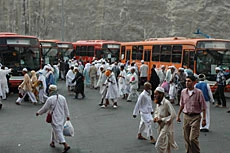
MAKKAH, 4 January 2006 — Most of the Indian pilgrims, especially the old and the infirm, find it tough to commute between their places of residence in Aziziah and the Holy Haram. This was made clear yesterday by the Hajis to a team of reporters when they visited Aziziah. It came as a rude shock to us that the pilgrims have to make two bus journeys before they reach the Haram.
Qamarunnissa Begum from Gujarat walked all the way from the Haram to cross the tunnel after Isha prayers and reached her room at 1 a.m. Tired and exhausted, she was “not in a position to go back to the Haram for Duhr prayers.”
Most of the women said they will prefer to stay in an old building near the Haram and appealed that next year the pilgrims should not be accommodated in Aziziah.
Many pilgrims offer prayers in their rooms due to the transportation problem.
Arif Qasmi and Ayesha Qasmi from Rampur, UP, complained about bus frequency and the time it takes to reach the Haram. They compalined that they are “unable to offer prayers in the Haram. It takes 40-50 minutes on an average to reach the Haram. The return journey is more exhausting and takes about an hour and a half.”
Rais Ahmad of UP was furious about the transportation arrangements. “I appeal to the authorities not to accommodate pilgrims in Aziziah next year and provide them accommodation near the Haram so that they utilize maximum time of their journey of a lifetime to pray at Haram.”
We went round several buildings and also visited the Indian dispensary in Aziziah. We talked to the Hajis to find out their problems. We found problems like broken cots and overcrowded rooms.
Almost all the pilgrims whom we talked to want to be shifted to buildings near the Haram after Haj so that they can offer all five prayers there. They said they are not interested in new buildings. They are here to pray in the Haram as much as possible.
Drinking water is not available in most of the buildings. Many pilgrims said they have to go out of the building to fetch drinking water.
Even a seasonal consulate staff member admitted that “30 to 40 percent of the buildings in Aziziah are having water problem.” Some of the buildings under construction are not safe for pilgrims with exposed live wire jutting out from walls. Some kitchens have no platforms for cooking and food is cooked on the floor causing a big fire hazard.
Pilgrims complained about the nonavailability of doctors and their unwillingness to go to a building in some cases to treat sick elderly pilgrims.
The Hajis complained that the medical staff insists to bring the sick pilgrims to the dispensary which is some time not possible due to the pilgrims’ age and physical condition.
Since pilgrims go to the Haram in the morning, they leave their belongings in rooms and nobody is there to take care and some of them lost their belongings.
In case of lost pilgrims nobody is there to guide them. Mohammad Osman, a missing pilgrim from Kannauj, UP, was helped by us to find his building. No consulate volunteer was available to help him. He had arrived overnight and lost all his belongings while doing Umrah.
Keralite pilgrims including Beevi, 65, her son Habib Rehman and others could not go to Haram after they reached Aziziah. They went there only once to perform Umrah. They are performing all prayers in their rooms.
Overall, it is a problem mainly of logistics in transportation. The best solution to this is not to put up pilgrims in Aziziah.