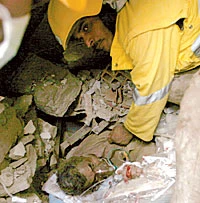
MAKKAH, 6 January 2006 — The news of the hotel collapse and the resulting death and injuries spread “at the speed of light”, as one Emirati official described it last night. News of the accident spread among the two million Haj pilgrims, as well as foreign Haj missions, as Saudi authorities continued to work on crowd control, rescue operations and cleanup.
Nervousness and tension could be felt among the pilgrims camped out at Makkah, as everyone was trying to find out the nationalities of the victims.
“I am very worried and my heart goes out to the relatives of the people who died in this tragedy,” said Rehana Anwar, a Bangladeshi pilgrim, who was weeping at the scene of the accident as earth-moving equipment continued to clear debris. “All the pilgrims are my brothers and sisters and if anything happens to any one of them I feel sorry and dejected. To me, those who died were one of us.”
Shah Jahan Khan, a Pakistani national who works in Riyadh and is currently in Makkah for Haj, said that the accident has caused nervousness among his relatives who came for the pilgrimage from Peshawar.
“To me the wailing of the sirens has a very unnerving effect,” said Khan. “I always dread this sound because it is always associated with death and destruction.”
As the news of the tragedy spread to Jeddah, residents there began streaming into the holy city to inquire about their near and dear ones.
“All of the roads are blocked or have additional checkpoints,” said Jeddah resident Jihad Al-Mubarak, from Alexandria, Egypt. “There was no way I could park anywhere near the Grand Mosque. I had to walk quite a distance to reach my relatives in the Gazza area.”
Al-Mubarak said he has received numerous calls from Egypt, friends and relatives inquiring about loved ones.
“They think I have all the information. The fact is that I have no idea about what is happening,” he said.
Many officials from foreign Haj missions are facing the same problem, fielding a constant stream of inquiries about the list of dead and injured.
The missions from India, Pakistan and other countries were busy making the rounds at local hospitals inquiring about the nationalities of the victims.
“It is very difficult in such circumstances to ascertain the nationalities of the victims because the local authorities do not allow anyone to interfere with their procedures,” said an Emirati official who wished to remain anonymous. “We will get to know the identities of the injured or killed only after the formalities are completed. But because news of the tragedy spread at the speed of light, we are getting constant calls from our capitals.”
The identities of the victims should be easy, as all pilgrims wear identity bracelets, however, because most of the victims were inside the hotel, they may have removed them temporarily. The dead may also be difficult to identify due to disfigurement from the collapse of the building.
During the confusion, many of the pilgrims chose the most obvious location of refuge and solace: The Grand Mosque itself.
“I think the Holy Mosque is the safest place on earth, and I don’t want to leave its confines until I am sure that everything is all right,” said Hana Ismail, a Palestinian pilgrim who sat with her husband in the Grand Mosque.
“My wife feels uncomfortable going out,” said her husband. “She wants to spend the night here. I tried to take her to our temporary residence in Makkah, in the Gazza district, but the moment she heard the wailing of sirens, she rushed back toward the mosque.”
But while the tragedy affected many pilgrims, people continued their preparations for the Haj, which begins with the trek to Mina on Saturday night or Sunday morning.
“Tragedies are part of Haj. It should not stop a Muslim from looking ahead,” said Ayman Karimi, an elderly Turkish pilgrim. “Those who died have attained martyrdom. God will accept their Haj, because it was their intention to perform Haj. And in Islam, intention is everything. We have to look ahead and prepare for the most important event in our lives.”
Javid Azim, an Indian national who works in Jeddah, also came rushing to Makkah to inquire about his brother who is performing Haj. “I know that the building collapsed in the Gazza area and that my brother is staying in a district far away from the affected place, but still I was nervous. I feared the worst. When I found him, I breathed a sigh of relief. I hugged him and I was very happy to see him in high spirits.”