
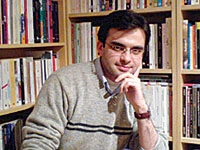
Palestinian poet Ehab Bsiso does not agree with the idea of immediate poetry. It took him three years in and out of Gaza to write about the transparent experience of being a Palestinian with the hope that his message would reach out to the world. In this interview Bsiso speaks to us about Palestinian poetry in general and his own poetry in particular.
You have a collection entitled “The Albatross of the Blurred Skyline,” It symbolizes trapped Palestinians, whether inside or outside Palestine. Why did you use an albatross?
The albatross is indeed the Palestinians, but not only Palestinians living under occupation; it also applies to Palestinians in camps, in exile and the ones who are refugees. All these people live within a very narrow space which makes me wonder if it is our fate to live in a very narrow space. Inside Palestine, the space is narrow because of fear, bullets, invasion, killing and isolation. Outside Palestine, the people live in a similar situation but for different reasons because they can see Palestine slipping away and they cannot return. Those people still hold the keys to their homes and they dream of returning one day — and that is a blurred skyline. When you look at refugees’ camps in Lebanon, Syria and Jordan, you feel how passionate these people are. They talk about Palestine as if they only left yesterday so the albatross in the skyline is the Palestinians, inside or outside.
In such a narrow space, how do you as a Palestinian see the future?
Pain is part of our lives as Palestinians; we are living in pain, but I don’t believe that we should live for the pain. It may be part of our lives but there is more to life than pain. We can live, grow up, fall in love, get married, go to the beach and, at the same time, feel the pain. If pain is life for us, then we will be destroyed. No need for a future, no need for optimism, why not just go and die?
One of the positive things that happened during my recent visit to Gaza was that I was invited to attend a play. It was a basic play performed before an appreciative audience. What was fascinating and thrilling was that we were in Gaza, sitting there watching a play and Israeli soldiers were less than 100 meters away from where we were.
This is exactly what I mean by living with pain but not letting pain dominate our lives. I can live with pain but I will not allow pain to control my life.
After more than five decades of Palestinian struggle, what is the role of Palestinian poetry in spreading Palestine’s message to the world?
Let’s first define the role of the poet — or any artist — within the framework of the Palestinian cause or within the framework of the Arab-Israeli conflict. I feel that a poet, or any other person who deals with artistic values, should essentially reflect reality in some way and to use creative thinking and the creative process in order to illuminate that reality.
Who is your target audience?
I don’t think it is right for a poet to target a certain audience or to say: “Well, I am going to write this poem for people living in the West.” The poet should target human values, assuming that human values are shared between people in the East and in the West. When we write about our stony land, when we write about our struggle, when we write about our right to exist, when we write about our memories, such subjects can be addressed equally to Arabs as well as non-Arabs. After nearly 60 years, I think generally that not only Palestinian poetry or literature but even Arab poetry and literature understands the concept of addressing human values and that makes the values universal.
Can you tell us more about the evolution of Palestinian poetry?
Obviously, looking at the past 58 years, there have been times when Palestinian poetry was used as a mouthpiece for the struggle itself. It used strong language in order to mobilize people and it was just beside the freedom fighters. In fact, many Palestinian poets were themselves once freedom fighters. One that I still remember is Abdul Raheem Mahmood, who was one of the famous poets and freedom fighters of the 1936 uprising; he was shot in 1958 a few minutes after writing a very patriotic poem. With Palestinian poets being freedom fighters, poetry used very strong language. Now, however, it is slowly shifting — probably because of so many political and social changes in addition to other factors not only in the region but in the world. We are starting to become poets who are more aware of the need to address human values rather than what we were aware of in the past.
What influence have political changes in the world — 9/11, the death of Arafat, the Israeli wall — had on language, settings and scenes in Palestinian poetry?
Obviously there has been plenty of discussion about changes and modification. First, however, let’s agree on something: That language never changes. What changes is the way it is used and the expressions used by novelists, things such as lifestyles and certainly social and political changes too. I don’t think we should put any extra pressure on poets because, after all, a poet is not a journalist. The faster the poem is produced, the poorer it is. I am not writing a report on the Palestinian-Israeli conflict or on the Arabs and Israelis in general. No, as a poet I am inspired by an event and I may not write about it until a year later. It exists in my mind until it suddenly goes on paper. There will surely be some kind of modifications in expressions, but we have to bear in mind that these do not have to be immediate and they do not have to be on behalf of — or limited to — my own culture. I have to grant creativity its right to exist, no matter how it goes. At the end of the day, I am not being judged as a poet from a political point of view but as a poet from an artistic point of view. And the people who will judge me are the ones who appreciate these values, whether or not they agree with them.
As a poet, do you feel that you are caught in the dilemma of having to justify violence on both sides to readers?
I do understand the suffering on their side and I feel sorry for those who are killed — the innocents, the women and children. At the same time, I want the Israelis to remember that those women and children were killed because of their government’s policies. As much as I want to express my sadness, I really wish people from the other side to courageously announce that they are really angry and sad about what is happening to the Palestinians.
Why did you write a poem entitled “Rachel”?
Rachel Corrie is my message to the West. She is the symbol of human unity and human values. When I think of Rachel, a 23-year-old American girl who left everything behind and came to Gaza, just to help... just to stop Israeli bulldozers from demolishing Palestinian homes; just to help Palestinians live for a better day tomorrow and then suddenly Rachel died under a bulldozer. For the reader of the poem, Rachel summarizes the entire message I want to send to the West. She is becoming now — and forever — a symbol of all those who want justice for the Palestinian cause.
There are other peace activists from around the world who are refused entry to Israel, who do not lose hope of achieving their goal of visiting and helping Palestinians — Rachel summarizes all of them. She reminds us of these things; she represents a conscience and that is why I wrote for her and about her. She deserves our respect because of what she did. She gave us hope and she did so by standing in front of a tank and a bulldozer. If people in the West could understand us as she did, I think we could achieve a great deal. Then again, an icon like Rachel deserves our respect and admiration and that is the reason I wrote in my poem that she had entered the memory of every Palestinian. Also, the poem is a tribute to Westerners who have lost their lives in Palestine and who have also entered the memory of every Palestinian — to mention only two: James Miller and the German doctor who was shot in Bethlehem plus of course the hundreds who have been injured by the Israeli army.
Can you tell us more about the dedication in your book?
I dedicated the entire work to the child martyrs; to the men and women who lost their lives because of the occupation; to those who did not have the time to say good-bye; to those who left suddenly but remain in the memory. I dedicated the book to those who gave their lives for their cause, believing that one day they would be able to go home. I wrote the book out of respect and loyalty for those people who will never be forgotten and who will live forever in our memories.
What inspires you to write?
Reality inspires me but I do not want my work to be a kind of camera. It is it shot with a director somehow behind. I do not deny that there have been scenes which I saw and took directly from reality. For example, one of my poems is about a seven year-old girl buried under rubble; she was found because of her braids which were seen by a man who was digging in the rubble. When he grabbed the hair, it did not move. He shifted the rubble a bit and saw the little girl’s head and then her body. This inspired me to write the poem called, “I Saw Her Braid.” In another poem, “Staring at Who Passes in Front of Me,” I wish that the person I see crossing the street in front of me will go home safely to kiss his child on the head and tell him or her a story. I hope he will not be killed today or tomorrow.
How about the other side?
I am not in a position to write about Israeli suffering because I belong to the Palestinian culture where I see my people die every day. In one of my poems — “To A Soldier” — I address an Israeli soldier and I initiated a discussion, calling on the Israeli soldier to think before invading, to remember, to recall the memories of the Holocaust and how his grandmother survived that terrible time. How she lived in the concentration camps in fear and cold, waiting for death, and how she survived and brought his mother with her to Palestine and how later, he was born here. I wanted to suggest that if the soldier — who was a baby a few years ago — had come here peacefully, we would probably all have come together because there would have been no political agenda in his head. But instead, he is here to deny my right to exist; he grew up to be a soldier, killing and causing fear and death. He negated my memories; hundreds of villages were demolished with hundreds of thousands killed. In 1948, 800,000 people fled Palestine because of Zionist gangs. I reminded him of his own suffering because if he remembered his people’s suffering, he would probably not play a part in causing suffering to others. At the same time, I told him that if he carried on, not only Palestinians would be hurt, but also his own country, his own family and his own children. Similar to Palestinian children, his kids also live with a distorted image, in fear because they are not allowed to live normally. How will he justify his killing? How will he look at his child and give him or her a good-night kiss if he killed a Palestinian child only a few hours ago? He is not only causing damage to us but he is also causing damage to himself and to his people.
I am not speaking out of weakness because if you tried to come and even invade these alleys, squares, villages and cities, they would not submit to the aggression. And they would fight to the last minute. So the poem was a call for the Israeli soldier to revise his present and recall his past. I believe that it will enable him to live in stability, and that it will also give substance to our freedom.
Who are the main characters in your poems?
The most dominant are Palestinian children. Generally, children stand for things beyond simple childhood. They symbolize innocence, along with the future. But that is not the case with the Palestinian child, and I experienced this myself when I visited Gaza three years ago. I saw horror and fear in children’s faces, how children suffer and shake when they hear the sound of Israeli Apache fighter jets, how the fear is engraved on their memories. It worries me how these children will live tomorrow and where tomorrow will take us. Just as we are losing martyrs in the Intifada, so are we losing the innocence of the children. Our children are growing up too fast; they are becoming aware too quickly of everything around them.
Why would you want a ten year-old boy to tell you the difference between MIS bullets and Kalashnikov bullets? Why should he know? Don’t Palestinian children deserve to live their childhood, to play football, to have normal lives?
What is happening is that they are engaged in the whole political scene and the occupation forces them to be engaged in it. A large number of those killed in the Intifada were children. How can I understand what happened on Oct. 5, 2004 when an Israeli soldier shot Iman Alhims with 20 bullets as she was going to school? And when one bullet would suffice, why 20? Twenty bullets into a child’s body? How can I understand the sufferings of Muhammed Aldurrah, Faris Oudah and other Palestinian children?
When I write about children or use children in my poetry, the message I am sending to every one is to understand that the suffering of Palestinians is epitomized in the children who are pointlessly killed every day. It is not epitomized in the number of funerals or how many people were buried. It is what is behind the deaths or funerals because I believe that suffering does not end here; it has only just begun. You see the dead man had a wife, children and a life which has been completely destroyed.
I know a child who refuses to go back to his home even after remodeling. He refuses because it is where he saw his brother killed by Israeli soldiers. It is where he saw his brother’s blood spread on the walls. The meaning of ‘home’ has been horribly changed for him; it now means fear, horror and the death of his brother.
Transforming the pain into poetry or literature or creative work is something which I have attempted. Now I am in the position of watching, thinking and taking notes for my next book.
The Confrontation
By Ehab Bsiso
-I-
When we uncovered our names
That were hidden, submerged
Under the waves
We realised there and then
That we have been here
Forever…for thousands of years
Forever more…
And that, long before Moses had discovered
The stick road,
Long before the sea was subjected
To God’s flogging…
We were here…
Clinging to Time which grows wheat
Near the hills of skies…
-II-
Whenever the invaders’ wind blew
We hurled at it oak, and wheat
And the sun that which sank in our veins…
Ever since the Earth was made…
-III-
When death mounted the helm
Of wind
We were here, counting stars
Keeping a clean sky in jars of olive oil
And a close approaching time of
Harvest…
We used to let our dreams stroll barefooted over the sea…
We were here
Waiting for the birth, the coming,
Of Butterflies
Over the hill tops…
-IV-
Those grannies of the Earth
On those downs and moors
Whose fingers are still weaving
sand bags
And knitting woollen jumpers
For a thousand summers and winters,
Their feet still know
The road to the spring among the rocks.
They still sing songs
For a lover who climbed the hills,
The hill tops
Towards a far away wedding.
-V-
We have not invented war
In order to reap
The harvest of our souls.
Yet we fenced sun fields
With our shadows
In order to guard
The dream orange in our blood.
-VI-
All those who were familiar
With the road to our hills
Via spears of death
Have fallen in the traps of the wind…
And we continued to populate
The Earth with songs.
-VII-
All those who tried to enter
Our language through holes of blood
And to our wheat through fences
Of thorns
And to our daylight
Through the roaring of bombs and rockets…
Have left behind them
None but the remains of a goddess
The mud of winter
And only ashes
-VIII-
Those invaders who feel
In our ink pots
Have left none but bleak shadows
Trodden by the hooves of ink.
-IX-
Whenever the invaders were invaded
By their own sleeplessness
Outside the doorsteps of night,
We mended the sky’s ceiling
With our songs
So that we might guard the poem’s dawn
Against the howling screams of owls.
-X-
Ink will never go dry in our blood
Because we know which well
Will quench the thirst of our fingers
Which cloud will store its rain
In our tales
And from which direction we shall repulse
The invaders with the poem…
Ehab's Profile
Ehab Bsiso is a Palestinian writer and poet born in Gaza. He has contributed widely to literary events and publications in the UK and Palestine. He is a teaching assistant at Cardiff School of Journalism, Media and Cultural Studies.
A collection of his poetry “The Albatross of the Blurred Skyline” was first published in Beirut and a second edition was recently published in Cairo.