
In late 1979, Hussein Alawi Shata went to the United States to study English. He was fascinated by the passion people had for their old cars. He attended events featuring the classic designs of the steel-and-chrome dream machines.
He began to appreciate the precious cars his family had back in Jeddah, and that’s when he decided to collect and take care of these treasures as he refers to them. Sadly, when he returned to the Kingdom, Shata found his treasure trove of old cars had been mistaken for junk by the municipality and hauled away into oblivion.
The tragedy, however, proved to be a short detour for him on the road to roadster restoration. He started searching out owners of classic cars and made the first of many purchases in 1985 when he bought a 1953, pistachio-colored Chrysler with V-8 power and an early automatic transmission. An added plus was that the car had once belonged to Sheikh Soroor Sabban, a well-known man who also was a friend of Shata’s father. “I took the seller’s word on it, though I could not get any official documents to prove that,” Shata said.
The second addition to his fledgling fleet was the venerable Volkswagen, and he picked a white 1973 model with a black leather interior. He tracked down this one time car of his uncle to a Filipino man who agreed to sell it to Shata.
Shata was missing a decade — the 1960s, so he started another classic quest, which resulted in the purchase of a 1961 Dodge Polara, definitely a model ahead of its time. In addition to a snazzy red interior, the futuristic Polara had power seats and a dash-mounted push-button automatic transmission. “It was a marvelous thing when you compare it with the other cars,” he marveled.
As his quest for classics continued, a kindred spirit in the States gave his a “must-have” list of cars in the late 1980s. Among these cars was what many car buffs consider the quintessential classic — the 1957 Chevy Bel Air. With its perfect fins and beefy performance, it’s still one of the most sought-after cars in the world today. Shata was blessed with a white 1957 Bel Air ragtop (convertible), which he graciously sold to his cousin who shared the same interest in collecting classic cars. Other cars he ordered at that time included a 1957 red and white two-tone Buick and two Gazelle replicas of the classic 1928 Mercedes-Benz.
Although Shata had sold the last two, he went back to the States afterward to look for other classics to purchase.
The Story of the Sweet Cadillac
In 1995, Shata received an invitation from a friend to attend an international auction for classic cars in Florida. Shata’s friend explained to him that these auctions were rare, and it was a great opportunity to meet motorheads from around the world and enjoy an exquisite array of sheet metal and chrome that some might not understand. Shata understood.
That’s where he met his 1941 Cadillac — and fell in love with what was to become the most expensive, the oldest and possibly the grandest addition to his hot-rod harem.
“This Cadillac was like something I never saw before as if it was the latest design of the year,” he waxed. “Even those who didn’t buy any car, they all kept cheering and congratulating those who did buy one,” he said.
Bidders from Japan and Germany, hot for the Caddy, sent the price higher and higher, but Shata prevailed. Saudi Arabia would have a new treasure.
The auctioneers introduced the victorious Shata to the cheering crowd of car buffs. He said he was proud to represent the Middle East. Then he received the Caddy’s pedigree, complete with certificates, trophies and official documents.
The adventure wasn’t over yet. Rolling down a Florida highway, the Caddy stalled. Mechanics were contacted and a tow truck dispatched. When the truck arrived, the awe-struck technician refused to lay a finger on the beautiful, black Cadillac. This required a specialist, he said.
Soon a classic car recovery team was on site to gently roll the ailing princess onto a suitable carriage — and off to intensive care.
“I really admired that technician and thanked him,” Shata said. “Although he came and offered his help by calling another company for me, he wouldn’t accept any money. He said that his job was to help — not to break or damage.”
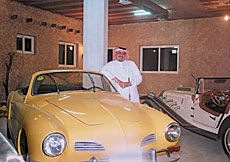
After getting a tour of his house, we were privileged to get a tour of the treasury — the garage — where the mother lode of Shata’s collection is stabled. Some of the cars are so special, they have their own names. He started by introducing the yellow Volkswagen Karman Ghia, which essentially is a sporty VW with a handmade body from the Karman Coachworks in Germany. The Ghia is named Alameed 1 or The Doyen 1, a nickname which is used to refer to Jeddah’s Al-Ittihad football team. Zooba was the other name he gave to one of his Gazelle 1928 Mercedes-Benz replicas.
Shata likes to take his beauties out for a spin, though he doesn’t do it often. He’s discovered that others share his love of classic cars, and he’s met many well-known businessmen and celebrities. He even found one of his Kuwaiti kinsmen was a car collector who has even more cars than he does.
Some say it costs a lot to have children; it doesn’t seem like quite so much when you consider what Shata pays for the care and feeding of his babies.
“It’s no wonder that these kinds of cars need special treatment,” he said. “They are truly expensive and cost me in a range from SR80,000 to SR200,000 depending on the model year and the car’s condition.”
To keep the classics in tiptop shape is a big chore. “It’s not just about cleaning or washing them from the inside and out,” Shata said. “I have to take good care to maintain them.”
Maintenance for three of his cars costs SR20,000 apiece. No. 4 required a new engine he found in Syria for another SR10,000. Some Jeddah stores stock parts for some of his fleet, but others require parts that must be ordered from the States.
Shata has reluctantly decided to sell some of his cars. It’s just too much to take care of, he says. He will sell off some models — provided the buyers look like they can provide a good home for his sheet-metal kids. But if you think the Doyen 1 Ghia or the 1956 Chevy Bel Air will ever be sold, you’re dreaming.
For Shata’s flesh-and-blood kids, the future is more secure. His son, Rannam, is the only person who is allowed to drive these cars; however, he only likes to drive the 1928 Benz replica.
“Probably because the model looks somehow filled with the spirit of youth,” Shata said.
There are cars that Hussein still longs to own, and he won’t hesitate if he finds a 1955 Ford like his father once owned, or, of course, a 1957 Chevy Bel Air. And he says given a choice between a new car or an old car, he’ll always take the old.
“Classic cars have a majesty,” he said. “Although they aren’t as comfortable, they’re stronger than the the new ones where most of the parts are made out of plastic or fiberglass.”
Someday, he may show off his collection in a gallery-style show, but he says that’s something that will probably wait until retirement. It’s been 36 years now since Shata was bitten by the classic car bug, and it seems like he’s made his mark among Saudi collectors.
List of Recent Cars Shata Owns:
1. 1953 Chrysler (Pistachio).
2. 1961 Dodge Polara (White).
3. 1955 Willys Jeep (Dark green).
4. 1958 Buick Century (Red and White two-tone).
5. 1956 Chevrolet Bel Air (Red and white two-tone).
6. 1955 Chevrolet Bel Air (Green).
7. 1985 Gazelle 1928 Mercedes copy (Brown and beige two-tone)
8. 1941 Cadillac (Black).
9. 1971 Volkswagen Karman Ghia (Yellow).
10. 1986 Maserati (White).
11. 1971 Ford Lincoln Mark IV (Red and white two-tone).
12. 1959 Cadillac Eldorado (Red and white two-tone).