
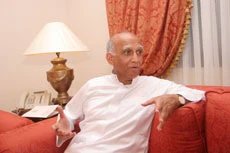
JEDDAH, 24 January 2006 — Seventy-two-year-old Dr. Ahmed Rashid Beebeejaun is the deputy prime minister of the island nation of Mauritius. Situated east of Madagascar in the warm waters of the Indian Ocean, Mauritius was very likely visited by early Arab traders. They did no more than visit the island, however, and it was then colonized first by the Dutch, then the French and finally the British. Mauritius gained its independence from Britain in 1968. Dr. Beebeejaun became the nation’s deputy prime minister after the Mauritius Labor Party, headed by Prime Minister Dr. Navin Ramgoolaam, won the elections in July 2005 on a platform of national unity. He was one of the leading consultant pediatricians in the Mauritius Health Service following medical studies in the UK. He was in Saudi Arabia as part of a high-level delegation that was invited by Custodian of the Two Holy Mosques King Abdullah for Haj 2006. In an exclusive interview while in Mina earlier this month, the astute politician and elderly statesman talked about the role of Mauritian Muslims in the nation’s democratic setup, the economic challenges his country faces and his government’s focus on remaining a top tourist destination. Excerpts from the interview:
Q: This is your first Haj. How has the experience been?
A: Yes, this was my first Haj. I have tried in the past to come here but like everything else, God decides. I couldn’t make it on two previous occasions. I am very grateful to Custodian of the Two Holy Mosques King Abdullah for extending an invitation to me and my delegation for this year’s pilgrimage. I am very happy to be here. I was touched by King Abdullah’s message at the reception that he hosted in Mina.
The message calling for unity, helping each other and focusing on dialogue was very appropriate. Saudi Arabia under King Abdullah has a great role to play. I have prayed in the streets, in mosques and in the middle of this vast sea of Muslims; I have never felt so close to God in my life. I went to Madinah as well and that was also a very spiritual experience.
Q: How many Mauritians were here for Haj this year?
A: Officially we had 2,000 Mauritian pilgrims this year. That is our quota. If it is increased, I am sure more will come. We have a population of 1.2 million and 17 percent is Muslim. They are practicing Muslims, very fervent. They follow Muslim traditions in letter and spirit. They are strong believers. With Saudi Arabia, we have had a long history of association.
Q: In the past we have had reports in the Arab media about discrimination against Muslims in Mauritius. Is that true?
A: No.
Q: The torture of Muslim activist Cehl Meah by Mauritian security forces was widely publicized. What about that?
A: Cehl Meah is another matter altogether. He was involved in activities that had nothing to do with Muslims.
Q: So Mauritian Muslims enjoy complete freedom?
A: They enjoy the same rights and privileges as every other citizen of the country. We are a multiracial, multiethnic, multireligious society. We live very well with each other. It is quite normal and to be expected that at certain times, one community complains about the another. I would like to stress that often we use the fact that we belong to a certain community to complain about whatever injustice we may think we are being subjected to. I wouldn’t take that very seriously. My appointment as the deputy prime minister in a country with 17 percent Muslim population has made history.
The elections were won on a platform of national unity. All the components of Mauritian society came together on this platform and then Muslims entered into the pact with great fervor. The results were quite impressive. We have had Muslim ministers in the past but we have never had a Muslim deputy prime minister. It is a constitutional post. It was there in the past and it was filled by others. Now, however, for the first time, a Muslim is occupying it.
Q: How do you see this achievement?
A: It is a sign of the political empowerment of Muslims. Certainly yes. But we should use this opportunity judiciously. We shouldn’t use it at the expense of others. It gives us more leverage to claim our own rights. I call it social justice. The fact that a Muslim has become the country’s deputy prime minister has been very well-received by the entire spectrum of society. It hasn’t been a subject of any controversy. Our platform has been national unity.
In Mauritius we have Hindus, Muslims, Christians. All play their roles. Muslims, as I told you earlier, played a very important role in the last elections and are very supportive of the current government.
Q: Mauritian Muslims are generally liberal. Is that right?
A: It is a small country and everyone knows everyone. Whatever excesses there are, are contained in a very positive way. There is a lot of social interaction. We have different opinions and different schools as in every other country. But in a small country such as Mauritius, this diversity of approach within the Ummah is very interesting. It doesn’t lead to any sort of clash. By and large Mauritian Muslims are liberals.
Q: What system is in place for Mauritian Muslims coming for Haj?
A: The government has set up what we call the Islamic Cultural Center (ICC). It has given the ICC permission to organize Haj, along with other things cultural. There has been some diversity of opinion whether a cultural center should organize a religious event but it hasn’t led to any controversy whatsoever. The ICC has its own board and it is independent of the government though we have government appointees on the board. It works well. We make it a point that the chairman of the ICC is in constant contact with the Saudi authority for Haj affairs.
Q: Does the Mauritian government provide any subsidy to pilgrims or concessions in air fare like some countries in the Indian Subcontinent do?
A: The short answer is no. There are Muslim organizations based in Saudi Arabia who invite a certain number at their own expense but that has nothing to do with the government. It is purely an organization to organization matter. The major complaint that we face from pilgrims is that of the air fare. They say it is too expensive.
Q: What are the economic challenges currently facing Mauritius?
A: Our economy is facing a changing world scenario. Sugar is our major export, followed by textiles. We depend a lot on sugar but the European Union to which we export our sugar has decided recently that it is going to lower the prices by 37 percent over four to five years. Suddenly we will be short of more than a third of our income from sugar. We export a lot of textiles. Again the tariff problem is going to crop up. We enjoyed a privileged tariff. Soon all these are going to go because of World Trade Organization (WTO) regulations. We have to face these two challenges.
We have faced difficult situations before. The average Mauritian is known to be very resilient. We are in the process of building our tourist industry. It is a thriving industry and attractive as well. Just for the record, we are a peaceful place and there has been no, and I repeat, no incidents whatsoever regarding tourists, no banditry, vandalism etc. Mauritius is a safe haven for tourists. Also, we are outside the tsunami zone and we hope a tsunami will not happen again for thousands of years. We are trying to build our tourist infrastructure by inviting foreign businessmen to invest in residential schemes. They can buy expensive villas for a certain amount — say $500,000 — and they get the residency rights.
Q: Is there any serious effort to popularize your country among Saudis?
A: We are very interested in establishing good relations with Middle Eastern countries, especially Saudi Arabia and the United Arab Emirates. We would be happy to welcome any investment or anyone from Saudi Arabia who would like to come. We are working on improving relations with the Middle East by setting up more embassies in the region. We have no embassy in Saudi Arabia. We have one in Cairo with jurisdiction over Saudi Arabia. My appeal to Saudi businessmen and the Saudi people is: There is no point in talking about something you have not seen. Come and see for yourself. As to safety, there is no problem whatsoever.
Q: What is your message to the people of Mauritius working in the Gulf in general and Saudi Arabia in particular?
A: Take what is best from this country from the educational point of view. Many Mauritians come here for Arabic studies and to study the Qur’an. Get the best teachers, go to the best universities and come back and be a model to others.