
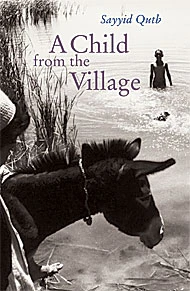
A Child from the Village,” the interesting autobiography of Sayyid Qutb, has been recently translated into English by the American University in Cairo Press. It was originally published in Arabic in 1946 at a time when the author had not yet used his Islamic beliefs in support of his political and social ideas. The book depicts in a touching yet realistic manner life in a typical Egyptian village in the early decades of the twentieth century.
The author insists that he has not embellished the tales of life in his village: “I have done no more than transfer them from the ledger of my memory to the page of my notebook…I have provided a kind of literary museum in which pages of our national life and modern history are preserved.”
Although the content of this autobiography is in stark contrast to Sayyid Qutb’s later works, it does show his deep concern for social justice. In one of the last chapters entitled “Sorrows of the Countryside,” he describes a grim life, filled with miseries, and burdening both men and women: “The bitter miseries of poverty following wealth, the painful miseries of poverty inherited from previous generations, and the miseries of death and its ceremonies… When the men are in the fields they can forget. The bright sunlight fills their souls and brightens them, and the sprouting of seeds in black earth causes dim hopes to grow in their souls, even though in their profound simplicity they cannot fully perceive them. But the women, who generally do not leave the houses, have nothing to make them forget their sorrows. The houses are dark and their rooms are gloomy, especially when night falls and the houses are lit only by those dim, small kerosene lamps, so that people’s shadows dance like specters upon walls, and a gloomy feeling of distress and sorrow settles over the house and those in it.”
Interestingly enough, throughout the book, the author constantly refers to himself in the third person. In a remarkable introduction, the translators, John Calvert and William Sheppard explain this as a deliberate effort by Qutb “to allow the reader easily to distinguish between the author’s adult worldview and that of his child protagonist; he presents his material in a series of episodes, which despite their anecdotal nature, are highly developed and thematic in character. Taken together, these vignettes document what Qutb perceived to be his ‘awakening’ from the unreflective slumber of customary rural life to a new kind of existence”.
In 1948, two years after the publication of his autobiography, Qutb wrote “Social Justice in Islam.” By 1954, the book had gone through four editions and he had written “Islam and World Peace” and “Islam’s Battle with Capitalism.” He had also begun his commentary on the Qur’an, “In the Shade of the Qur’an,” which he continued working on for the rest of his life.
After an attempt on the life of Abdul Nasser in October 1954, the government banned the Muslim Brothers. As one of its leading members, Qutb was imprisoned, released briefly in 1964 and arrested again, a few months later. He was eventually convicted and executed on Aug. 29, 1966.
Despite the success of his later writings, Qutb’s earlier works are still read. A collection of his poems was published in Egypt in 1989. It is interesting that Qutb dedicated his autobiography to Taha Hussein. As Calvert and Sheppard clearly point out, Taha Hussein’s autobiography “Al-Ayyam” encouraged several writers to recount their childhood memories, “however, despite this similarity between the two books, the purpose of the two authors is somewhat different. Whereas Taha Hussein was led by his experiences to embrace the civilization of the West, Sayyid Qutb’s response was to seek a modernized and reformed version of the Egyptian national community, which throughout his career as a writer, he identified with Eastern, Muslim civilization.”