
In Negril, the skies open every day in the late afternoon. Residents say the rain is so punctual, they can tell the time by its arrival. Unlike the unwelcome wintry sludge that dulls the streets of London, this is a refreshing, clear rush of water that takes off the edge of the heat.
We would watch from the cliff’s edge as the wall of water approached us slowly, making its way over the ocean. Moments later we’d be drenched. We’d chuckle when someone from the hotel rushed over with an umbrella, shaking our heads at the bemused bell boy. It felt exhilarating. An experience from another time, years ago, when the rain coaxed us out of classes. We’d hop to the tapping rhythm of the rain, our feet soaking in the muddy water collecting in the tiling of the school courtyard while the teachers watched, helpless.
The first time we felt the force of the rain showers was when we landed in Jamaica in May which is off-season. We rented a jeep, and drove off to find our hotel without a map: We knew it was west of the airport, somewhere on the coast. When the rain began, we pulled over to watch in stunned silence. It was monsoon-like in its intensity but before we had time to relax and enjoy it, it stopped. Somewhere in my head a man was crooning: “I can see clearly now, the rain has gone…It’s gonna be a bright, bright sun-shiney day.” We continued along the road by the sea, until we were able to stare out at the sea from the comfort of a small cottage on a cliff in a relatively secluded part of Negril.
The Rockhouse is an “irie likkle place” which translates from Jamaican patois as “a very cool little place.” There was a time when the colonial masters frowned at this ‘corruption’ of the English language but today, the Jamaican patois is a recognized creole language.
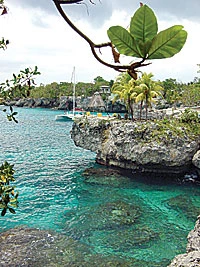
A charming woman with a lilting accent shows us around the boutique hotel. The cottages are made entirely of dark wood and huge panels of glass, and furnished sparsely with four-poster beds and mosquito netting. The little cabins were spread over the rocky outcrops of a single cliff that jutted into the sea and separated so skillfully by foliage that you’d think you are all alone. The infinity pool is perfectly positioned to allow an unobstructed view of the sun surrendering itself to the sea as the sky blushes bright peachy pink. Guide books say Rick’s Café, where the Rolling Stones hung out in the sixties, is the place to watch spectacular sunsets. Unless you like being around pot-bellied Americans making a pilgrimage to the place their holy tour book touts, it is not your scene.
After the first day and a half of decadence at the hotel, we developed a conscience, and ventured outside to find a local joint to eat int. With that mission, we set off into the heart of white privilege in a society still suffering from a colonial legacy. Nothing is black-Jamaican owned and run. White Jamaicans own what foreigners do not. The Rockhouse Hotel is owned by Australians. A Scottish couple operated a brunch spot we stopped at. A British team owned a set of resorts we looked at. Americans have bought chunks of the coastline for development. We gazed at the purple-blue mountains in the distance and consoled ourselves with the thought that Jamaicans must make a killing off their coffee crop — the finest in the world. There is a lot of money being made from their coffee but it’s not going to the Jamaicans. About 90 per cent of Jamaican Blue Mountain Coffee is exported — green — to Japan, where it is blended with inferior beans and sold for a massive profit as the Blue Mountain brand.
The cost to the Jamaicans? The cash value of a rare bean along with the long-term cost of degrading the integrity of their local brand. Foreign white-faced men are still suffocating the economy, but this time they are not alone. The Jamaicans are complicit in their own exploitation. They are a sovereign nation. They can resist foreign money or insist on a caveat that ensures that profits are plowed back into the community.
We returned to our tiny octagonal wooden cottage by the sea to stare at the stunning shades of asure and green water, and forgot about our socio-economic musings for the moment. We followed several steps down the cliff as it slides into the sea below.
We took tentative little steps until the salt water was licking at our toes, rising over our legs, lapping at our torso, closing in over our shoulders until we were floating, suspended in the jewel blue of the Caribbean Sea. Grab snorkeling equipment from pool-side, and watch the little fish watching you. If you prefer the safe confines of the resort, you can gaze out a the sea from the infinity pool that feels as if continues straight into the sea. Look down and you might catch a crab or two staring curiously at you from the dark rocks that the waves wash over below the pool.
To explore the island, head inland, past farming communities. You could do it as we did — armed with no more than our barefoot bravado — or you could get a little organized. We managed, amid confused laughter, muddled directions and wrong turns that took us past delightful little pink, green and yellow structures that turned out to be Jamaican houses or tiny hair saloons or barbeque shacks. It felt so liberating to drive down the coast with no specific destination. Freed from our schedules, we shed the last vestiges of our world and left the map in the hands of a roadside shack owner so we could explore at our leisure.
If you like your adventures to unfold in a slightly more methodical fashion, get someone at the hotel to give you specific marks to look out for enroute because roads just aren’t signposted. If you don’t mind roughing it, make your way to Mayfield Falls and Mineral Springs. This hike will have you wading through knee-deep water, scrambling up waterfalls, the force of which you will have to fight as you wedge your foot into crevices, and holding your breath for a minute while you pull yourself up through the gush of mineral spring water. There will be calm stretches where you wade through gentle rapids, and stop for a minute to admire the light filtering through the thick jungle canopy above. There are no fences here, no ropes, no human imposition on the natural landscape, just a guide who knows the terrain so well he could dance through it with his eyes closed. The thrill of hiking through the falls — the guide disappearing as we stopped to sit at fairy-like grottos, trailing our toes in the water — remains etched into our memories of Jamaica.