
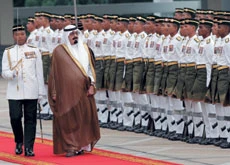
KUALA LUMPUR, 31 January 2006 — Custodian of the Two Holy Mosques King Abdullah arrived here yesterday to a rousing welcome. His talks with Prime Minister Abdullah Badawi will focus on rising oil prices, increasing trade exchange and major issues of the Islamic world, informed sources said.
Abdullah, the first Saudi king to visit Malaysia in 36 years, was welcomed at Kuala Lumpur International Airport by Badawi, Foreign Minister Syed Hamid Albar and other top officials. He was then driven to the Parliament building where Malaysian King Tuanku Syed Sirajuddin accorded him a red-carpet welcome. A 21-gun salute was fired as King Abdullah inspected a guard of honor.
Saudi officials accompanying the king told Arab News that the two countries would sign agreements worth SR4 billion including one for a SR1 billion real estate project during the two-day visit. A medical college will be established in Madinah under one agreement, they added.
“Both leaders are free to discuss political issues related to the Muslim world. I’m sure they will touch on the subject (of rising oil prices),” Albar said on summit talks today.
Albar said whenever oil prices rise, it hurts non-oil producing countries. “I think it does all the time,” he said. “Iran is a big producer. If it decides to cut production, it will affect the stability of oil prices.”
Oil prices rose sharply above $68 a barrel in Asian trade yesterday as Iran stirred turmoil on the eve of an OPEC meeting by calling for a cut in production levels, dealers said.
Albar said the issue of Iran and its disputed nuclear program should be resolved through negotiations. “It should be within the domain of the International Atomic Energy Agency,” he said, adding that, “the last thing that should happen is to bring it up to the (UN) Security Council.”
King Abdullah attended a state banquet hosted by the Malaysian king at the national palace.
He is expected to speak to corporate leaders today at a lunch organized by the Malaysian-Saudi Business Council.
The Saudi-Malaysia summit comes at a time when Muslim nations increasingly find themselves grappling with problems of poverty, unemployment, economic instability and violence.
Ties between Riyadh and Kuala Lumpur have never been better. The Malaysian prime minister has visited Saudi Arabia at least three times since taking office late in 2003.
“I see there are a lot of similarities in the thinking, especially in the approaches toward developing Islam’s image by being open and competitive,” said Zainuddin Maidin, Malaysia’s deputy information minister, who was in Saudi Arabia recently.
As Muslims across the world seek answers on how to reshape Islam to fight terrorism, preach tolerance and moderation and gain respect, Badawi offered a ready solution. He calls it Islam Hadhari, or “civilizational” Islam.
“We in Malaysia would like to show by example that a Muslim country can be modern, democratic, tolerant and economically competitive,” Badawi said during the OIC summit in Makkah in December. “Islam does not enjoin us to turn our backs on the rest of the world.”
“Malaysia’s importance stems from the fact that the entire Muslim world views it as a successful model of a modern Islamic state,” said Abdulaziz Sager, chairman of the Gulf Research Center, based in Dubai.
“As the leader of the Islamic world that houses the holiest mosques, Saudi Arabia is grappling with the process of internalizing the virtues of moderation and modernization under the leadership of King Abdullah,” Sages said in an article published Sunday.
“Drawing from the reservoir of Malaysia’s experience could not only prove beneficial to Saudi Arabia, but also chart a peaceful, progressive and prosperous road map to the entire Islamic world,” he wrote.
Last year, bilateral trade amounted to about $1.8 billion. Malaysia’s major exports to Saudi Arabia include palm oil, furniture, television sets, jewelry and plywood, while imports are mainly petroleum and petroleum products.
Malaysia, whose Muslims make up just over half its population of 26 million, is a magnet for Arab tourists. This year alone, more than 200,000 Arabs visited Malaysia, up from just 50,000 a year before Sept. 11, 2001.
The visit is part of the king’s first tour outside the Middle East since assuming power in August after the death of King Fahd. He is accompanied by a delegation comprising 11 ministers, 13 members of the royal family, senior government officials and a large number of businessmen.
The king has already visited China and India. He leaves Malaysia tomorrow for Pakistan on the final leg of his tour.
A Foreign Office spokesperson in Islamabad said the king would hold “in-depth” talks on bilateral, regional and international issues with President Gen. Pervez Musharraf.
Abdullah’s sojourn to Pakistan is the first by any Saudi monarch in nearly three decades. King Khaled visited Pakistan in 1976. Abdullah visited Pakistan while he was crown prince.
Foreign Office spokesperson Tasneem Aslam said the emerging security scenario in the Middle East in the wake of recent Palestinian elections and Iran’s controversial nuclear program would figure in talks.
“The visit of the Saudi king is taking place at a critical time in the region and his talks with Musharraf will thus be of particular importance,” she added.
A number of bilateral cooperation agreements are expected to be signed during the royal visit. Saudi Arabia is Pakistan’s largest oil supplier, and trade between the two countries stood at $2.8 billion in 2004-05. The Kingdom plays host to more than one million Pakistani expatriates.

