
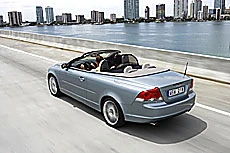
DUBAI, 5 February 2006 — Volvo’s eagerly awaited new convertible C70 was launched last week in Dubai. The launch was attended by motoring journalists from many countries who became among the first in the world to road test the new car.
The all new second generation C70 made its appearance at the Frankfurt Motor Show and is due to be in dealer’s showrooms in the first half of 2006.
“It takes a generation to become an established player in the premium segment for open cars,” said Volvo Car Corporation President Fredrik Arp. “Having built up a considerable body of knowledge and consolidating our credibility even further, we expect to double sales compared with the first generation’s best year,” The sales target for the new model is 16,000 cars per year, double the number of the preceding C70.
The full four-seat convertible addresses several market segments. A convertible coupe rather than a “soft top,” the car has a three section retractable steel roof that folds into the trunk. Operated by a push button, the whole operation takes 30 seconds. It was designed and developed not as a gadget but with a particular market segment in mind.
It will, hopes Arp, make the car both convertible and saloon and will appeal to customers who would otherwise have to choose one or the other. Aiming at the premium segment of the market, the car is expected to attract purchasers who face the choice between convertible and saloon. “Here they have both cars in one. The touch of a button transforms an elegant convertible into an equally elegant coupe,” said Arp.
A joint venture with Pinnafarina, the car will be built in the Volvo plant at Udevalla in Sweden, now known as Pininfarina Sverige AB, making it the first Pinafarina design to be built outside Italy and the first joint venture by the design company with a car manufacturer.
The new C70 is slightly shorter and lower than its predecessor but keeps the width. In combination with the slightly shorter nose section, this gives the car a powerful profile and keeps the characteristic rounded corners that have become modern Volvo style.
The Dubai launch included a full day’s road test drive. Over a 400 km run, which included fast highway and some tortuous mountain roads, motoring journalists were impressed. Not a designed as a sports car, the coupe demonstrated its fleetness and good road manners even when pushed and yielded a lively driving experience with comfort.
It shares its basic technology with other Volvo models, including front-wheel drive and an extremely stable, compliant chassis. It has MacPherson front suspension and a Multilink rear axle. Together with Dynamic Stability and Traction Control System which is fitted as standard the vehicle gives extra stability when driving on a slippery road surface.
Safety has long been a central concern in Volvo’s design and build. The convertible by virtue of the removable roof offers more challenges. Many innovative materials and design features which redirect the impact away from drivers and passengers during a collision during were developed and built into the car.
The succession of smoother and more adventurous designs developed during the late 1980’s and 1990s’s have radically changed the somewhat staid and utilitarian image of the “safe saloon and estate car” producer.
Coupling traditional build quality and safety with innovative styling has developed a new generation of younger premium customers and reinforced brand loyalty.