
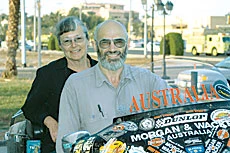
Celebrity status wasn’t quite what Australians Peter and Kay Forwood had in mind when they entered Saudi Arabia on their Harley-Davidson Electra Glide classic motor bike in January. Nonetheless, this is more or less how the low-key intrepid bikers have been received here. As perhaps the first tourists to ride across Saudi Arabia on a motor bike, they were something of a novelty and news of their arrival in the Kingdom caused quite a hubbub. (As the Arabic word for motor bike is “dabbab,” this rhyming English word seemed appropriate!)
They have so far visited some 131 countries since they first ventured out of their home country in 1996. In the introduction to their website (www.horizonsunlimited.com/forwood), they claim that their “main emphasis is travel to unusual destinations” and this was their second attempt to visit Saudi Arabia. After a three week stay at the end of last year in Kuwait — the longest they have spent in any one place since 1996 — they almost gave up. They moved on to Bahrain where finally their patience was rewarded and they were granted a multiple-entry visa for three months.
Peter and Kay belong to the baby-boomer generation who grew up in the legendary 1960’s. They see looming retirement not as a time to nest down and wait for the grandchildren to visit, but as a time when they are free of the responsibilities of looking after their own children and now have the freedom — and money — to travel at leisure. This engaging and fit-looking couple met at university in Canberra and although the passing years have left their physical mark (Kay’s long hair is now gray, and the only hair on tall, lean Peter’s head is his grey beard), they have retained an enthusiastic and youthful outlook on life. Although Peter does all the driving now, Kay owned her own motor bike in the past and riding motor bikes is something they have both enjoyed since they were young.
Their worldwide trip grew out of a joking remark they made during their first trip that they wanted to keep riding until the Harley-Davidson centenary celebrations in 2003. They thought it would be fun to arrive at the Milwaukee event having ridden the furthest to get there. The joke became a reality and they continued to ride beyond 2003. Kay sometimes takes a break to stay home in Australia but has nonetheless ridden with Peter for 350,000 of his total 450,000 kms.
They consider their biking a “lifestyle” rather than a journey and don’t mind living minimalist. They each carry two sets of clothes, 5 sets of underwear and socks, one pair of boots, a pair of flip-flops, a down jacket, wet weather gear, a sleeping bag and a mattress. They also carry a tent and a box containing a mini-kitchen. They are completely self-contained and frequently camp instead of sleeping in hotels. There isn’t space to carry water on the bike, so they are also rugged enough not to mind skipping their daily showers from time to time. I asked Kay if she missed any of her home comforts and had any luxury item with her. “Good shampoo and conditioner! Otherwise, not really. I find that when I am home I wear the same clothes that I have used when we are traveling. I just have more tops to choose from!” I asked Peter about his luxury item and without hesitation he replied: “Kay.”
Kay is an active team member when it comes to the cleaning and maintenance of the bike. They have a lap top computer carrying the full Harley-Davidson maintenance manual and, generally, Peter carries out the work according to instructions that Kay reads out from the desired page. They also use the computer to update their website regularly and, as an information source, it contains the full Encyclopaedia Brittanica. Lastly, a digital camera, and a satellite radio keeps them up to date on world affairs.
The hotels they stay in are generally small, local ones that are very cheap. “That is where you meet people,” Peter explains, “You don’t meet people when you stay in five star hotels.” They have ventured into remote parts of the Kingdom, staying and eating in the travel motels and restaurants at Sasco petrol stations, normally the preserve of truck drivers. Their rooms at Suqur and Hanakia cost a modest SR50 per night. They also travel without a mobile phone. Kay commented that Saudis seem to be “mobile phone crazy” and use them frequently to confirm and reconfirm pre-arranged appointments. “In the past, you would make a date, write it down, and that was it.” They do, however, try to visit internet cafes once a week to communicate with their three children, all now adults.
The longest, continuous journey they have made so far, without taking a few weeks off at home in Australia, has been 14 months. They leave their bike in the last country visited and keep any plans to a minimum. “Most people over plan,” comments Peter. They prefer to be observers, maintaining a “wait and see what occurs” attitude. The main aspect of this minimalist planning is the weather. They like to keep warm and dry. “We follow the sun,” says Kay. “We have met people traveling in Africa who have complained about all the rain they have come across. If they had planned their journey wisely, they could have avoided that.” The only dates they stick to are visa entry and expiry dates, and any ships or transport they might have to catch to move on to another country.
They like to travel slowly; “We stop to take photos; we eat in little roadside places, look into funny little shops, look at camels, anything we find along the way,” says Peter. As an example, it took them 7 hours to ride from Dammam to Riyadh. They also like to take routes that are off the beaten track and instead of riding
directly from Riyadh to Jeddah, they traveled northwards via Unaizah, Buraidah and Madinah. As a result, they had the unusual experience of a desert dinner, with music, given in their honor, by the Governor of the Qassim area. Included on the menu, in addition to the usual mutton, was baby camel. “It was really delicious,” Kay told me.
Although they prefer to ride alone and as independently as possible, they have had company on most of their journeys through the Kingdom, including a police escort most of the time. “The policeman who took us around Madinah spoke very good English and was charming,” said Kay. “And he let us take a photograph of the sign that says Madinah is for Muslims only — he was amused that we wanted to do that,” added Peter. The policeman was also very accommodating when they explained that they wanted to take the old road down the mountains from Madinah to Badr, a journey which they said was the best one they have done in Saudi Arabia. Again, they were welcomed by local residents and received warm hospitality there.
Their overall impression of their three week tour in Saudi Arabia is that it is the most hospitable country that they have been through. Everywhere they have been, people have insisted on paying for everything, from food to hotel rooms. “We haven’t had to pay for anything at all! We have also been invited into people’s houses,” Peter told me. “The hospitality we have received here is most unusual,” added Kay. As they like to respect the customs of countries they travel through, Kay has also worn an abaya throughout the time she has been here — even when riding on the motor bike.
The next part of their trip is to Sudan — by boat from Jeddah and then they will drive south to be in Eritrea by 16th February. I asked if they had any advice to offer would-be long distance travelers. “Think of it as a lifestyle, not as traveling. It is important to check the visa situation of countries you want to visit. Also, plan your journey according to the weather. If you do that, you should have good weather more or less wherever you go.”