
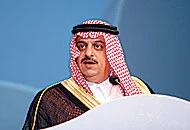
JEDDAH, 12 February 2006 — The Seventh Annual Jeddah Economic Forum (JEF) began yesterday with delegates acknowledging a wide variety of national cultures while admitting certain common grounds as building blocks for sustainable economic growth. With the global village a reality, pressures are increasing for preserving cultural identity and respecting the beliefs and values of all without a “one size fits all” approach. Unlike previous forums, this year there is particular focus on cultural and social issues in the light of economic and political strategies.
Following the opening remarks by the chairman of the JEF, Amr Enany, who pointed to this need for balancing globalization with local identity, the Saudi minister of culture and information, Iyad Madani, presented “Saudi Arabia-Vision 2020.”
He went through a historical account of Saudi Arabia’s political, economic and technological development and how they had shaped its identity and place in the world. He talked about some of the challenges facing the world — and Saudi Arabia — such as poverty unemployment and the need for dialogue and transparency. He called upon Saudi officials, the Saudi private sector and regional and international partners to share in the vision and the processes that will deliver it.
An interesting session followed with the Saudi woman diplomat, Thoraya Obaid, undersecretary general at the United Nations. According to her, with the challenge of locating itself in a rapidly changing global environment where there is confrontation between global values regarding human rights and local values and traditions, Saudi Arabia faces three main challenges. The first challenge is the youth, male and female, who will continue to increase and therefore create a need for more while also providing necessary services for the society. The global economy requires expansion but that does not mean that our youth should blindly adopt foreign ways. To enable them to meet the challenge, Obaid recommends that we give the youth their social, economic and cultural rights as well as the civil and political rights to express themselves and be part of the country’s development.
The second challenge facing Saudi Arabia is globalization which is a two-edged sword. She presents a scientific and flexible approach for dealing with the reality of diversity and being tolerant and accepting of others. The third challenge is again globalization but this time with human rights. The real issue is the frustration within a society which requires management for social justice by eliminating poverty, protecting the weak, supporting women and youth and protecting the rights of citizens. For all this to happen and for Saudi Arabia to achieve its vision for 2020, Obaid finds a need for an atmosphere that allows open dialogue between members of society at all levels and between people and the government.
Former German chancellor, Gerhrad Schroeder, also spoke about recognizing diversity in the globalized world. He said that politicians were called upon to convince their people of the great opportunities generated by global business activity and world trade while also protecting national identity and cultural diversity. He also expressed the need to respect religious beliefs and shared with the Muslims dismay at the offensive cartoons. He also called for finding a political solution to the Middle East problem, praising Saudi Arabia’s peace initiative. Schroeder said we had to accept Hamas’s right to exist, that it should stop the violence and a stable democratic society should be supported. As for Iraq, he said what was needed was development of Iraq to help the Iraqis. Regarding Iran, he said it had the right to use nuclear power but not to build nuclear weapons; he called for continuing negotiations. He objected to the claims of a clash of civilizations and instead called for a focus on the common grounds between cultures to live in peace and justice.
Another session that generated a great deal of interest and excitement was the news of the King Abdullah Economic City (KAEC). It came from the governor of Saudi Arabian General Investment Authority, Amr Al-Dabbagh, and the director general of the department of economic development at the government of Dubai and the chairman of Emaar Properties who are the developers of The Economic City, Mohammed Alabbar. Five principal motivations are behind the decision to launch KAEC, according to Al-Dabbagh. The first is the concept of regional development, which means to shift migration away from the three population centers of Riyadh, Dammam and Jeddah by creating a whole new city. Another criterion comes from examining the competition and using existing and successful models as a guide. Another motivating factor is the correlation between special economic zones and investment inflow. SAGIA also wants to provide an obstacle-free city and facilitate everything as much as possible. Furthermore, according to Al-Dabbagh, investors use three criteria when deciding upon an investment location: economic feasibility, location feasibility and quality of life. “KAEC offers all three. The integrated package means everything is within 30 kilometers, and the location means easy access to international markets even beyond the region’s 250 million people. As for quality of life, we mean service. KAEC will be world-class in every area — education, healthcare, housing and recreation. We’re talking about a way of life which provides the best for the Kingdom’s citizens,” said Al-Dabbagh.