
JEDDAH, 13 February 2006 — “Assalam-o-Alaikum Wa-Rahmatullahi Wa-Barakatuhu.” The highlight of Day 2 at the Jeddah Economic Forum (JEF) was the stirring speech by articulate and soft-spoken Irish President Mary McAleese. She got a rousing round of applause for opening her address with a prayer in Arabic. “Peace be upon you and the mercy and blessings of Allah.” After applauding, the audience responded, “Waalaikum Assalam.”
Responding to a question about the role of women in business, she drew more applause when she said: “The Prophet’s first wife was herself a very successful businesswoman.”
McAleese was obviously referring to Khadija, the Prophet Muhammad’s first wife who was an important merchant in those times. Saudi and Muslim businesswomen throughout the world see Khadija as a role model.
McAleese said women were contributing immensely to the Irish economy. “Let me put it this way: We are flying on two wings instead of one in the past. Women have come a long way in Ireland. They are now well-represented in politics, in business, in academics. There was a time when women had to give up jobs to get married. That is what society expected them to do at that time. That is no longer the case.”
McAleese noted that perceptions have changed since 1969 when she was a student of law. At that time, few women entered the field, she said now there were many women lawyers in Ireland.
To drive another point home, she recalled how her grandmother refused to get electricity. “‘That will entail more bills,’ she would say. So she preferred to have candles rather than electricity.”
Her anecdote reminded many in the audience of an era in Saudi Arabia when anything new was resisted — but for an entirely different reason. Telephones were once resisted because they were seen as the devil’s work.
A lot of what McAleese said touched a common chord with the Saudis. “When we joined the European Union, we were the poorest country. We were always worried about losing our unique identity. Now we no longer feel threatened. We are confident and our economy is thriving,” McAleese said. Some economists have looked to Ireland and its conservative past as a possible model for Saudi Arabia, and much of what McAleese said applied to the Kingdom.
There was one more round of applause for McAleese when she concluded her speech by saying: “Shukran Jazilan.” Thank you indeed.
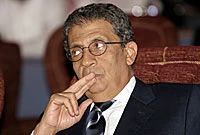
Amr Moussa, the secretary-general of the Arab League, also was a hit with the audience. When session moderator Ali Hussein Alireza described himself as a politically frustrated Arab, Moussa said he too counted himself in that number.
When somebody asked him a question in English, he apologized and said “Let me answer you in English.” The hall reverberated with thunderous applause.
His statement, “Resistance should not be confused with terrorism,” referring to the Palestinians’ right to resist the Israeli occupation garnered another round of clapping.
“If anti-Semitism is a crime, then anti-Islamism should be a crime, too. No double standard, please,” he said.
Some reporters were seen being nudged by their editors — “Good quote. Put that in a headline!”
A pattern is emerging in the questions emanating from the women’s section. They invariably ask about the role of women in the speaker’s country and then urge him/her to draw inferences for them. Amr Moussa was asked questions from women along similar lines.
“I have appointed a woman as assistant secretary-general at the Arab League,” he said. “And almost 40 percent of the staff at the Arab League is women.”
One regular American visitor to Saudi Arabia had a different perception.
“There is a misconception in the West that Saudi women are the oppressed lot. Each time I come back what I realize more and more is that Saudi women run the country. They are the primal forces in the family. The family is the extremely dominant part of Saudi society. The appearance might be that the men are making all the decisions but each day they go to office they get their orders from their wives or mothers.”
That regular American visitor was none other than Dr. J. Gregory Payne of the Department of Organizational and Political Communication at Emerson College in Boston. Saudis have been repeatedly heard saying the same thing in jest though. “The first 20 years we are controlled by our mothers and the next 30 by our wives.”
While we are talking about Dr. Payne, we should mention that the good doctor is a good friend of the Saudis. He has launched a program to promote understanding between Saudi Arabia and the United States. Called the Saudi-American Exchange, it strives to bridge the gap between the two countries. With Dr. Payne was Sonia “Tita” Puopolo. She is at the forum as a special guest. Sonia lost her mother in the 9/11 attacks. “She was on American Airlines Flight 11. The first plane that hit the tower,” she said.
Puopolo is a courageous woman who holds no malice. That’s why she took the first step to visit Saudi Arabia to learn more. “There are lot of myths about this country,” Puopolo said. “If you are in the States there is a feeling everybody is scheming and plotting to kill the Americans. We have to speak to each other and take some very important steps to remove that misunderstanding.”
For more on her, watch this space in the coming days.
According to Roger Harrison, who doubles as Arab News’ ace writer and sharp photojournalist, the “inverse square law of light” was a complete mystery to the forum planners — and many others. “So what?” he said. “It matters to lighting technicians who have to project the visuals on to the 10-meter high screen in the main auditorium at the Jeddah Hilton, move the projector back a few feet and the screen becomes so dim that the visuals disappear.”
It also affects still photographers. “Able to close focus with lenses the size of sewage pipes, they cannot however increase the light output from their flashguns. So when they were prevented getting close to the stage with the speaker’s podium at the rear, noises of consternation were heard. The inverse square law struck and the speakers looked — well, dim!
“After considerable kerfuffeling and at least one photographer being escorted from the hall, the message got through to the powers-that-be: ‘You want these guys’ photos on the page? We have to get close enough to take them.’”
It worked, said Roger. “An incredibly smooth Omani lad was dispatched with the good news to a bunch of scowling rather muscular looking chaps sporting bazooka-like cameras early yesterday. We suppose the thinking was that he would either succeed in calming the group or end up being used as a tripod. He succeeded in the former and one more wrinkle was ironed out.”