RIYADH, 16 February 2006 — Custodian of the Two Holy Mosques King Abdullah yesterday inaugurated the 21st Janadriya Festival, which began with an impressive camel race attended by 600 contestants from Saudi Arabia and other Gulf countries.
“The festival has now become one of the landmarks of this country,” said Prince Miteb ibn Abdullah, assistant deputy commander of the National Guard for military affairs.
Prince Miteb said the festival, which started in 1985, was the brainchild of King Abdullah.
“He initiated the national heritage and cultural festival to go along with the annual camel race,” he told the gathering of a large number of Saudi and foreign dignitaries.
“Unity of the Arab and Islamic Ummah” is the title of this year’s festival.
“Every year the festival gives an award, the King Abdul Aziz Medal of the First Order, to an outstanding Saudi cultural personality,” he said.
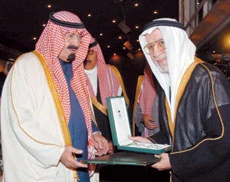
Abdullah Abdul Jabbar, a well-known Saudi man of letters who hails from Makkah, won the award this year. Muhammad Al-Arabi received the medal from King Abdullah on behalf of Abdul Jabbar.
Abdul Jabbar was among the first batch of Saudis to receive a university degree in the Kingdom. He also established and managed the first Saudi school in the UK before dedicating his life to literature. He played an important role in developing secondary school education in the country.
The mufti of Lebanon Muhammad Ali Judo gave a speech on behalf of the intellectuals attending the event. The mufti lauded the efforts of King Abdullah to defend the issues that concern the Muslim Ummah, saying that whenever a threat posed, “there was nobody better than the House of Saud to come to the defense of Islam.”
Judo called for the unity and solidarity of Muslims in the world, saying that it was for a long time that Muslims put aside their differences and united under one flag that represented Islamic faith with Qur’an as its holy book and Muhammad (peace be upon him) its messenger.
“We and all Muslims of the world follow and appreciate the efforts you exert in the service of Islam. And your call made at the Islamic Summit held in Makkah is proof to that cause. This resembles the great burden put on your shoulders,” he said.
An opera performed by over 1,300 artists from all over the Kingdom was one of the main attractions of the opening day. Four of the top singers in Saudi Arabia took the main chorus: Muhammad Abdu, Rashed Al-Majed, Abbas Ibrahim and Abdul Majeed Abdullah. This year’s opera was under the slogan “homage and unity.”
Representing the different cultures and traditions in the Kingdom, performers took to the stage and presented a variety of folklore dances, beginning with Najdi and then Najrani, the Eastern Province dance, the Asiri and the finale, the Makkan dance.
Fifty young girls and boys sang “Baba Abdullah”, which was a first in the history of the festival where children from both sexes sang together on one platform. The king applauded the performance of the young artists.
King Abdullah shared the momentum of the dancing crowds as he got up from his chair and began to sing with them waving his sword high as the famous Najdi “Arda” song was played.
Guests of honor were Sheikh Saeed ibn Zayed Al-Nahayan, head of ports in the United Arab Emirates, and Sheikh Muhammad ibn Eisa Al-Khalifa, head of the National Guard in Bahrain. Also attending were senior princes and other top Saudi officials.
The camel race, which covered 19 km and lasted for an hour, began to pick up pace as several of the camels approached the finishing line. Finishing first was “Markhan”, belonging to Ozayiz Al-Qurashi. “Hajr” came in second place, owned by Muhammad Al-Dosari, and “Muhajim” came in third place, owned by Fahad Al-Subaei.
Winners were presented cars as gifts from the organizing committee. The Saudi Binladin Group also offered two jeeps for the first and second place winners.
Sheikh Khalifa presented the winner of the first place with a golden sword, the winner of the second place with a golden dagger and the third place winner with a silver dagger.
Mark Howell from the US Army Central Command in Kuwait, one of the international figures that attended the camel race, said that it was the first time he attended such an event in the Kingdom. “It was fantastic what I saw in the event, particularly the camel race which for me was the best,” said Howell.
He said that he noticed as he was watching the race how many camels were exhausted halfway due to the length of the race as only small numbers from the original number that first participated showed up at the same time at the finish line.
Prince Mashari ibn Saud, deputy head of the National Guard in the Eastern Province, told Arab News that the speeches and folklore activities performed in the festivity reflected the rich heritage of the Kingdom.
He said that he believed the event should not be limited to just two weeks, adding that there are many suggestions to make it an event that would be open to the public all year long where citizens and residents could attend and see its cultural aspects.
“There are many officials in the National Guard Organizing Committee who are working to make this event an-all-year-long one,” he said.
“Citizens should be aware of their past heritage and culture and the achievements made by their forefathers,” he said.
He said that the event could serve the national tourism interest of the Kingdom since it consisted of many folklore activities.