
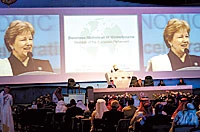
This week’s Jeddah Economic Forum was well attended, though some of the women were disappointed by what they called insubstantial, even condescending, speeches in the forums that addressed issues about women in the workplace.
As usual, the sessions with women speakers, especially Saudi women, received the largest attendance and the widest variety of responses. Most of the women were disappointed by the speeches given by the female guests. Some speeches, they said, lacked depth while others failed to inspire. The most anticipated speech, they said, failed to deliver.
The morning session on the last day of the forum entitled, “Glass Walls and Brick Ceilings: Impediments to the Progress of Women in the Workplace” gave some valuable insights, but not much to build on. While some considered it the most interesting session of the entire forum, others were less enthusiastic.
“I’m so frustrated that none of the panelists addressed the issue of the devaluation of women’s jobs. Jobs that are traditionally dominated by women, such as teaching and nursing, are not considered valuable or important to society and the economy,” said one woman who did not want to be named. “Some of these jobs are not even considered professions. The other thing is why no one is talking about the most important job a woman can do — being a mother and how nothing is being done to enrich and empower mothers so that they feel appreciated as well as being valuable members of society. It’s all part of the discrimination against women.”
Another woman complained that though a few of the problems were addressed there was no follow-up. “How can they talk about choices when there are no options or the options are not clearly stated and neither are the mechanisms for making changes?” she pointed out.
One woman brought up the touchy subject of sexual harassment in the workplace and how it becomes a formidable obstacle toward the goal of creating more mixed-gender work environments. “I almost fainted when I heard the question raised, but everyone has the right to free expression,” said another woman.
Other sessions by women also fell short, according to some women delegates. One woman said she felt the speeches were too formulaic and conventional. “I’m tired of these foreign women coming here telling us ‘Good for you’ and ‘We’re proud of you’. It’s so condescending. We do not lack intelligence or skills. What we lack is opportunity,” she said.
Some Saudi businesswomen said they were disappointed because they were not involved more in the forum and there was no recognition of their contributions.
“The thing with Lubna Al-Olayan (CEO of the Olayan Financing Company, who was the keynote speaker at JEF two years ago) is that she is the only one of that standard. She is way above most businesswomen in the US, let alone here,” commented a businesswoman.
This particular point reflected the big gap between the experiences of men and women business executives and the types of enterprises they manage. Being limited in the enterprises they can enter and run on their own imposes limits in their perceptions and their participation in the economy as a whole.
Thoraya Obaid, undersecretary-general at the United Nations, addressed the status of women according to the recent UN Human Development Report on the Middle East, especially regarding Saudi Arabia. She said that the report certainly showed a great number of gaps in terms of the advancement of women locally in comparison to women internationally.
In many cases looking at some basic health and education statistics, Saudi Arabia ranks highly, but in other areas it lags behind considerably. “I think the weaknesses in Saudi Arabia are more in areas of participation,” she said.
Obaid said that she is optimistic, especially under the leadership of Custodian of the Two Holy Mosques King Abdullah. “He’s the one who nominated me for the post at the UN, so he’s been committed to women’s issues for a long time,” she said.
In any case, women will continue to face obstacles as long as they are not part of the decision-making process. Baroness Emma Nicholson discussed how women could break that glass ceiling if they cannot be involved in the decision-making process.
Her answer was clear: “I see the legal base as the key to successful implementation of United Nations conventions on human rights. Those conventions give men and women, majorities and minorities, equal opportunities, equal value and equal identity. They should be consulted in domestic law, so a full examination of the laws that are now in place and the laws that will improve the implementation of UN conventions is the heart of the matter.”