
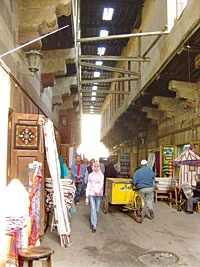
Cairo remains one of the few cities where you can still travel through time. Wandering through the narrow streets around the 10thcentury gate of Bab Zuwayla in old Cairo gives a compelling sense of the living past. Just inside the gate lies the Tent-makers Street, Sharia Al-Khayyamiya. It is situated along the historic road connecting Fustat and Fatimid Cairo. The Street of the Tent-makers is one of the last roofed medieval streets left in the city.
“This sense of historical continuity adds a special fl avor to sightseeing. There is some speculation that tentmaking may be the oldest textile craft practiced continuously in Egypt. In any case, the tent-makers of Cairo have plied their trade for more than a thousand years,” says Jayme Spencer who has been following the fate of the tent-makers craftsmen since her arrival in Egypt in the 70s.
Many of King Abdul Aziz’s tents were made on Sharia Khayyamiya but that was in the good old days. The ancient craft is now slowly dying.
“Until recently in Cairo, it was the practice to pitch tents in the street outside the home to increase seating for an important event.
For obvious reasons, the practice of pitching tents in the street anytime, anywhere had to stop. Though the change was necessary, one cannot help feeling that a unique custom has been lost. Once the practitioner of a vital and fl ourishing trade, the tent-maker today is searching for new markets and uses for his craft, and is creating small items for home use that are both decorative and utilitarian,” explains Jayme.
The exquisite creative art of appliquéd stitching is, in additioin, competing with printed materials. Local textile manufacturers stole the tent-makers precious designs — which take many months to sew — and fl ooded the market with cheap but colorful fabric often seen all over Cairo during Ramadan. Regretfully, few are aware of the difference and many, especially tourists, like the mass-produced version.
Despite this, it is good to know that some people recognize and appreciate the tentmakers’ creativity. When Denys Johnson- Davies, the famous translator of Arabic into English, sent a collection of the Goha Stories to the editors of Philomel Books, a division of Penguin young readers, Patricia Lee Gauch decided to illustrate the tales with designs created by the tent-makers. Her daughter Sarah who lives in Egypt selected Hag Hamdy Mohamed Fattouh and his nephew Hany el-Saeed Ahmed who are known for their Goha motifs and are considered the best in the fi eld.
The book, Goha the Wise Fool is delightful — the illustrations brimming with life, humor and color echo the unfailingly funny Goha stories. And one can only hope that, just as Goha entertained generations of grown-ups and children alike, the tent-makers of Cairo will be able to pursue their art of stitching for many years to come.