
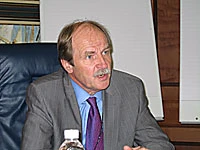
JEDDAH, 21 February 2006 — During last week’s 7th Jeddah Economic Forum, Christian J. Poortman, vice president of World Bank in Middle East and North Africa (MENA) region, gave a speech addressing poverty in this part of the world.
In an exclusive interview with Arab News following his presentation, Poortman talked about the role of the World Bank in the region, and the need to enforce democracy in the region to help combat poverty.
Poortman said the World Bank must also combat the misconception many people have that the organization is a tool of capitalism that engages in ineffectual development projects that mostly benefits middlemen and exacerbates countries’ debt.
Poortman calls this perception “unfortunate”, insisting that the primary role of the World Bank is “fighting poverty.” He said it was a sad irony that while the education rate in the region is rising, so is poverty and unemployment. He said that part of the problem is the region’s educational system that does not bridge the gap with the actual needs of the job market.
According to the World Bank, the Kingdom’s economic growth has averaged 1.1 percent annually from 1981 to 2003 while its population has grown 3.8 percent annually in the same period of time, from 9.9 million in 1981 to 22.5 million in 2003.
Regarding the Kingdom, which gets very little World Bank assistance because of its oil wealth and low poverty rate in relation to developing countries, Poortman emphasizes the vital need for the Kingdom to both diversify its economy and reduce the unemployment rate of Saudis. “It’s important to develop the non-oil sector,” he said, in order to provide employment opportunities for the growing number of Saudi youth in the country.
Poortman stressed the importance of creating a suitable environment for foreign direct investment into the country. He said that the opening up of the economy is a must for competing in the global environment, including setting up favorable trade policies. “Saudi Arabia needs to create a niche that the country can expand into,” he said.
The World Bank is facing a major problem with some MENA countries in the inability to acquire accurate statistics. There are only seven countries that provide reliable statistics, he said, listing Algeria, Egypt, Iran, Jordan, Morocco, Tunisia and Yemen. He said that such data are urgently needed, especially for combating poverty.
In Saudi Arabia, Poortman said that there is plenty of anecdotal observations of poverty, but not enough in the area of facts and figures. He referred to Jeddah’s south side neighborhoods as one focal point of poverty in the country. Poortman also cited the highly publicized visit of Custodian of the Two Holy Mosques King Abdullah to a poor neighborhood in Riyad in 2002 (when he was crown prince) as an example of the attention being paid to the poverty problem in the Kingdom.
“It is important to go systematically” when addressing the poverty problem, he said, adding that the data should tell the location and makeup of the poor. He said the Kingdom should conduct more surveys and social research in these communities. “My understanding is that Saudi Arabia is building that database, but it’s not there yet,” said Poortman. He added that there are some governments in the region that are still not willing to make such data public.
World Bank projects in the MENA region that get the most attention, said Poortman, “tend to be large projects involving lots of money.” But, he said, the bank is also focusing on smaller projects. “The World Bank is really keen to support the educational sector.” The World Bank does not do any projects anymore in the Kingdom, Poortman said. He also said that it does provide studies and technical guides to its government.
Poverty is not only derived from bad planning or lack of some services, said Poortman, but also bad government. Some regimes lack the stability to take action or implement rules. Such timidity of some regimes circles back to the importance of promoting democracy and a culture of human rights, said Poortman.
In some countries there are groups of people who have never been heard in their own societies in terms of their needs, and their situations, he said, stressing the importance of including the needs of these people into the purview of policy-making.
Unless this problem is addressed such countries will never be able to fully deal with the poverty problem.
“Inclusion is important. You cannot design a development program unless you bring everyone to it, men and women,” said Poortman. The call by the World Bank to enforce and improve the human rights conditions in some countries, often Third World countries, is sometimes viewed as bold interference and a violation of sovereignty, said Poortman. The notion perceived by the anti-globalist groups on the Arab street is that the World Bank is an imperialistic economic tool. Another widespread belief about the World Bank is that whenever their country accepts loans from the bank, they become prisoners of debt.
Poortman responded to this accusation that the World Bank mettles in internal policies of developing countries, by saying it is often necessary to advise countries in how to reduce poverty. One case is when the World Bank advises a government on economic policies, or on the development of certain sectors. It is often required that to abide by these recommendations, the government is forced to instigate unpopular moves. According to Poortman, such governments then turn the World Bank into the pariah for instituting these necessary economic changes.
Sometimes, he said, the World Bank is criticized by certain countries because it advises that such regimes need to take serious decisions in terms of redirecting the safety net from those who don’t really need it to those in the most need.
Ignoring such important actions sometimes leads to tremendous blundering and waste, and then some government passes the blame to the World Bank.
Poortman said that many ill notions about the World Bank in the Arab street ought to be redirected at their own governments. He said that such claims “takes away attention from other things that we do.”
He concluded his interview with Arab News by citing the bank’s activities in helping Palestinians, including assisting in the construction of water and sanitation projects, as well as tertiary educational programs. Poortman said such projects in Palestine and other places are mostly ignored. “We get little credit for it and we get castigated sometimes justifiably, but frequently wrongly,” he said.