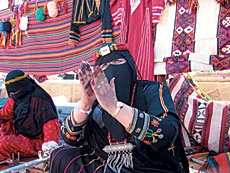
RIYADH, 1 March 2006 — After 12 days, the 21st Annual Janadriya Festival welcomed women to attend for three days from Monday.
Indeed, the 15-day event celebrating Saudi cultural diversity was mostly a men-only affair, meaning that families were unable to walk together through the model villages set up as the main attraction of the cultural festival.
Nevertheless, women and children had a blast at Janadriya yesterday. This Arab News reporter attended the festival in the eastern Riyadh suburb and immediately got lost among a crowd of women and children who explored the nine showcase villages representing distinct cultural regions of the Kingdom.
Each village displayed its corresponding architecture and folk art, and women from these regions replaced the men that had been there previously to show and sell their wares.
In the Al-Baha “village”, old Saudi men from the region stood proudly next to their arts and crafts and jars of mountain honey. The Qassim “village”, which represents the central region north of the capital, featured the ubiquitous off-white and white clay houses.
As Arab News explored the different villages, the chanting of women could be heard. They recited old folksongs to the rhythm of tambourines. Old women sat in the corners of rooms watching younger ones with highlighted hair, trendy abayas, and Gucci sunglasses singing along to well-known standards from their childhood.
In the Qassim village, a particularly surreal spectacle stood out as a woman completely veiled in the Bedouin burqa sat on a floor covered with hand-woven carpets. Next to her was a loom containing an unfinished woven carpet.
“Sing for us, Umm Shugaa,” said one woman. “We hear that you know the old songs. Please sing for us,” said another.
Then the old woman began singing and several women started clapping in syncopated Bedouin rhythms that left visitors clapping clumsily along.
Arab News approached the formidable Umm Shugaa after her performance as she continued working on her carpet. She said that she learned how to make carpets from her mother and her mother learned that from her grandmother. Umm Shugaa’s daughter Salma is also a weaver. She’s taken the family tradition into the 21st century by hand-weaving mobile phone carriers out of lamb’s wool.
The festival will end today for both men and women, and, at least for the ladies, it seemed to have succeeded in celebrating long traditions that are at risk of being forgotten. As such, many interviewed by Arab News seemed to agree on one thing: Even if men continue to get a lion’s share of the time for themselves at the festival, it should not just be open for three weeks, but throughout the year.