
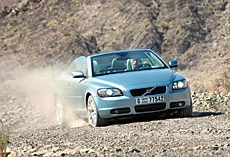
Few production cars attract as much attention as the all new Volvo C70 when it is transforming itself from open top to hard top. A cross between the 1980s “Transformer” toys and a gleaming scarab donning its new carapace, the segmented steel top seems almost to come together magically and finally lock, giving the car a completely new sleek character. It is just fascinating and typical of Volvo, a beautifully engineered and meticulous piece of design.
The new C70, test driven for the first time ever in Dubai in early February, heralds a new sophistication in open top cars. The soft top convertible — with its accompanying joys of broken fingernails, pinched fingers and flapping canvas — is going the same way as the tumbril. Not the first retractable steel roofed car, Volvo has added a degree of sophistication to the idea. A single button mounted on the central console and pressed continuously for 30 seconds lifts or retracts the roof completely. The whole arrangement is powered by electro-hydraulics, controlled by a computer. When fully retracted into the trunk, there is still enough room (80 liters) for a couple of suitcases; when raised, the capacity increases to a healthy 200 liters.
The whole car has been reworked yet keeping the characteristic sculpted look of the earlier C70. The shoulder of the car retains the distinctive curve and sharpness but the rear lights are less obviously fluted. A fraction shorter than its predecessor, it is the same width and with the rounded front end and sharply terminated rear end, offers a pleasing and distinctive wedge-shaped silhouette. The traditional Volvo grille and fender has been smoothed out and replaced with what Volvo describes as the “egg-crate”grill, giving a distinctly sportier look.
With the roof raised, the silhouette is of a rather slippery coupe; roof down, the steeply raked windscreen pillars, which conceal a massively strong beam that acts as a roll-over bar, lend an air of purpose to the outline. Remember, this is a Volvo and the safety features are everywhere — but not at all intrusive.
Being Volvo, safety has come in for considerable thought, the result of which is the addition of a roll-over protection system. If the car is about to roll, hoops behind the standard rear headrests spring into place above head height. This works in conjunction with side impact and anti-whiplash systems borrowed from the S80. In addition, this is the first convertible car to be fitted with automatic seatbelt pre-tensioners on all four seats. Roughly speaking, inversion does not mean dispersion of your body parts over the tarmac.
Front and rear end crumple zones with force-distributing beams turn the passenger compartment into a safety cell. This was not easy to achieve as in a standard hard top car, the roof and roof pillars are part of the impact absorption package. However, a horseshoe shaped impact absorbing beam at the rear, reinforced door pillars and doors that contain huge aluminum beams all add to the rigidity of the car. As a result, the doors, with a heavy feel to them, shut with an entirely satisfying “clunk.”
The safety features make it a chunky car, weighing one and a half tons. It would be easy to think of it as an open sports car and expect less weight; but it is not. The car is a full four-seater convertible with a steel roof and all the luxuries you would expect, including a phenomenal sound system. It is just that you wouldn’t notice when the roof is down.
On the road, the car is very deceptive at first; it is so quiet. I cannot think of any other open top in which it is possible to hold a conversation at normal speech levels at 140kph. The designers have spent a lot of time getting this just right. With the rather frail but very effective mid-section wind buffer raised and the rear windows down, noise levels are minimized.
The sound system calculates the volume of air in the car — thus working out whether the roof is up or down and balances volume and tone accordingly. Coupled with the inherent quietness of the car, the result is remarkable. All very pretty and safe; but how does it drive?
Probably best summed up as a sporty touring car, the C70 T5 is fast enough — 210 kph plus — for most users. The entry-level 2.0T is good for 163bhp; the 2.4-liter light pressure turbo engine develops 200bhp, while the 2.3-liter fully-blown turbo in the T5 GT version manages 245bhp — enough horses to boost you from rest to sixty in 7. It cruises effortlessly at 160kph with the top down with a very comfortable cabin environment. Cruise control is fitted to the six speed manual as well as automatic versions.
The six speed manual box on the C70 under test was light and a wee bit fiddly. The upward changes from both 4th to 5th and 5th to 6th needed thinking about. A little sideways pressure was needed on the stick shift to be sure of engaging the gears accurately. It was just a matter of getting used to it, though. A niggle noted by more than one driver was that it was easy to accidentally depress the air-conditioning buttons from the gear shift in 3rd and 5th. A rapid change up occasionally met with all sorts of interesting noises and flashing lights.
The suspension was hard enough to minimize body lean, even when pushing hard up the tortuous roads up the 915 meter Jebel Hafeet overlooking the Omani border. This is when the rigidity of the car, aided by the massive safety beams, really came in to play. When very near the limit of adhesion, a pronounced judder came from the front wheels as the traction control responded to the abuse. There was still some latitude left, although unless looking for a front wheel slide, no one would want to push any harder. Pushing it is part of the temptation of the C70. It feels like a well-bred small sports car; and who in their right minds would resist temptation? It is not a sports car, but a comfortable sporty fast cruiser. Stylish enough for the urban circuit, lively enough for fast touring, road holding sticky enough for all but serious abuse. And with the top down, altogether huge fun to drive. Buy one now!