
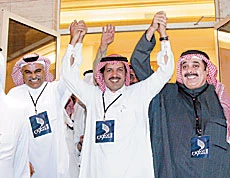
ALKHOBAR, 10 March 2006 — Last month, elections were held for the board of directors of the Eastern Province Chamber of Commerce and Industry (EPCCI). Four teams of candidates contested the elections. Al-Taaown (Collaboration) represented most of the incumbents. Two members of the previous board formed their own group, Ittihad Al-Sharqia (Eastern Alliance). There was also a third team called Majmouat Al-Sharqia (Eastern Group) and finally a fourth team called Al-Watanie (The Nationalist) — which was created by the business women who ran for election.
Candidates for the election were divided into two main groups overall, businessmen and industrialists, irrespective of their election teams, with each group eligible for six seats on the EPCCI board. Of the industrialists, Maan Al-Sanae won the highest number of votes. Of the businessmen, Khalid A. Al-Abdulkarim took the most votes.
Al-Taaown earned nine of the 12 seats on the EPCCI board. Ittihad Al-Sharqia took the other three seats. Those who won the elections from Al-Taaown group included Abdulrahman R. Al-Rashed, the president of the chamber, Maan A. Al-Sanae, the chamber’s vice president, Khalid A. Al-Abdulkarim, Saud A. Al-Gosaibi, Zamil A. Al-Zamil, Salman M. Al-Jishi, Issa A. Al-Dossary, Rashed A. Al-Suwaiket and Ayed F. Al-Qahtani. The three winners in the Ittihad Al-Sharqia group were Khalid H. Al-Gahtani, Yusuf A. Al-Dossary and Abdullah H. Al-Ammar. Ayed Al-Qahtani and Yusuf Al-Dossary are the only new faces to win election to the board.
The Ministry of Commerce and Industry has now appointed six additional members to the board including Naser S. Al-Hajry, Mohammed S. Al-Farraj, Hilal H. Tuwairqi, Ghassan A. Al-Nemer, Fahad A. Al-Shuraieh and Rasheed A. Al-Hussan. The 18 board members will serve for four years. The elections for the board of the EPCCI are of particular importance because the president of EPCCI currently heads the Council of Saudi Chambers of Commerce and Industry and will do so for two and a half more years.
Khalid A. Al-Abdulkarim, the overall winner among the Eastern Province businessmen, had some thoughts on the election and the way forward. He pointed out that for decades the boards of the Saudi chambers have been the only elected bodies to represent a majority of people in the Kingdom and he believes that they will continue to play an important role in Saudi society.
“These elections have given those in the business community an opportunity to express their support or disapproval in an open forum. The chamber of commerce has always represented the businessmen, traders and industrialists. When you consider the numbers of people who work in companies engaged in business, trade or industry — especially in the Eastern Province where government representation is much smaller than in Riyadh for instance — much of the population works in the private sector. So the chamber of commerce plays a strong role in representing their interests,” said Al-Abdulkarim.
He went on to explain that most commercial or political visitors who come to the Kingdom tend to interface in some way or another with members of the Saudi chambers. This means that the chambers have an important role to play in shedding a light on the true nature of the Kingdom and its people.
There was much emphasis on the participation of women in the EPCCI elections and Al-Abdulkarim welcomed their direct vote and candidacy. Personally, he is disappointed that the board does not have any women members.
“The election teams were assembled about nine months ago, some even a year ago, well before women were given permission to run for election. This is why they were not part of the major election teams and so they set up their own group,” said Al-Abdulkarim. “We had record turnout in this election but the number of women voters was disappointing. A total of only 42 women out of 700 eligible to vote, did cast votes. I feel that this was an embarrassment. Even when the women did not win through election, I had hoped that the ministry would appoint women to the board. This did not happen. From now, women should be out there networking, making their names known and garnering support so that we will see women winning in the next EPCCI election.”
Al-Abdulkarim asserted that incumbents won the election in the most part because they are doing a good job. He noted that the EPCCI board is made up generally of young, professional, highly-educated individuals who are pushing to capitalize on the opportunities presented by the current economic boom in the Kingdom. The board is working to encourage investment in the Kingdom and strengthen the role of the private sector in the economy, which will serve Saudi Arabia well in the future.
“All indicators in the Saudi economy have been positive,” remarked Al-Abdulkarim. “As for the recent highs and lows in the Saudi stock market, we should always remember that there is no cure for greed. It’s human nature. Smart businessmen are always careful when there is a bubble in any market. Speculators will always get hurt. I believe there is a need for more awareness and education about financial management in order that Saudi families can plan better for the future.”
Despite the roller coaster performance of the stock market, Al-Abdulkarim advised that when looking at other aspects of the economy, the signs that good times will continue are everywhere.
“We are no longer worried about whether we can sell our production,” he said. “The current concern is whether there is enough capacity to meet the requirements. There is actually a trend right now to reserve production space. That’s how well the economy is performing.”
But Al-Abdulkarim cautioned that to keep the economy moving forward smoothly, many factors must be optimized. One major issue is the shortage of trained human resources.
“The chamber of commerce is very active from the level of the king, all the way down, in providing the exact picture of the business environment. We all need to carry the burden of training and education but the businessmen are passing the message to the government that there are no trained professionals looking for jobs in the private sector. In fact all businessmen are urgently hunting such individuals. Even for myself, if any Saudi comes to me and speaks English, I’ve got a job for him. In the Eastern Province we have a uniqueness in that most of the jobs require some English language skills. These are skills that take years to develop. With that in mind, I would urge that the government smooth the way for the entrance of professionals into the Kingdom from abroad, while at the same time dedicating educational resources to appropriately growing the local talents that this economy urgently needs.”