
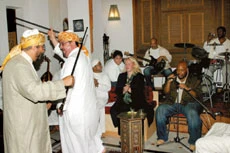
Alive duet from a hip-hop band and traditional Hejazi musicians is a novel idea in itself. To see such a performance in Jeddah is almost inconceivable. Thus the excitement and enthusiasm of the show’s audience was to be expected. The room genuinely buzzed and as the band was introduced, silence fell across the room.
Opus Akoben is a hip-hop quartet from Washington. They are part of a US State Department tour of American musicians around the globe. But they give a new meaning to the general perception of hip-hop as a music style and, as their jazzy-reggae melody filled the hall, the excitement of the listeners could not be contained. Picture thobe and abaya-clad Saudis, swaying and clapping to the rhythms of jazz.
The venue was the beautiful house of renowned architect Dr. Sami Angawi — which he himself designed. In cooperation with the American Consulate, he hosted an informal evening of music dubbed “Jazz and Hejaz.” Those participating were the quartet along with Abdul Rahman Al-Miriani on the oud and Saleh Al-Qaidi, a traditional Hejazi singer who had come all the way from Madinah to take part.
While the band was setting up, members of the audience were free to have a look at the house and marvel at the design and the incredible attention to detail in each room. Once everything was ready, the men sat down in front and the women behind; Erin Eddy, Public Affairs officer at the Consulate then introduced the band, saying she hoped the “meshing” of music would be a success. Once the music began, the atmosphere was electric. Angawi got the mood going by taking up his walking stick and dancing in “Yanbawi” style to the music.
He was soon joined by another man and as they twirled their canes around the room, everyone laughed in delighted amazement. Was this really Jeddah? One beaming elderly woman turned to her friend and said, “This is the first time in my life I’ve ever seen anything like this in Jeddah.” After a short time, others borrowed the canes and began dancing themselves, keeping the flow going the entire time. Al-Qaidi and Miriani took their turns, and then it was the quartet’s turn to listen in amazement, particularly after Al-Qaidi sang and the entire audience expressed its approval. Then both styles were blended — meshed — as the musicians joined in and played together.
Everyone left feeling that they had just experienced a moment in local history and, as Carl of Opus Akoben later said, “It was very touching. Just a magical moment all round. It was something very beautiful.” Ezra, also of the Opus Akoben, said of Hejazi music: “I love it. I think (the session) worked very well. I think we could put some very beautiful things together.”
One of the coordinators, Adeeb Faidah, said it was amazing to see how both cultures were joined spontaneously through music without any preparations or rehearsals. “Singing the ajam (Persian) key as in the old Hejazi song “Ya Sariya, Khabirini” (Tell Me, Sariya) made it easier for the jazz band to harmonize.”
Miriana and Al-Qaidi both believed it was a challenging and rewarding experience to bring two different cultures closer through music. “We were able to talk through the music; it is the language that attracts many people of different nations. We danced to their music and they sang to ours,” said Al-Miriani who confirmed that he would willingly participate again in a similar performance. It might be the first time Hejazi music was ‘remixed’, he added, but with a stable flow of rhythm, the mix with other cultures adds more beauty to its richness.
“I was amazed by the gathering,” said Hasan Hatrash who joined in on the drums. “Being a bass guitar player, I know something of rhythm structures which was quite helpful to me when I was asked to hold the darabukka (Arabian drum).” For him, it was a chance to experiment mixing two completely different musical styles. Artists from both cultures had no difficulty in understanding the unified language of music. Such gatherings, Hasan said, serve as a chance to generate greater cultural understanding which was made very clear in the expressions of not only the performing artists but the guests as well. It was a unique experience that has proven the unlimited boundaries of music.
In the end, the idea of mixing “Jazz and Hejaz”, or even finding anything in common between the two, didn’t turn out to be as impossible as we had first expected.