
CALOUSTE Gulbenkian was a born collector — his son-in-law, Kevork Essayan, recounted that when Calouste was 14 (in 1883) his father Sarkis Gulbenkian gave him a gift of 50 piastres for successful schoolwork. Calouste spent all of this on some ancient coins. In later years Gulbenkian said that these coins were the foundation of his acclaimed collection, part of which is exhibited in Muscat, Oman, until April 18, 2006 at the Bait Zubair Museum.
Calouste Gulbenkian was born in Üsküdar (Istanbul), March 29, 1869 to Sarkis and Dirouhie Gulbenkian. The family were scions of an aristocratic Armenian family from near Lake Van in central Turkey. After studying first in France and then graduating from King’s College London, where he studied petroleum engineering, Calouste became a pioneer in the oil industry. He used his contacts to build up political and economic influence which formed the basic of his oil interests some of which exist today in the form of Partex Oman. However, he did not regard himself as an oil magnate referring to himself as a ‘business architect’ while today he has become known principally for his foundation, the Calouste Gulbenkian Foundation, and the superb pieces in his collection.
That his collection is eclectic is beyond doubt. However, Calouste Gulbenkian had simple criteria in amassing the collection — ‘only the best is good enough’. The pieces from his Islamic Art collection, which are on display in Bait Zubair, exquisitely demonstrate how superb his judgment was.
For me one of the most surprising pieces is a Velvet Caparison. The style is sumptuous with polychrome silks embellished with gold and silver thread to add luster to its appearance. Floral motifs in muted tones of olive green abound with birds, perhaps doves, holding a floral offering in their beaks. Created in 18th Century Persia (probably during the Safavid dynasty) the cloth is fit for a Shah; however its opulence was created as an elaborate cloth for a horse. In a European setting the Caparison would be decorated with the Coat of Arms of the horse’s rider as identification, in Persia it simply seems to have been used as pure decoration for the prestige of the owner or pleasure of the onlooker.
Calouste Gulbenkian became the financial adviser to the Ottoman embassies in Paris and London in 1898 and a few years later, in 1902, he acquired British nationality. Perhaps he felt that unpredictable changes were on the way in Turkey and the rise in Turkey of ‘The Young Turks’ was the foretaste of more to come. However the rise of the Young Turks acted to cement Calouste Gulbenkian role in acting as private adviser to the Ottoman government for he was appointed as a consultant to the National Bank of Turkey which promptly began negotiations with a third European power, Germany. Gulbenkian apparently was able to create for himself a role as an independent and neutral consultant who was useful to four powers in the early 20th Century.
Gulbenkian’s access into the corridors of influence in Western Europe seems to have allowed him to increase his acquisitions of art from Western Asia. He made a number of purchases in Paris before World War I including another piece in a velvet fabric from 17th century Persia. Here the background color is a cherry red with a contrasting elegant golden pattern. Probably produced in Yazd, now known for its carpets but in Safavid times one of the most renowned centers of Persian fabrics. The piece is alive with floral motifs possibly including roses and tulips. However the recurring symbols through this piece are of two birds. One of the legendary phoenix is set with two birds sitting on a plants’ vine and while they are back to back both birds have turned their heads to face each other. The other is a peacock with again a pair of birds with arched necks facing each other. These floral and zoomorphic motifs were a favored decoration of fabrics for a Safavid monarch’s palace or tent.
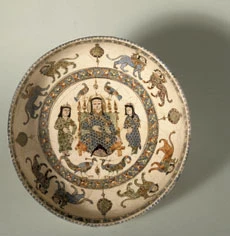
Purchased during the same year (1914) was a Persian ceramic bowl created in the 13th century during the Seljuk period. This piece shows a young prince sitting on a chair or throne with two raptors perched on the chairs back. Like the later Safavid fabric this piece has two peacocks which in Persia were a symbol of royalty at the prince’s feet. This bowl was made using a lengthy but necessary firing process where the piece was fired at an initially high temperature suitable for pigments which melt at high temperatures and on several subsequent firings pigment with lower melting points were painted on until the final firing where gold was applied. Surrounding the rim are several pairs of sphinxes whose features have the same stylized almond shaped eyes as the prince.
Quite different is a 14th Century mosque lamp. These lamps were commissioned by the Mamluk rulers (1250-1517) mainly in Cairo and Damascus. Their gilding and enameled decoration (fired onto the glass) made them impressive in appearance. However, the style was almost rigid in its requirements allowing little room for artistic flair. The lamp was made for Sultan Al-Nasir Hasan bin Mohammed Hasan around 1358. Its subsequent history illustrates Calouste Gulbenkian quest for the best. On the occasion of the opening of the Suez Canal in 1869 the Sultan of Egypt, Khedive Ismail, presented it to Leopold II, king of Belgium. Calouste Gulbenkian then was able to purchase the lamp through the dealer Jacques Seligmann in 1909.
Following the upheaval of World War I Calouste Gulbenkian was appointed to yet another influential role, this time as Persian trade and diplomatic representative in Paris, a post he held for 24 years from 1920. This period was one where his oil interests became joined with those of Royal Dutch Shell and he also became known as Mr. 5% — for his typical remuneration in handling negotiations was to receive a 5% equity in the resulting company in this case the Anglo-Persian Oil Company and later the Turkish Petroleum Company which became the Iraq Petroleum Co. Ltd. It was these interests in the arc surrounding Oman that lead his company PARTEX to become a partner in the early explorations for oil in Oman where PARTEX is still involved.
It’s possible to imagine that for Calouste Gulbenkian one of the pieces that he purchased during this period of his rapidly evolving commercial interests was done not only for its quality but also as a reminder of his roots. As an Armenian he must have been familiar with the Armenian quarter of Istanbul called ‘Kum Kapi’ or Sand Gate. Set just outside the Topkapi Palace this was an area where some Armenian craftsmen set up their carpet production facilities. The superb Kum Kapi carpet piece again has the combination of golden and dark reds predominating in its color palette. The decoration is again floral with prunus leaves creating a frame for stylized carnations. This more modern piece was produced in the early 20th Centaury and may have been specifically purchased in 1932 to decorate his mansion on Avenue d’lena in central Paris.
Calouste Gulbenkian left Paris after the start of World War II and his astute political skill seems to have let him down, for in 1942 despite being a British citizen he was classified as a “technical enemy” by the British government. Though the following year the classification was revoked Calouste Gulbenkian had already settled permanently in Lisbon, Portugal in April 1942, and remained there for the last 13 years of his life at the Hotel Aviz until July 20, 1955, when he died.
It was Lisbon where his collection of over 6,000 items also found a permanent home and in 1969 the Calouste Gulbenkian Foundation established a museum from which the remarkable pieces on display at Bait Zubair Museum in Muscat have been displayed until April 18, 2006. Like the wonderful Velvet Caparison the exhibition is one to enjoy.