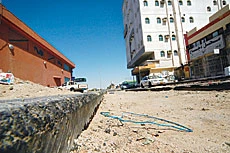
JEDDAH, 22 March 2006 — Sharp-edged rectangular trenches and unfinished road surfaces, the result of the laying of Jeddah’s new sewage system, have added another unnecessary safety hazard to the city’s roads.
Frequently unmarked and in urban areas with minimal-to-zero streetlighting, drivers encountering them have burst tires, buckled wheel rims and collapsed suspension as a result of encountering them at even normal speeds.
One local civil engineer who preferred to remain unnamed said that there was no sound technical reason to leave these backfilled trenches unfinished. He said that the idea of leaving them open to allow the backfill to settle, which might have been an explanation, was completely wrong.
“With even quite small compacting machines used properly, the trenches that contain the pipes can be paved over immediately,” he said. “There is no technical excuse for leaving them open.”
Filling the trenches in layers and compacting each layer, which a resident of Al-Faisaliah district confirmed was the practice in the trenches outside his apartment building, allows for immediate covering of the backfill with new road surfacing.
Some of these shallow yet potentially lethal trenches are left open in busy urban roads for weeks at a time. While some are marked, many are not. In Al-Faisaliah, 10-12 cm sharp-edged depressions have remained open for two weeks or more.
The surface of the trenches is relatively soft and easily disturbed by moving vehicles. Sand and gravel is thrown out of the depressions as cars drive over them, causing the trenches to gradually deepen, making the problem worse the longer it is left.
Even vehicles moving in slow traffic, forced to drive with two wheels in the unfinished trench, suffer tire sidewall damage. Any such damage that goes unrepaired increases the risk of high-speed blowout with possible lethal results.
Even more dangerous are neglected holes that gradually increase in size as cars impact the edges, chipping pieces of the tarmac away.
Eyad Hussein, a King Abdul Aziz University graduate, encountered an expanding pit as he drove to work. Forced to swerve to avoid a maneuvering taxi entering a slip road in the Al-Jamaa district, Hussein said he hit the hole and burst a front tire on the fractured tarmac edge.
“The impact threw the car wildly to one side,” he said. “We thought the suspension was broken. We could not avoid it because we were trying to avoid colliding with the other vehicle.”
The impact burst the tire, buckled the rim and left the car in a dangerous position on the busy road. The hole when they measured roughly it proved to be about 30 cm deep and nearly a meter wide.
One particularly notorious hole-hazard appeared on the main highway out of south Jeddah toward the southern industrial park. A 66-cm manhole cover was removed to allow an inspection of the drains below the road surface; for over six months it was neither marked as a hazard nor replaced.