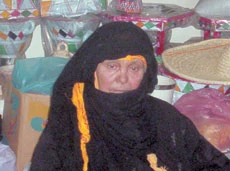
ABHA, 23 March 2006 — Before sunrise, she opens her little shop and prepares Arabic coffee. She prays for a profitable working day and that the Thulatha Public Market will be thronged with customers for her and other shopkeepers.
The market is located in the heart of Abha and Gumasha Mastoor, 75, sits in front of her store on a wooden chair every day. She works along with a number of other businesswomen. When customers arrive, she serves them Arabic coffee and in fact, her shop is known as the “Arabic Coffee Shop.”
Gumasha supports a family of four and she relies on selling traditional products, clothes and leather to do so. She has no one to help her and in addition, she supports a 20-year-old handicapped daughter.
Gumasha sits unveiled outside her shop, and indeed, many of the other women are also unveiled. They never wore a veil, even when they were young. “Covering our faces is not part of our tradition,” said Gumasha.
Despite the fact that many women now cover their faces, she said that she follows the earlier tradition which now seems to be on its way out. She said that in the past, men and women worked together in groups. “Women used to work side to side with men, especially in the fields,” Gumasha explained.
Men and women used to mix much more freely, especially with neighbors and family friends. Gumasha described that era as a good one. A woman’s role, she said, was very important and different from what it is today; women received guests and visitors if their husbands were away from home, serving them food and drink in keeping with Arab standards of hospitality.
She said, “Working as I do now is the only job that suits me socially and educationally.”
Gumasha usually earns SR70 on Thursdays and between SR10 and SR20 per day on other days. She uses the money to meet her family’s expenses. She said that it was considered a good day if there were bread and milk in her house. The rent on her shop is SR5,000 a year and she pays that from the social security check she receives from the government every year. She spends a great deal of time in her shop and she is still coming to terms with the difficulties of her life. She lost her husband 12 years ago and then four sons and a daughter. She still supports other family members in her little house north of Abha.
Gumasha is not the only woman in the market with a sad story. There are many women who suffer as she does because of social and financial problems. “Because of our poverty, we travel up to Riyadh — more than 1,000 kilometers — to sell our products during the Janadriya Festival,” Gumasha said. Fortunately, it is not unusual for the women to come home from Riyadh with as much a SR6,000.
Ibrahim Al-Shaier, a poet from the southern Asir region, said that unveiled women were an old southern tradition. Veiling, he explained, began in the 80’s and 90’s when women in Asir stopped working in the fields.