
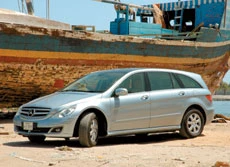
BETTER looking than a platypus, which combines bits of other beasts without morphing into them, the new R Class is unique. The graceful arc of its sloping roof and aerodynamic lines help disguise its size. It manages to combine a physically large vehicle, a huge and luxurious interior with a Tardis-like trompe d’oeil that gives the impression that it is not as big as it really is.
Breeding will out; the understated elegance of the exterior together with the well-appointed interior and the massively solid feel of the car leaves the driver in no doubt that he is in a vehicle of real class.
The radical design and its sloping roof and sweeping front-to-rear lines tend to minimize the size and accent its sportiness simultaneously. The R-Class uses the sports car grille design with the aggressive circled star in the center, multi-element headlamps and a steeply raked hood and windshield yield a remarkably low drag coefficient of only 0.31.
The R 350 has four conventional doors and a lifting tailgate, but station wagon it is not. Three rows of paired bucket seats with space enough for seating six large adults comfortably do not make it a min-van and the permanent “intelligent” four wheel drive does not make it an SUV. The passengers are protected by an impressive array of passive safety features in an interior that is brilliantly lit by large side windows and an optional 1.5 meter long glassed sun-roof. It is simply unique.
The car comes with front, side-impact, and side curtain air bags for all three seat rows and holds five-star crash ratings in all directions. Anti-lock brakes (ABS) with Electronic Brake-force Distribution (EBD), an electronic stability program (ESP) and all-wheel drive are all standard.
It is a long car with a low ride height and big easy access doors. They make it very easy to access the second and third row seats, but can be a disadvantage in tight parking spaces. Forty two centimeters longer than the M-Class sport-utility and longer than the Cadillac Escalade, by more than 10 cm, it is almost as wide as the Escalade, but only slightly taller than the SRX due to its deliberately low ride height and ground clearance.
Depending on model and options, there are four different alloy wheel packages to choose from, in five-, seven- and ten-spoke designs. The AMG Sport package adds a whole new front end look, 19-inch AMG five-spoke wheels and tires, and a new rear treatment.
The R-Class was designed from the beginning to accommodate six average American adults, not four adults and two kids. However, six adults and their gear for the beach or touring would encounter storage problems. With all the seats occupied, the leftover space for their luggage is miniscule, only 0.45 cubic meters.
With the third row down this increases to 0.96 and to 2.41 cubic meters with the second row folded using the brilliantly easy and simple folder mechanism. Items of 2.5 meters plus long can be fitted in.
The instrument panel combines the chronometer style analogue speed and rev counter with a neat digital display nestling between them, all easily readable by the driver through the chunky steering wheel. On the test model, the sound system once set up could be operated from the steering wheel. Behind the wheel, easy to reach with the fingers, were paddle buttons that operated the seven speed gear box. That took a bit of getting used to; changing gear on a button — miniaturization gone perhaps a little too far.
A small analogue clock nestles in the speed dial and a fuel gauge in the rev counter. The digital display keeps and displays travel information — fuel consumption, average speed, time of travel and similar.
Like most modern cars, there is no oil pressure or water temperature gauge included in the permanent dials. I am one who likes to know what is going on so that I can do something about it before the little red light that signifies the disappearance of a couple of month’s salary in repair bills blinks smugly at you.
The central console with its mass of buttons and options together with a bright information screen is, to say the least, comprehensively stocked with options, including entertainment systems, telephone, maps and the gizmos that modern drivers seem to want. The panel has its control buttons flush to the surface; they need searching for — a case of ‘eyes off the road’ while you do it. Very sleek, very efficiently laid out — but with a tendency to divert attention from concentrating on driving.
The car is loaded with all the luxury you would expect: Immaculate leather seating and trim, birds-eye maple wood trim, eight-way power seats, dual-zone air conditioning, the COMAND instrument panel and control system, rain-sensing wipers, multi-function steering wheel, eight-speaker AM/FM/WB/CD sound system, and six cup-holders.
Big machine though it is, it is nonetheless remarkably nimble, reaching 100hph in under 8 seconds from rest. The seven speed automatic box is turbine smooth even under hard acceleration. Even using the steering wheel gear-change paddles, it was all but impossible to feel the changes.
At legal road cruising speeds the interior was very quiet, the suspension soaking up uneven surfaces without complaint. It is a first class touring environment. The permanent four-wheel drive keeps the car pointed where you want it and it corners as if on rails.
Niggles? There were some. Apart from the limited luggage space when all six seats are occupied, I had two: Sluggish response to kick-down in full automatic from cruising speeds to urgent acceleration and the mirrors.
Especially in the Kingdom’s driving environment, all round awareness of fellow road users is vital. The mirrors are decidedly limited in their rear vision — especially the nearside (curbside) one. Sitting with arms almost straight out in my normal driving position, I lost a significant amount of rearward view. Larger and slightly convex wide-angle mirrors would be a distinct improvement, simply in the interests of keeping this classy chassis dent-free.