
Bangladesh has a host of tourist treasures to offer to international tourists — beaches, lakes, rivers, hills, forests, wildlife, tribal life, archaeological remains, including historical monuments, folklore, religious and cultural heritage, handicrafts and much more combined are enormous tourist products for international tourists.
Beaches:
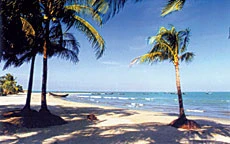
Cox’s Bazar: Miles of golden sands, towering cliffs, surfing waves, rare conch shells, colorful pagodas, delightful seafood — this is Cox’s Bazar, the tourist capital of Bangladesh. Here the world’s longest unbroken smooth straight shark-free 120 km long clean sandy beach slopes gently down to the blue waters of the Bay of Bengal against the picturesque background of a chain of hills covered with deep green forests.
The breathtaking beauty of the golden sun setting behind the waves of the sea is captivating. Attractive local variety of cigars and handloom products of the Rakhyne tribal families are good buys.
Visits to the fascinating spots at Inani, Himchari, Teknaf, southernmost tip of Bangladesh, Buddhist temple at Ramu and nearby islands of Sonadia, Moheshkhali and coral island St. Martin’s are memorable experience of a lifetime.
Kuakata: It is the only beach in Asia where one can enjoy both clear sunrise and the sunset in their entire majestic splendor. Kuakata in Patuakhali district is one of the few tourist spots in Bangladesh where nature survives in pristine, unspoiled grace. With its unspoiled vast sea shore along groves of coconut trees, colorful Rakhyne tribal life, Shima Temple having 70-feet high statue of Buddha, the highest in Bangladesh, thousands of varieties of fish and the yearly Hindu Rush festival are added attractions in Kuakata for the visitors.
Eco-Tourism Spots:
Sundarbans: Bangladesh owns the largest mangrove on earth, the Sundarbans — the home of the majestic Royal Bengal Tiger. About 6,000 sq. km. of deltaic swamps along the coastal belt of Khulna, Satkhira, Bagerhat and Pirojpur districts the Sundarbans is also the natural habitat of spotted, deer, crocodiles, monkeys, cheetahs, pythons, wild boars, hyenas and different species of colorful birds making it a paradise for the eco-tourist.
Hiron point, Katka and Dublar Char are the main tourist spots where the visitors may have glimpses of wildlife and also the simple life and living of fishermen, bawails and other working professionals in the forest. The Sundarbans is really a place of the mystery of nature. This wildlife sanctuary is a declared World Heritage Site of UNESCO.
Among other tourist attractions nearby is Khan Jahan Ali’s 60 domed ancient mosque built in 1459 A.D. and his mausoleum. UNESCO has enlisted it also a World Heritage Site.
Hill Tract Districts:
The three hill districts of Rangamati, Banderban and Khagrachari are inhabited by number of distinctive enterprising tribes like the Chakmas, the Tripuras, the Murang and the Marmas — all preserving their age old cultures, colorful rituals, dances and music. Rangamati: is the most favorite holiday resort in the Hill Tracts known for its windings hills, colorful climate and enchanting beauty as well as for its colorful tribal life. The hanging bridge over Kaptai Lake, the largest manmade lake in Asia (255 sq. km.), tribal handicraft factory and sales center, ivory jewelry, tribal museum, fishing, cruising and water skiing are its prime attractions. Other places of rare beauty in the Hill Tracts include Kaptai, Suvalong, Chandraghona, Khagrachari, Alutila, Matiranga, Bandarban and Chimbuk.
Sylhet:
In the vibrating Surma valley, the scenic tea plantations of greater Sylhet district are the main attractions for all tourists. Its terraced tea gardens, eye-soothing orange groves, pineapples plantations and hills covered with tropical forests form beautiful landscape.
The panoramic waterfall of the country at Madhabkunda, and Jaflong are other scenic spots of the area. Colorful Monipuri, Khasia, and Garo tribes live in Sylhet. Monipuri tribal dance is world famous.
Historical and Archaeological Sites:
The country possesses a many number of archaeological sites and relics, which tells our glorious civilization of the past. Archaeological excavation at Paharpur has unearthed the remains of a Buddhist monastery, which is the biggest in the south of the Himalayas. A similar one at Mainamati at Comilla 75 km southeast of Dhaka bears testimony of the glorious past of this land. It dates back to 8th Century AD.
Cultural Heritage and Tourism Industry:
Bangladesh is heir to a rich culture and heritage. The National Museum at Dhaka, the Ethnological Museum at Chittagong, the Folk Art Museum at Sonargaon near Dhaka, the Varendra Research Museum at Rajshahi houses our past history and rich culture.
Tourism Development:
The World Tourism Organization has prepared a Strategic Master Plan of Tourism for the country with the assistance of UNDP.
The government has decided to setup and develop Special Tourist Zones (STZ) at different potential places of the country to cater to the needs and demands of the foreign tourists.
These include Cox’s Bazar, Sundarbans and Kuakata. The Chittagong Hill Tracts (CHT) comprising three districts: Rangamati, Khagrachari and Bandarban will also be developed as a Tourists Zone.
Recent Initiatives of Public-Private Sector Cooperation:
The government has taken necessary measures to encourage the private sector to play a positive role in the development and diversification of tourist facilities to promote domestic and international tourism in the country. In consonance with the declared policy of a free economy in the country and support to the private enterprise, the government has adopted a policy of leasing out public sector tourism enterprises to the private sector for operation. In the background of free-market economy the government has decided to hand over some of the commercial units of Bangladesh Parjatan Corporation, National Tourism Organization to private investors and work is going on toward that direction.
Conclusion:
Bangladesh is situated in the northeastern side of the South Asian subcontinent. It is a country of diverse attractions, bountiful nature and friendly millions of people with more than a millennium of cultural heritage. The present government is giving priority and importance to the tourism sector. As a result, the government in its latest industrial policy has listed tourism as a thrust sector. Investment by local and foreign investors can act as catalyst to develop and promote tourism as an industry in the country. Moreover, additional facilities that Bangladesh Parjatan Corporation is going to introduce on self-financed and Built, Operate and Transfer (BOT) basis would make the corporation more profitable through increased earnings.