
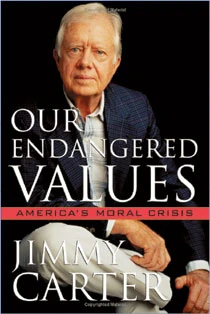
JIMMY Carter’s new book, “Our Endangered Values: America’s Moral Crisis” is a book both liberals and conservatives ought to read. This is a book about the definite and deliberate erosion of the country’s values, the bedrock of America’s national identity, which are as Carter writes: “to preserve peace, to promote economic and social justice, to raise high the banners of freedom and human rights, to protect the quality of our environment, to alleviate human suffering, to enhance the rule of law and to cooperate with other peoples to reach these common goals.” These values are being eroded through the policies of the “neoconservatives,” or those with a strong fundamentalist religious faith who have gained unprecedented influence in the political process over the last five years. Carter writes about the increasing influence of religious fundamentalism in the nation as well as in the administration, the overt influence of big money in the political process and the administration and the subsequent polarization among the citizenry and in the halls of government. Carter believes there is indeed a moral crisis, both within the nation and within the administration, and he convinced me.
Carter raises very valid concerns. There is an increasing influence in politics and the administration by religious fundamentalists. As Carter writes, this can be seen in the resulting discourse in such diverse arenas as science, individual rights and environmental custodianship which have become arguments for which there is no compromise, only right-fundamentalism, or wrong- liberalism. Fundamentalism leads to a narrow, self-serving perspective, and this is evident in the political arena in laws and regulations favoring certain constituencies over individuals and the environment. This tunnel vision can be found in the acrimonious debates and government intrusion into areas of individual rights such as creationism or the big bang theory and evolution, abortion and the right-to-life, divorce and homosexuality. It can also be seen in the corporate and high income tax breaks that for middle and lower income people translate into a few tens of dollars as reported in the Washington Post recently; to the neglect of our environment; the administration’s steady drumbeat of the need for opening the ANWR to oil drilling to solve the nation’s dependence on foreign oil; to conservatives nominated to the Supreme Court who threaten the status quo of individual rights; to the use of pre-emptive military force in foreign affairs. These factors culminate in a national policy which restricts individual rights, and a foreign policy which eschews détente for pre-emptive action. We need to ask ourselves if this is the national agenda we really want, for it is one that negates the very values upon which our nation is built. Jimmy Carter deftly shows us that we don’t have to move in this direction.
Carter spends a portion of the book explaining his own religious beliefs, which while it may annoy some readers and discourage others, is vital to his premise. According to Carter, a strong religious faith is the foundation of moral development. In his view it does not need to be a divisive force in social discourse and governance. He is a firm advocate of the separation of church and state, though he admits that it may be difficult for individuals to subsume their faith when governing, yet he gives clear and unequivocal examples that prove faith and governance can be kept separate. Carter describes how he maintained the separation of church and state when as president he dealt with abortion issues, by following the letter of the law, but advocating ameliorating measures to reduce abortion rates. He gives many examples of his deliberate efforts to preserve church and state separation during his presidency and later through his work at The Carter Center. This also makes for interesting reading as Carter moves in very powerful political circles not just in the United States but throughout the world.
Ultimately one comes away from the book with an understanding that religion and government aren’t mutually exclusive terms. One can be of strong religious faith while in government without eroding basic values or rights through narrow fundamental beliefs. This also speaks to a broader audience than just citizens and politicians in the United States where we actually have laws mandating the separation of church and state. This is a message for many parts of the world, from the Balkans to the Middle East to Asia and Africa where fundamental religious faiths are continually, literally, at war with efforts at moderation and compromise among peoples of differing faiths. Carter writes eloquently and persuasively on the delicate issue of religion and state which is one of the driving forces in the world today.