RIYADH, 4 April 2006 — Crown Prince Sultan, deputy premier and minister of defense and aviation, yesterday reaffirmed the unity of the ruling royal family. “I can assure you and everyone else that the ruling family is united in one hand and one heart,” he said.
Speaking to reporters after presenting the King Faisal International Prize to the winners, the crown prince said there are no differences among the members of the royal family. “These are lies spread by those who envy our country,” he said when asked whether there were any differences among the family members.
Prince Sultan said the Shoura Council is open to all suggestions. But replying to a question, he said there was no plan to appoint women on the 150-member consultative body at the moment.
With regard to women driving, he said the government was still studying the issue. “Some women are already leaders in all other aspects — education, medicine etc. Driving is just one other aspect in their leadership role,” he said.
He said the government was exerting every effort to get rid of red tape from its departments and agencies.
Referring to the situation in Iraq, he said he did not believe that there would be a civil war in the Arab country. “What is happening there now is a natural consequence of the fall of a long reign of dictatorship,” he said. Prince Sultan was optimistic that the Iraqis would remain united to protect their national interests.
He denied reports that there was cooperation between the Kingdom and Pakistan to develop nuclear weapons. “We have denied that and Pakistan has denied it before us. This report is totally false,” he added.
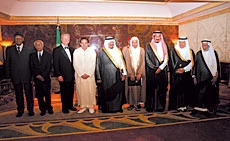
Prince Sultan distributed the awards of the King Faisal International Prize to seven distinguished scholars at a glittering function. The winners are from the United States, Britain, India, Egypt, Morocco, Kuwait and Saudi Arabia.
Also present were Asir Governor Prince Khaled Al-Faisal, ministers, members of the diplomatic corps, educators and senior officials from the public and private sectors.
Over the past 28 years, a total of 170 laureates from 38 countries have won the prize.
The Prize for Service to Islam was jointly awarded to Sheikh Saleh Al-Husayen, head of the Presidency of the Two Holy Mosques, and Sheikh Yousuf ibn Jassem Al-Hidji of Kuwait, president of the International Islamic Charitable Organization.
Al-Husayen won the prize in recognition of his prominent role in preaching Islamic principles of righteousness, philanthropy, and particularly its moderation and tolerance.
Al-Husayen is also a recognized researcher in Islamic economics, especially its ability to accommodate contemporary economic ideas. He is also an ardent supporter of education, being an active member of the supreme councils of five Saudi universities.
Sheikh Al-Hidji is recognized for his distinguished contributions to Islamic dawa, education and philanthropy. He is a member of the boards of trustees of four Islamic universities in Africa and Asia and initiator of the College of Shariah at Kuwait University. He is also the founder or co-founder and chairman of several national and international charitable and relief organizations, and founding president of the Kuwaiti Red Crescent Society.
The prize for science (mathematics) was presented to joint winners professor Simon Kirwan Donaldson (UK), president of the Institute of Mathematical Sciences and professor of mathematics at Imperial College in London, and professor Mudumbai Seshachalu Narasimhan (India), honorary fellow of the Tata Institute of Fundamental Research in India, for their seminal contributions to theories which have strengthened the links between mathematics and physics. Their work has been instrumental in helping to provide a rigorous foundation for physical theories related to the laws of matter at the sub-nuclear level. This has helped establish strong ties with the formulation of quantum chromodynamics for which the King Faisal Prize was given last year (in physics).
Professor Michael Anthony Gimbrone, Jr. (USA) was the proud winner of the Prize for Medicine (Biology of Vascular Inflammation). Professor of Pathology, Harvard Medical School, and chairman of the Department of Pathology at Brigham and Women’s Hospital, Gimbrone has published in more than 250 publications in renowned international journals over the past four decades. He has made fundamental contributions to the field of vascular biology.
Professor Tammam Hassan Omar (Egypt), emeritus professor at the Darul Uloom College of Cairo University, and professor Abdul Qader Fassi Fehri (Morocco), director of the Institute for Study and Research of Arabization and professor of Arabic and Comparative Linguistics at Mohammad V University, were the joint winners for Arabic Language and Literature (Arabic language in modern linguistics).
Professor Omar has been awarded the prize in recognition of his distinguished efforts — over the past 50 years — to establish modern Arabic linguistics, an endeavor that has been reinforced by his profound knowledge of the Arabic heritage and the principles and methods of modern linguistic analyses. Professor Fehri was honored for his detailed pursuit of modern linguistic theories and efforts to reconstruct the classical Arabic linguistic theory in the light of modern linguistic concepts.
The cash award of SR750,000 ($200,000) for each category brought the total prize value to $1 million. Each winner also received a 200-gram, 22-carat gold medallion and a certificate.
— With input from Mohammed Rasooldeen and Naif Al-Shehri