
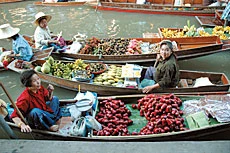
The floating markets of Thailand are among the most fascinating tourist attractions in the country. They give a realistic glance of what daily life must have been in earlier times. The floating markets are places where the sellers, their boats laden with a wide variety of tropical fruits, flowers, vegetables and various souvenirs, come to meet and barter with other traders. These days, modern supermarkets and department stores have largely replaced the traditional floating markets, but a few still survive. The most popular one is at Ratchaburi, about 100 km west of Bangkok. It is the largest of its kind and attracts a large number of tourists every day.
The journey from Bangkok took about 2 hours. I woke up at 5 a.m. to leave for Ratchaburi as the market begins at 6 am and closes at about 11 am. Because of the early departure, the driver and I managed to miss the early morning traffic jam which the driver described as a “hellish experience.”
We arrived in Ratchaburi around 7 am near the boat docking area. Of course the only way to go through the market is by hiring a long-tailed motorboat. I paid 800 baht (SR80) for the whole boat, which accommodated six people excluding the driver. There were also other types of smaller boats costing about 300 baht per tour. The boat went swiftly through the canal, taking sharp turns and smoothly passing other watercrafts, which reflected the boatman’s mastery of his job.
Traditional houses and vast orange and palm fields were spread along the banks of the canal that leads to the floating market. Trees, shading most of the path, created a natural canopy for visitors. The natural smell wafting off the orange fields drowned the smell of carbon dioxide generated from the boat’s simple but custom-made engine.
After an approximate 20 minute-ride in a maze of canals, the boat docked near a big house, which we were invited to enter. It turned out to be a big souvenir shop and since I had not asked the boatman to stop, I surmised the shop must pay boats to stop there. As soon as we entered the shop, we were served a unique drink extracted from palm tree flowers. The drink is called “nam tan sod” and has a mildly sweet refreshing taste. I was told that they boil the flowers of the palm tree and drink it after cooling. The extract is also re-boiled to generate a special type of sugar that is used for cooking. The shop owners were very nice; they kept giving us free traditional drinks and green tea, and what was amazing is that they were smiling even when I left empty handed.
We went back to our long boat, heading for the market. It took us an extra few turns to reach the main market place. The view was truly amazing as hundreds of boats were gathered randomly in the wider spaces of the river. Amazingly most of the dealers were women who wore traditional hats and simple cotton garments.
The boat reduced its speed and started gliding between the countless boats, which were filled with colorful fruits, vegetables and gifts.
A first-time visitor would surely end up with a sore neck from all the turning and craning in every direction in order to see everything and keep up with what all the nearby merchants were doing. Prices were cheap, but I was told that they were not as cheap as in other markets.
As we went deeper into the market, it seemed that it wasn’t completely floating. A number of shops were built on both sides of the riverbanks. I had to have the full experience, so I decided to buy something. The next boat that approached me was selling fresh fruit. The woman handed me a disposable plate filled with slices of fresh mango and pineapple. “30 baht,” she said — about SR3.
I hesitated as I thought how cheap it was, not knowing that my hesitation had pushed the price down to 10 baht.
The boatman told me that there were five main sections of the market spread over 10 kilometers of canals. After touring the markets we went to a floating temple. The water in front of the Buddhist temple was another tourist attraction. Since fishing is prohibited there, it is teeming with fish. I was told that the fish evidently realized that no one could fish in this particular area so they stay within the limits of the temple. The temple took full advantage of the situation by selling bait to tourists — not bait for catching the fish but as an attraction for the fish to make the water boil as a result of so many fish jumping for a free morsel.
After completing the tour, we returned to the main docking area where the dock master handed me a small plate with my picture printed in the center. I didn’t ask when the picture was taken but my puzzled reaction was met by a smile from the man who said “150 baht please.”
I paid him and left the floating market with a memory engraved in my head exactly like my smiling face printed on the plate “forever.”