
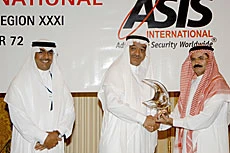
ALKHOBAR, 11 April 2006 — “Security Paradigm” was the keynote address delivered by Samir S. Raslan, senior regional VP of Group 17, ASIS International (ASIS), at a dinner meeting sponsored by Saudi Bell, held last Tuesday at Le Gulf Meridien Hotel. Hundreds of ASIS members and guests attended the event which was hosted by ASIS Middle East Chapter 72.
This was an opportunity for the new ASIS officers to meet the public and discuss the group’s plans to increase its activities. Sultan H. Al-Zahrani, the regional VP for Region 31, which includes all ASIS chapters in the Middle East, pledged to bring new energy to the organization throughout the region. He stated that ASIS chapters in Jeddah and Riyadh would be fully operational shortly.
ASIS (www.asisonline.org) is the largest organization for security professionals, with more than 33,000 members worldwide. Founded in 1955, ASIS is dedicated to increasing the effectiveness and productivity of security professionals by developing educational programs and materials that address broad security interests. ASIS also advocates the role and value of the security management profession to business, the media, governmental entities and the public.
The event on Tuesday was the start of a campaign by ASIS Middle East Chapter 72 to focus attention on the importance of continuing to improve local security including enhanced training of human resources and upgrading of security systems. Chapter 72 was founded in 1975 and has been a leader in efforts to bring the latest in security resources to Saudi Arabia. In that regard, educational materials and courses are now available in the Kingdom for ASIS certification programs for both the Certified Protection Professional (CPP) and the Physical Security Professional (PSP).
“The world has changed. Complacency has never been wise in the security business,” said Khalid Al-Farhan the new chairman for ASIS Middle East Chapter 72. “Trained security professionals are urgently needed by the nation and its companies and organizations.”
By offering courses and certification programs in Saudi Arabia, ASIS hopes that many Saudis will soon become certified security professionals. During the event, Ali Al-Manajem, the first Saudi PSP was recognized.
Trained human resources are extremely important for the private security industry. In his speech, Samir Raslan asserted that security professionals combined with appropriate technologies and processes can enable the private security industry to cope with threats and challenges in the short term and create strategies which offer a new hope for the future.
“This is important because the very nature of our business makes civilization possible,” Raslan said. “After all, without security, almost all other human endeavor stops in its tracks. In today’s security environment, attacks can come from a variety of sources. But whatever the source, one thing is clear — those determined to penetrate an organization’s security infrastructure are becoming more resourceful, and they are succeeding more often than ever before.”
Corporate executives are taking significant steps to shore up their security infrastructure. Raslan noted that it is “any CEO’s worst nightmare — a heinous attack on one of his organization’s critical facilities, resulting in the loss of lives, the loss of millions of dollars in assets, and irreparable damage to his company’s hard-won reputation.”
He pointed out that since the early 1980s security technology has been introduced to help the human element in security become more effective and efficient. Technology is now used in areas such as intrusion detection, access control, asset control and location monitoring. Technological advancements and brutal competition in certain market sectors have made physical security equipment simultaneously more affordable and more reliable.
“Technological advances are, in turn, affecting company organizational structures,” said Raslan “Traditionally, physical and IT security have been completely separate disciplines, but recently the wall that separates them has begun to crumble. According to one study in the United States, 40 percent of physical security departments are now merged with, or operating in conjunction with, IT organizations. This brings an increased focus on merging of technologies, network resources and applications.”
He continued, “The full integration of security systems is a major trend of the new security paradigm. Security industry standards have allowed the development of security system components from different manufacturers to be completely interoperable. Digital technology provides the linking of security system components over a wide-area network and Internet. Rapid, long range communications and computer networks link security ‘smart detection’ elements with security response forces for a quicker, more efficient response capability.”
Raslan was quick to remind everyone, however, that while many of the new technologies are excellent, excessive security measures are a waste of resources, as are not enough security measures. Maximum security is achieved by applying all practicable and justifiable measures, after a thorough and professional assessment of the risks.
“Well-designed security systems center on people and use technology to maximize the value that people provide, while adding minimal vulnerabilities inherent in the technology itself,” he advised. “A wall or locked gate will not stop threats; it is the people behind them that are the deterrent, and are the response necessary to neutralize the threat.”