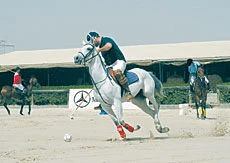
JEDDAH, 12 April 2006 — The first ever official polo match in Saudi Arabia is to be played tomorrow in Riyadh. The event, sponsored by Mercedes Benz, will take place at the Riyadh Polo Club based at the International Equestrian School in the capital.
The players will be competing for the honor of winning the Mercedes-Benz Cup which is expected to become an annual event.
Saudi Arabia, Jordan, Palestine, India, Great Britain and the Republic of Ireland are all represented, by one player each, in the match which consists of two teams with three players on each side. The match starts at 4 p.m.
The game will be arena polo, which differs from field polo in that the 300 yard x 200 yard grass field is replaced by a conventional show jumping arena. The reduced size of the playing area allows the players to use the same mount for the entire match rather than the four to six fresh horses needed for field polo.
The solid walls of the match area demand more control from the riders who need to accelerate to a gallop turn and stop in the limited space. It is also more spectator friendly as the game can be followed more easily and get closer to the action.
“This is a unique event,” said Safi Kobeissi, general manager of Juffali Automotive Company. “Mercedes-Benz sponsor polo in several countries around the world, and we’re delighted to be involved in bringing this exciting game to people of Saudi Arabia. It brings a new dimension to sport in the public arenas of the Kingdom.”
Polo requires both horse and rider to be skilled athletes. This has made polo one of the most exclusive games in the world, as it requires years of practice and patience to train a good polo pony. The players have to be a combination of superb horsemen and acrobats as well as being able to survive the very physical challenges of their competitors.
The match is expected to be popular with VIPs and the public who will be invited to attend the event. Equestrian concerns and the Arab horse have long been associated with the Arabian peninsula and in particular the growth of Islam across the Maghreb countries of North Africa, Central Asia and into Europe. Some sources claim that polo, after originating in west central Asia, spread from Iran to Central Asia with Muslim traders.
“We feel that polo can appeal to a broad spectrum of people. Obviously for horse lovers there’s the joy of watching horse and rider perform, but the teamwork, speed and sheer excitement of the game should appeal to any sports fan,” said Bruce Cowley, a founding member of Riyadh Polo Club. “This is really about introducing polo to everyone in the Kingdom and opening the door to aspiring players.”
The match is the result of more than a year’s planning and coordination by brothers Yousef and Adnan Al-Baitouni, who run The International Equestrian School and who compete in show jumping both locally and internationally. Over the years, the pair gave their full support to what is a very new sport in the Kingdom.
“Both of us are keen riders, and we felt it was an opportunity for an exciting new development, for Saudi, in the equestrian field,” said Yousef. “Over the years, there have been a number of Saudi polo players, playing outside the Kingdom, but the game has never been accessible to the man in the street. We’d like to change this, by providing an opportunity, for anyone who’s interested, to learn the game under professional supervision.”
They have even gone so far as to hire a professional polo instructor to advise and train team members and horses. “We appreciate that polo is a very dangerous sport, so you can’t do things in half measures, especially when you’re introducing the game to new players,” said Adnan.
Polo is the world’s most dangerous team sport, beating both American football and ice hockey for the title. It is also believed to be the world’s oldest. The exact origin of the game is unclear but the available evidence indicates strongly that it was first played in what is now modern Iran.
The game arose with the first domestication of the horse by the Aryan tribes in the area.