
It is axiomatic that mass tourism has the potential to destroy the very feature tourists travel to see. National parks recognize this and regulate accordingly to maintain the balance between visitor and visited. When a new area is identified as having the potential for development, careful evaluation of the damage versus development equation is essential.
That consideration was the motivation for an exploratory trip to Al-Birk in the Asir coastal region recently. The Supreme Commission for Tourism (SCT) in the form of Abdullah Mutaen director of the SCT and an executive of the Asir Tourism Board encouraged and supported the project. He turned to the kind of people he had in mind as tourists and invited experienced divers and marine photographers to have a look at a completely under-developed area of the Red Sea coastline and conduct what amounted to a SWOT analysis. (Strengths, Weaknesses, Opportunities, Threats.)
Organized by Majida Ahmed Salem, in the Abha region, the trip produced not only reports of facilities and environment but also zeroed in on some significant points that only those with an interest in diving would notice. For example, Abha, at 2,200 meters above sea level, is not a good place to return to immediately after a three or four dive day. The problem lies in the tendency of blood to release nitrogen absorbed under two or three atmospheres pressure when diving as gas bubbles. If those are trapped in body tissues, they result in the painful and potentially lethal condition known as “the bends.” If a diver travels from conditions of three atmosphere pressure to the surface where the pressure is one atmosphere and then upward another 2,200 meters, the usual potential for a bend is drastically increased. At this height, trapped air bubbles will expand by about 35 percent. The reduced pressure at 2,200 meters is also the pressure that commercial aircraft operate at.
This can all be controlled by simply controlling the rate of ascent underwater and allowing time between exiting the water and traveling up to Abha. Less obvious — especially to non-diving tourist planners — but incredibly important to dive tourists who spend money is the actual need to control the rate of ascent out of the water. It is this kind of detail that can make or break a tour operation.
The small group of divers expected underdeveloped land based facilities in a virgin dive area and indeed that was the case. Small but comfortable hotels are fine for the occasional tourist group, but large tour parties need facilities and not just hotel capacity. The same applies to the technical requirements for diving — compressed air, backup equipment and medical facilities, especially those related to diving incidents, available when needed.
The infrastructure is relatively easy to put in place and private investment, given that the area is attractive enough to tourists to turn a profit for tour operators, would cater for it. The crux of the matter is whether the area has the potential to attract divers and tourists in sufficient quantity.
The team dived from boats at three sites on two islands to attempt to answer that question. Both were located conveniently close to shore and each offered very different varieties of wild life.
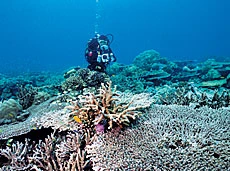
The water, said Pete Richards who compiled a report for the SCT on the visit, was of reasonable visibility and the site relatively shallow. “There was an absence of much fish life and the bottom was an amazing display of Cnidarians in the form of soft corals and anemones,” he said. Cnidarians are a hugely diverse family of animals, from the lethal box jellyfish to true corals; they live at all depths in the world’s oceans and all have a common characteristic — they sting! Their name derives from the Greek “cnidos” — stinging nettle. They also provide some of the most attractive undersea fauna to look at.
“There was an incredible diversity of Echinoderms,” he continued. Echinoderms have skeletons made up of interlocking calcium carbonate plates and spines enclosed by the. Sea cucumbers, starfish and sea urchins fall into this category. “Indeed what made the site notable was the sheer number of feather stars, starfish which feed by filtering the current for food particles with long feather-like projections.”
Serious divers — especially the sort that tourism needs to attract — are very often competent, or at least deeply interested, amateur marine biologists. Far from damaging the environment they pay large sums to visit, it is usually they who are at the forefront of protecting it. Sometimes, over a foaming sherbet at the end of a dive day, the language tends to become obscure with complicated scientific words tossed around between members of a tourist group.
“This sort of site is of great interest to divers who have an interest in marine biology,” said Richards, “but the bottom is a very fragile environment which could easily and rapidly be destroyed by ill-placed and repeated anchoring.”
The downside of a dense fish population is its attraction to illegal spear fishermen and legal but unthinking sport fishermen. Spear fishing with scuba tanks is illegal; it happens. It kills off the breeding stock — the biggest fish — for simple sport. The long-term damage is severe, especially as removing the breeding stock eventually reduces the fish stock to below the numbers at which it can replenish or sustain itself.
Photographing wildlife is what most divers want to do. However customs officials unfamiliar with complex equipment made all sorts of problems at Abha airport. Rough handling of equipment, persistent enquiry and deep suspicion of the individuals with the equipment to the point of intimidation was experienced by some of the team. Much modern underwater photography equipment has to be carried as hand luggage for technical reasons; it is also vastly expensive and could go astray very easily.
Officials, if they are to encounter tourists and especially divers, really do need to understand something of the paraphernalia that they carry. Something of a welcome with the famous Saudi courtesy would not go amiss, either.
The second site investigated just a short distance away on the same island was very different in character. Good visibility and an abundance of hard corals were complemented by an abundance of fish life. “There were schools of barracuda, as well as batfish, wrasse, grouper, surgeon fish, parrot fish, butterfly fish, rays and snappers,” reported Richards.
The third site was a lesson in the effect of lack of education in environmental conservation can have on a remote site. Under the surface, there exists what Richards described as “the most amazing display of table coral, the density and size of which I have not witnessed at any other dive venue in my 30-year diving history.” However, anchors dropped without care had already begun to destroy these ancient structures, vital nurseries for fish, which can take centuries to grow to maturity.
The island itself was, unusually, devoid of bird life. Dogs had been introduced to the island, allowed to run wild and had effectively wiped out most living things which had been there. It was a perfect example of the influence of un-knowing individuals visiting environmentally sensitive areas and a warning, if one were needed, to commercial interests to take heed of what they often describe as “tree-huggers.”
A recent estimate suggested that 58 percent of the world’s coral reef systems were at risk of destruction. The majority of these risk factors are man-made, and therefore controllable. Protection requires three aspects: Education so individuals understand why protection is necessary; controls and enforcement of those controls.
Many places in the world have declared marine reserves in order to protect their resources and ensure continued numbers of diving tourists. Commercial over-fishing, spear gun fishing — where the biggest fish are the targets in addition to being the breeding stock — and coastal development all affect the quality of the tourist potential of the marine environment.
Before the Asir area develops a dive-tourism industry, perhaps it should develop policed marine reserves. Not only would that be good for the environment, but would act as an insurance policy for the fledgling industry.